

Key Takeaways
- Growing Market Opportunity: The global alcohol delivery market is expected to grow significantly, offering a high-revenue potential for new businesses.
- Understand Legal Requirements: Secure all necessary federal, state, and local licenses. Implement strict age verification to stay compliant.
- Choose the Right Model: Decide between models like direct-to-consumer, third-party marketplace, or subscription-based delivery.
- Build a Solid Platform: Invest in a user-friendly app/website with eCommerce features, secure payment options, and inventory tracking.
- Plan Logistics Smartly: Opt for in-house delivery or third-party logistics while ensuring timely, safe delivery.
- Focus on Marketing: Use SEO, social media, email marketing, and loyalty programs to increase visibility and acquire customers.
If you own a liquor store and are considering launching an online alcohol delivery service, you’re making a smart choice. The alcohol delivery market is rapidly expanding, offering significant growth opportunities.
More customers prefer the convenience of having wine, beer, and other alcoholic beverages delivered directly to their homes at reasonable prices. This trend makes starting a liquor delivery business an attractive prospect.
The alcohol e-commerce market has seen impressive growth, projected to increase from $64.55 billion in 2024 to $74.4 billion in 2025, with a compound annual growth rate (CAGR) of 15.3%.
These figures highlight the potential profitability of entering the alcohol delivery sector in today’s market.
If you’re ready to move on to this venture, we’ve provided a step-by-step guide to help you establish a successful alcohol delivery business.
Alcohol Delivery Trends
Here are some key trends observed over recent years.
Customer Behavior and Preferences
- Convenience is Key: A significant portion of customers prioritize convenience, with 39% citing the ability to shop from home and 37% noting time savings as primary reasons for using alcohol delivery services.
- Popular Choices: Wine and champagne are the top choices for delivery in the U.S., Australia, and New Zealand, while whiskey leads in Canada.
Regulatory Developments
- Legalization of To-Go Cocktails: States like North Carolina have permanently legalized the takeout and delivery of cocktails.
How to Start an Alcohol Delivery Business Online?
Below are some steps to help you start an online alcohol delivery business successfully.

1. Do Market Research
Firstly, you have to do in-depth market research and gather information to help you start an alcohol delivery business. In this phase, you have to gather this type of information:
- Understand your audience and their interests
- Identify the demand for alcohol delivery in your area
- Analyze the existing competitors to identify the gaps and opportunities
- Determine what makes your company different from your competitors and helps you stand out from the crowd
With all the information, you can successfully move to the next step to help you start a liquor delivery business.
2. Select the Alcohol Delivery Business Model
Whether you are launching a food delivery or a liquor delivery business, you need to select a business model. It describes exactly how you will do business. Depending on your preferences and the demands of the industry, you can select the business model.
There are three proven models.
Direct-to-Customer (D2C): You deliver alcohol from your own store to customers.
Marketplace Platform: You create a platform connecting customers with multiple liquor stores (like Drizly).
Subscription or Membership Delivery: Create wine/whiskey boxes or a weekly delivery for repeat customers.
Below are some tips to help you select the right alcohol delivery business model.
- When selecting the on demand alcohol delivery business model, it’s essential to start by understanding your market. Research local regulations regarding alcohol delivery and identify your target audience, along with their preferences.
- You can choose from several business models, such as direct-to-consumer sales through your website or app, partnering with existing platforms like UberEats for a marketplace approach, or offering a subscription service that provides regular deliveries for a monthly fee with curated selections.
- Consider the logistics of your operation, including whether to use in-house drivers or third-party services for delivery. Also, plan for effective inventory management and warehousing.
- Compliance is important, so ensure you have the necessary licenses for alcohol sales and stay updated on local and state laws.
Supercharge your deliveries with Enatega.
Register Now3. Legal Requirements
Research and obtain the necessary licenses for selling alcohol online in your jurisdiction. This may include federal, state, and local permits. Implement an age verification system to ensure compliance with laws.
Look at the table below and understand the U.S. alcohol delivery legal requirements.
| State | Required Licenses | Processing Time | Compliance Checklist | ID Verification Requirements | Delivery Restrictions |
| New York (NY) | • Retailer License (NY SLA) • Delivery Endorsement • TTB registration | 2–4 months | • Delivery logs required • Must buy from licensed wholesalers • Drivers must be 18+ for beer, 21+ for spirits | • Must verify ID at purchase and delivery • Acceptable: Driver’s license, passport, military ID | • No delivery 12 AM–8 AM • No cross-state shipping |
| Massachusetts (MA) | • Section 15 Off-Premise Retail License • Delivery Permit • Local city/town approval | 1–3 months | • Mandatory RBS training • Maintain municipal logs • Use geofencing for restricted zones | • ID scanning recommended• Must verify age 21+ | • Max 9 liters per customer/order |
| Texas (TX) | • TABC Liquor Permit • Consumer Delivery Permit (CDL) | 60–90 days | • Mandatory TABC delivery training • Maintain logs for 4 years • Must refuse service to intoxicated customers | • Match ID name to order • Visual verification required | • No deliveries to dry counties • No spirits delivery after 9 PM |
| Florida (FL) | • Vendor License (3PS) • Local business tax receipt | 30–45 days | • Maintain timestamped delivery receipts • Drivers must be trained • Alcohol must remain sealed | • Scan or visually verify ID • Must be 21+ | • No delivery to intoxicated individuals • Follow county-specific hours |
| North Carolina (NC) | • ABC Off-Premise Permit • Delivery Service Permit | 45–60 days | • Mandatory delivery logs • No open containers in vehicle • Drivers must complete approved training | • Two-step ID check (ordering and delivery) | • Spirits delivery restricted • No delivery after 11 PM |
| Georgia (GA) | • Local alcohol delivery permit (city/county) • Retail package license | 30–60 days | • Vehicle must display delivery signage • Maintain delivery logs • Only employees may deliver | • ID must be checked at the door • Accept only government-issued ID | • No delivery to campuses, government buildings • Follow local city restrictions |
| California (CA) | • Type 20 or Type 21 ABC License • No separate delivery permit required | 60–90 days | • Mandatory driver training • Maintain delivery records • Alcohol must remain sealed during transport | • ID must be verified in person • Third-party apps must collect ID data | • No delivery to dry ZIP codes • Cannot leave the package at the door |
| Illinois (IL) | • Retail Liquor License • Delivery Endorsement (city-level) | 45–75 days | • Delivery logs • Employee training required • Local taxes must be collected | • Must verify ID using tech or visual verification | • Chicago has stricter hours (no delivery after 11 PM) |
| Washington (WA) | • WSLCB Endorsement for Delivery • Off-Premise Sales License | 30–60 days | • Maintain delivery logs • Drivers must be 21+ • Product must stay sealed | • Two-step ID verification required | • No delivery after 2 AM |
4. Select a Niche
This is a crucial step before you start an on-demand liquor delivery service business. You have to decide on the types of alcohol you want to sell (e.g., craft beers, fine wines, spirits).
5. Set a Budget
You need to set a specific budget when starting your on-demand alcohol delivery business. From the start, you should know how much money you must invest in running a successful business.
When you start deciding on the budget, you have to know these things:
- The cost of purchasing alcohol from the wholesaler and reselling it at retail should be included in the budget.
- Other potential costs, such as insurance and licenses, must also be taken into account.
- You must include employee pay in your operational expenses if you want to hire staff.
- Equipment cost required for order processing and fulfillment.
- Set the budget for marketing and advertising.
6. Create an App/Website
To establish a strong online presence, begin by creating a user-friendly and responsive website that incorporates e-commerce capabilities to effectively showcase your products.
It’s essential to develop a cohesive brand identity, which includes designing a memorable logo, selecting an appealing color scheme, and crafting clear messaging that resonates with your target audience. This foundational work will help differentiate your business in a competitive market.
7. Set Up Logistics
Next, determine your logistics strategy for handling deliveries. You have various options to consider, such as managing deliveries in-house, using third-party services, or forming partnerships with reliable carriers.
Each approach has its own set of advantages and challenges, so assess your business model and customer needs to choose the most suitable logistics solution.
8. Inventory Management
Establishing an inventory management system is important for tracking your products, orders, and deliveries efficiently. This system should allow you to monitor stock levels in real-time, manage reorders, and more.
An effective inventory management strategy will help prevent stockouts and overstock situations, ensuring that you can meet customer demand consistently.
9. Payment Processing
Setting up a secure payment processing system is vital for facilitating smooth and trustworthy transactions. Choose a reliable payment gateway that not only supports various payment methods but also prioritizes security to protect sensitive customer information. This step is essential for building trust with your customers and providing a better experience.
10. Marketing Strategy
To effectively reach potential customers, implement a marketing strategy that includes social media, search engine optimization (SEO), email marketing, and online advertising.
Consider offering incentives such as discounts, loyalty programs, or referral bonuses to attract new customers and encourage repeat business. A well-rounded marketing approach will enhance your visibility and engagement in the digital marketplace.
11. Customer Service
Providing excellent customer service is important for retaining customers and building a positive brand reputation. Offer multiple support channels, including live chat, email, and phone support, to accommodate different customer preferences.
Additionally, implement a feedback mechanism to gather insights from customers and respond to their suggestions. It will help you continuously improve your service and address any concerns proactively.
12. Launch and Iterate
Before fully launching your business, consider a soft launch to gather initial feedback from a selected audience. This approach allows you to make necessary adjustments to your operations based on real user experiences.
Use analytics tools to monitor your performance metrics and make data-driven decisions for ongoing improvements.
Benefits of Starting an Alcohol Delivery Business
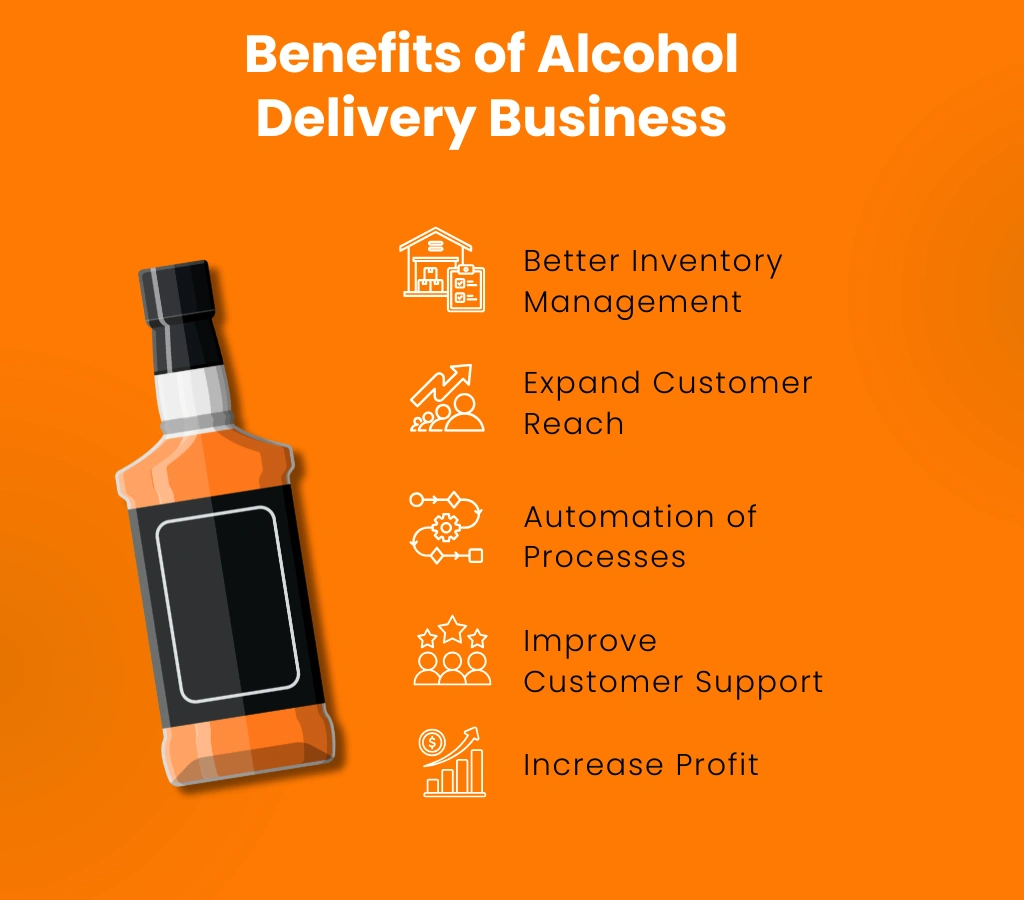
The online liquor delivery market is growing, and investing in this business can provide you with several perks, such as:
Better Inventory Management
Inventory management is a crucial aspect of business profitability. Using an online beverage delivery service, you can better manage the inventory. You can keep track of all the orders and consumer product deliveries so that you don’t overspend on inventory.
Additionally, you can maintain a supply of the goods that attract and retain customers by using the right inventory management strategies and resources. You can make sure your team is optimizing their time and your company’s earnings at the same time.
Expand Customer Reach
The alcohol sector is hot the whole year, and its demand is increasing. One of the great benefits of an alcohol ordering platform is that you get more customers in a short time. There are higher chances that your customer base may turn into repeat buyers. It will increase your retention rate, and your business will be more successful.
Automation of Processes
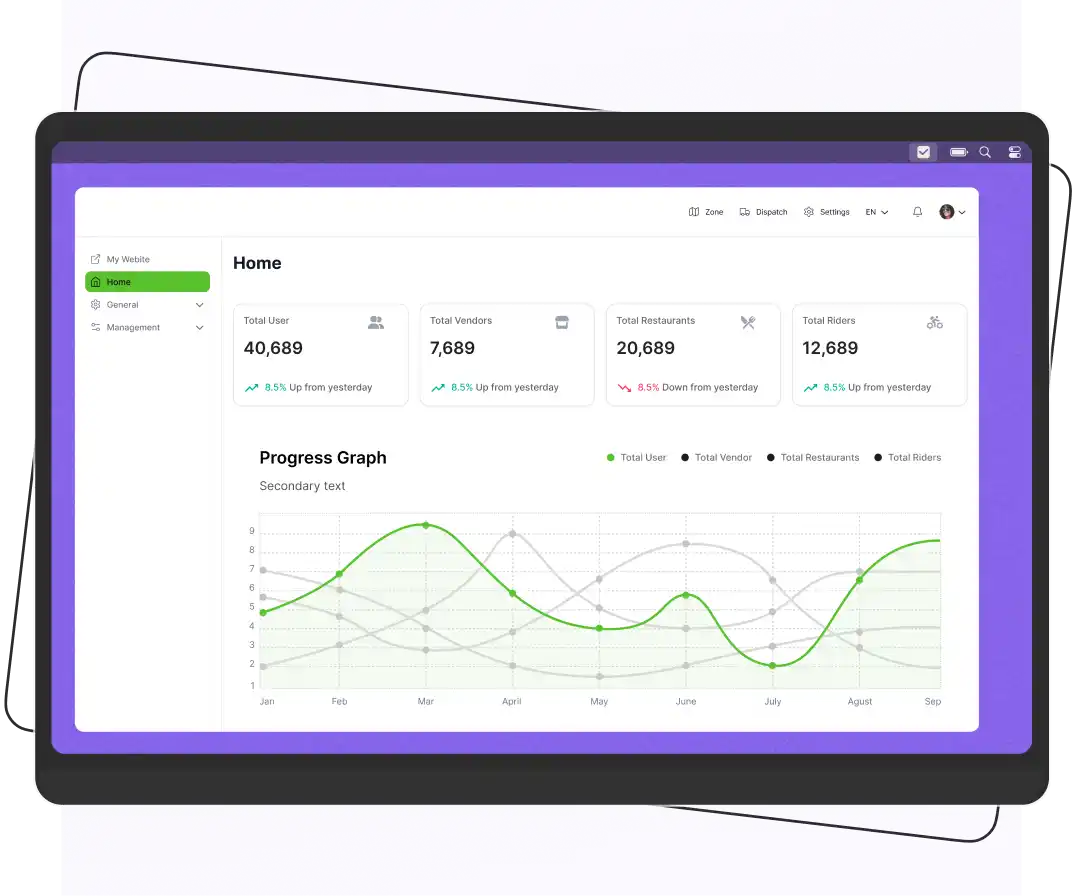
With an online alcohol delivery software solution, you can automate your business processes over time. It allows you to focus on other business aspects and gives customers peace of mind. Order automation and handling the delivery dispatch system online helps you save time.
Plus, you can schedule your delivery routes and assign them to different riders based on their availability. You do not need to allocate humans to the systems to update each piece of information; let your online platform do that for you.
Improve Customer Support
An online ordering platform simplifies the process of managing customer inquiries, allowing you to respond quickly and efficiently. By enhancing your customer service, you can significantly increase customer satisfaction and loyalty.
Increase Profit
Liquor store owners can increase profits by starting their online alcohol delivery business operations. It opens new opportunities, allowing businesses to reach a broader customer base and cater to the growing demand for convenience. By establishing a strong online presence, liquor stores can easily stand out in the competitive alcohol delivery market.
Marketing Tips for Alcohol Delivery Businesses
Here are some marketing tips to help you improve the online presence of your alcohol delivery business.
- Establish a unique brand by focusing on building a unique identity that customers can remember.
- When you deploy the app on the Play Store and App Store, choose the right keywords in your app’s title, subtitle, and description. Also, use high-quality images and videos to attract customers.
- Social media marketing can enhance visibility and attract new customers. Use social media platforms like Facebook, Twitter, Instagram, and LinkedIn to reach a large number of customers.
- Create an alcohol delivery system business plan to guide you better.
- Take advantage of email marketing and increasing brand awareness to build stronger customer relationships.
- Invest in paid advertising to boost engagement and your website conversion rate.
Optimize Your Alcohol Delivery Business
Whether you run a beer or wine delivery business, optimizing it is necessary. Below are some ways to help you in optimizing the alcohol delivery business.
- Assess your target market and understand demand patterns.
- Choose reliable suppliers to ensure quality and availability.
- Implement an efficient inventory management system.
- Use route optimization software for faster deliveries.
- Train staff on customer service and product knowledge.
- Establish a user-friendly online ordering platform.
- Offer various payment options for convenience.
- Monitor delivery times and customer feedback for continuous improvement.
- Consider partnerships with local businesses for cross-promotion.
- Stay updated on regulations and compliance related to alcohol delivery.
Alcohol Delivery Business Challenges and Risk Management Strategies
Look at the table below and understand the challenges and risks management strategies associated with the alcohol delivery business.
| Challenges | Description | Risk Management Strategies |
| Strict Licensing and Legal Compliance | Complex regulations vary by country, state, and local laws. Non-compliance can lead to heavy fines or a business shutdown. | – Regular legal audits – Work with legal advisors – Maintain updated permits – Train staff on compliance |
| Age Verification Issues | High risk of delivering alcohol to underage customers. | – Implement digital age verification – Mandatory ID scanning at delivery – Train delivery staff thoroughly |
| Delivery Logistics and Timing | Maintaining timely, safe, and accurate deliveries can be challenging. | – Use route-optimization software – Partner with reliable delivery providers – Real-time order tracking |
| Inventory Management Problems | Stockouts or overstocking affect sales and cash flow. | – Automated inventory tracking – Demand forecasting tools – Real-time stock updates in the app |
| High Competition | Many local liquor stores and apps offer fast delivery. | – Offer unique bundles/promotions – Use customer loyalty programs – Focus on customer experience |
| Product Damage During Delivery | Bottles and glass items are fragile and prone to breakage. | – Use shock-proof packaging – Train delivery drivers on safe handling – Offer damage insurance |
| Payment Fraud and Security Risks | Alcohol orders have higher fraud rates compared to regular eCommerce. | – Use secure payment gateways – Multi-step order verification- Fraud detection tools |
| Marketing Limitations | Alcohol advertising is restricted on many platforms. | – Use SEO, email marketing, and content marketing – Partner with influencers allowed for alcohol promotion – Build strong organic reach |
| High Operational Costs | Delivery, packaging, legal, and marketing costs can reduce margins. | – Outsource delivery to reduce fixed costs – Optimize operations with automation – Negotiate with suppliers for better pricing |
| Seasonal Demand Fluctuations | Sales drop during certain months or days. | – Promote subscription models – Offer limited-time deals – Use forecasting to prepare stock |
| Customer Expectations for Fast Delivery | Apps like Drizly, Uber, and DoorDash raise expectations. | – Guarantee delivery windows – Use multi-zone delivery planning – Enable local micro-fulfillment |
Supercharge your deliveries with Enatega.
Register NowFAQs
1. How does ordering alcohol online work?
Ordering alcohol online involves the following steps:
Choose a Retailer: Select an online platform or app that delivers alcohol, such as Drizly or a local liquor store’s website.
Browse and Select: Browse the available selection of beers, wines, and spirits, then add your choices to the cart.
Age Verification: You’ll need to provide your age during the checkout process, often with ID verification upon delivery.
Payment: Complete your purchase using a credit card or other accepted payment methods.
Delivery: A delivery driver brings your order to your specified address, usually within a set timeframe.
Receive and Sign: You may need to show ID and sign for your delivery to confirm you are of legal drinking age.
2. How much does it cost to start an alcohol delivery business?
Starting an alcohol delivery business costs between $10,000 and $50,000, depending on factors like licensing, inventory, and marketing. Additional costs may include delivery logistics and technology setup.
3. Is alcohol delivery legal in all states?
No, alcohol delivery is not legal in all states. Each state has its laws regarding the sale and delivery of alcohol, with varying regulations on licensing, age restrictions, and delivery methods.
4. Do I need a special license to deliver alcohol?
Yes, you need a special license to deliver alcohol. This may include a retail license and a specific delivery permit, depending on state and local regulations.
5. What is an alcohol delivery certificate?
An alcohol delivery certificate is a document that verifies a business’s compliance with local and state regulations for delivering alcohol. It includes proof of the necessary licenses, adherence to age verification laws, and any training requirements for delivery personnel. This certificate ensures that the business operates legally in the alcohol delivery market.
6. Which food delivery company stands out for its grocery and alcohol delivery services?
Instacart stands out for its grocery delivery services, while Drizly is notable for alcohol delivery. Both offer convenient, quick options tailored to their respective markets.
7. What items are eligible for alcohol delivery?
Eligible items for alcohol delivery include:
- Beer: Bottles, cans, and kegs.
- Wine: Various types, including red, white, and sparkling.
- Spirits: Liquor such as vodka, whiskey, rum, and gin.
8. How to get an alcohol delivery certificate?
To get an alcohol delivery certificate, follow these steps:
- Check state and local requirements
- Register for a portal account
- Complete an online training program approved by your state’s alcohol control board
- Pass the final exam
- Apply for a license (If required)
- Review and print your certificate
- Renew your certificate
9. How long does it take to get your alcohol certification?
It can take anywhere from 2 to 4 hours to get alcohol certification, depending on the specific course and state requirements.
Conclusion
Online alcohol sales have seen a huge growth in the US. Adding online alcohol delivery to your liquor store's business plan can be great for your business by increasing your clientele and creating new revenue streams.
So, if you start an alcohol delivery business and need the help of an experienced company, contact Enatega. We have experts who help you in starting an alcohol delivery business.
So, book a free demo with us and get help from our skilled team members.
About the author

Hudaibia Khalid is a senior content writer with several years of experience in creating clear and easy-to-understand content. Over the years, she has worked closely with startups, restaurants, and entrepreneurs, helping them simplify complex digital and technical topics into actionable insights.
Her expertise lies in writing about on-demand platforms, food delivery solutions, and business growth strategies in a way that is accessible even to non-technical readers. With her experience in the industry, she focuses on guiding businesses step by step, from understanding ideas to turning them into fully working solutions.
SHARE






 IOS
IOS Android
 Web
Web