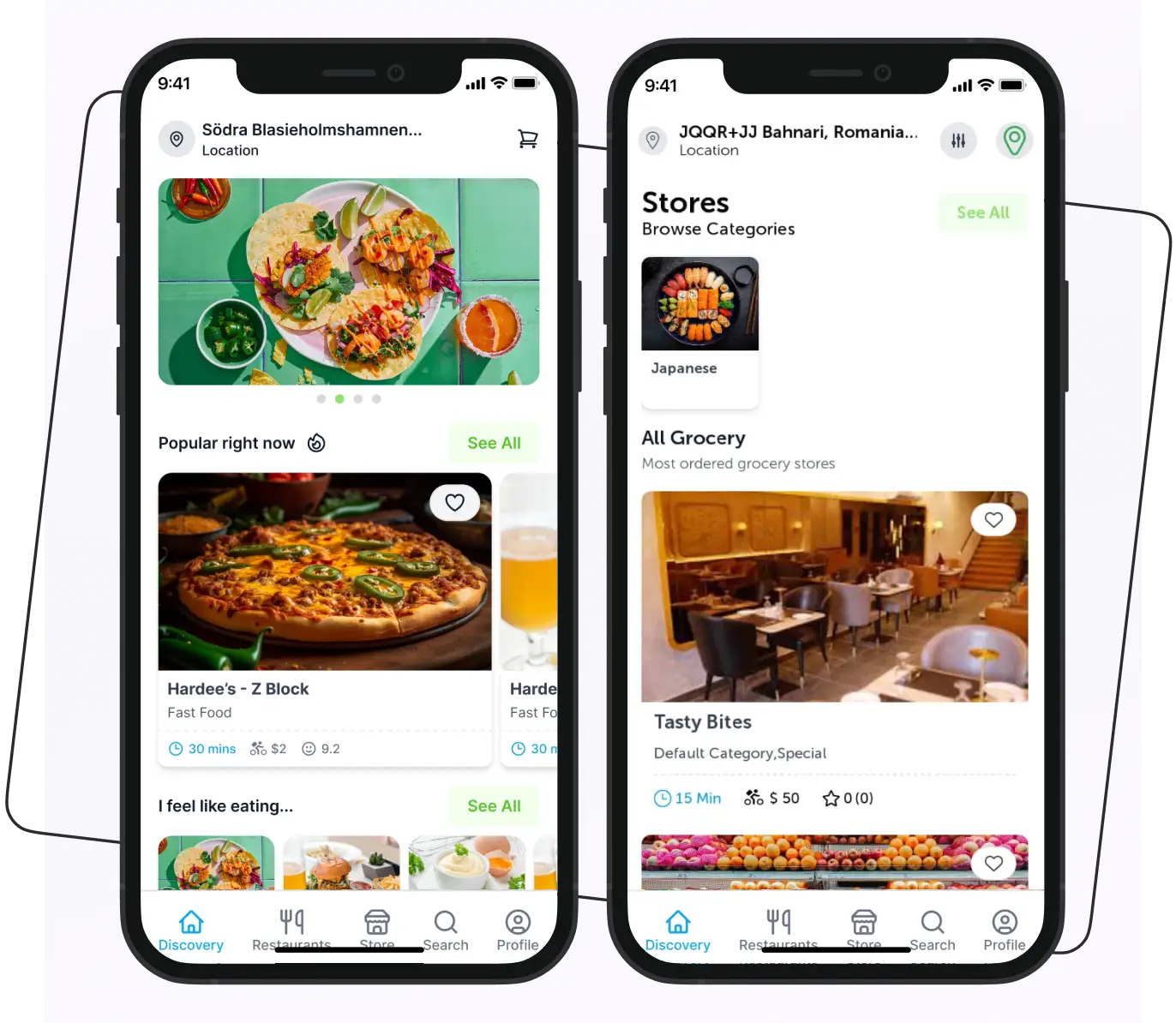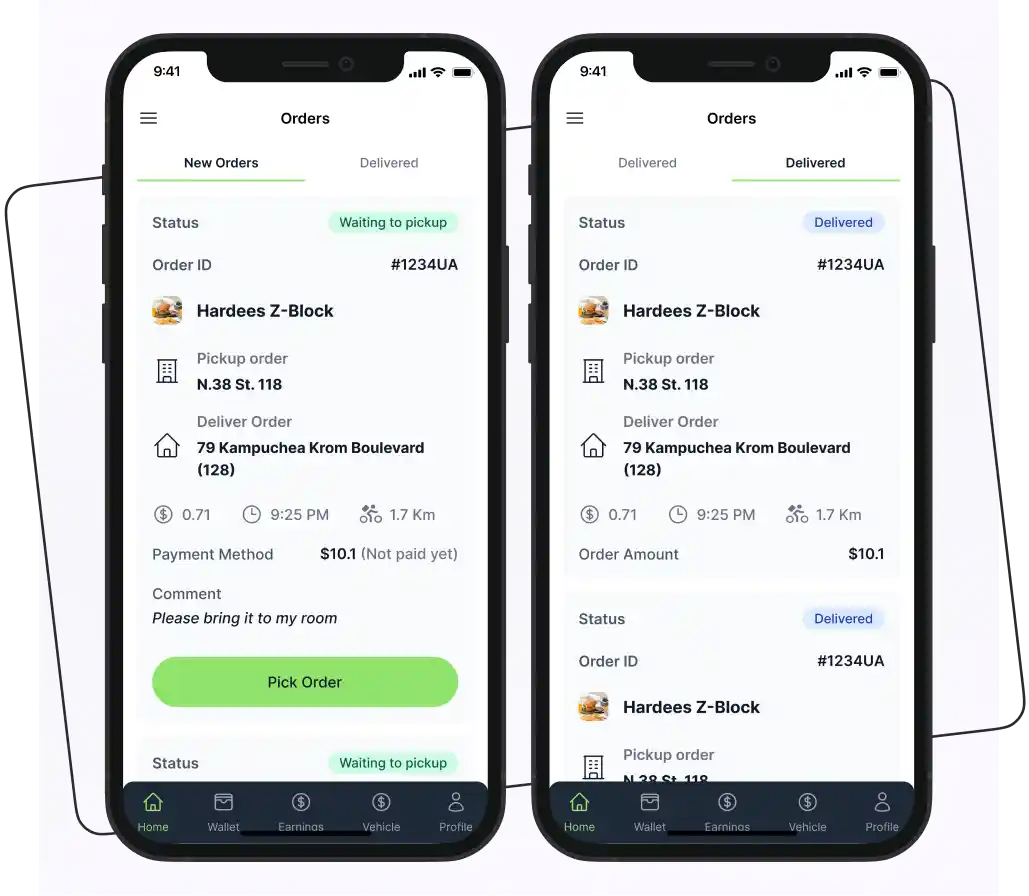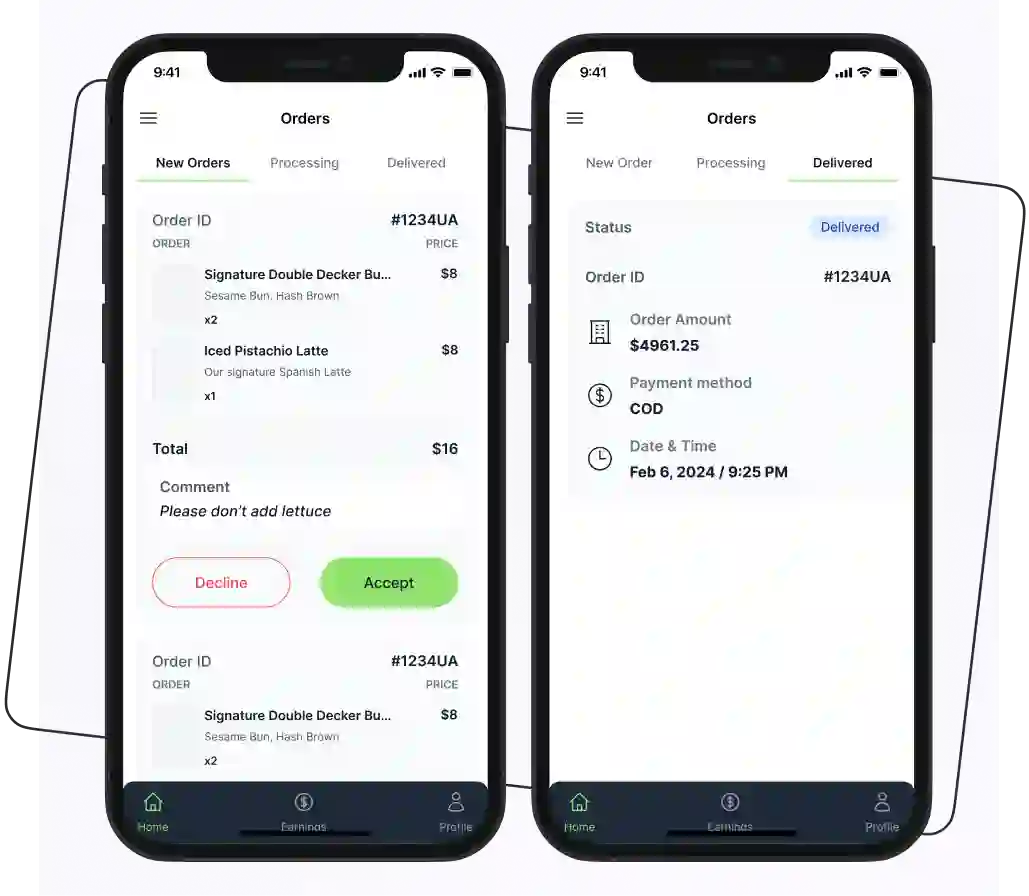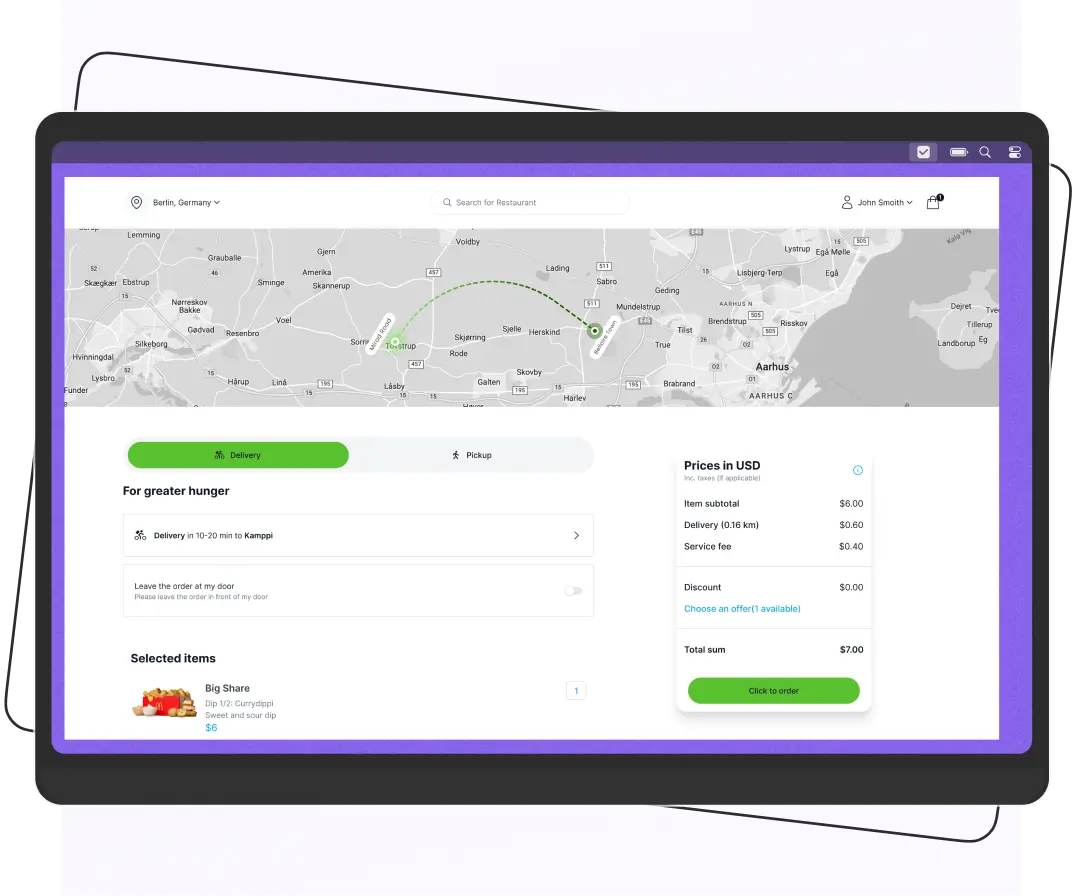


To build a gift delivery app, start by:
- Researching your target market
- Defining your unique selling proposition (USP)
- Selecting the right features and technology stack
- Developing an MVP
- Testing the platform
- Launching it with a focused marketing strategy
Development costs can range from $50,000 to $150,000+ for a basic app, depending on features, platforms, and team location. A basic MVP may require a smaller investment. A full-featured multi-vendor platform with customer, vendor, rider, and admin applications can cost considerably more.
The global gifting market is projected to reach $300.8 billion by 2030, according to For Insights Consultancy. This broader market includes different types of gifting products and services, creating opportunities for businesses that focus on specific segments such as personalized gifts, corporate gifting, flowers, and online gift delivery.
For entrepreneurs and businesses looking to capitalize on this golden opportunity, creating a great online gift delivery app could be the key to growing their business.
Building an online gift delivery app is not just about meeting consumer demand; it’s about changing how we think about gifting. This cost-effective approach allows businesses to scale efficiently while providing a better customer experience from selection to delivery.
So, let’s explore in detail how to build an online gift delivery app and how you can benefit from it.
Why Does Your Business Need an Online Gift Delivery App?
An online gift delivery app helps businesses reach more customers, simplify ordering and delivery operations, and offer a convenient shopping experience. It can support features such as online payments, order tracking, scheduled deliveries, and personalized gifts. For multi-vendor businesses, it can also bring multiple gift sellers onto one platform and create additional revenue opportunities.
Let’s discuss them in detail.
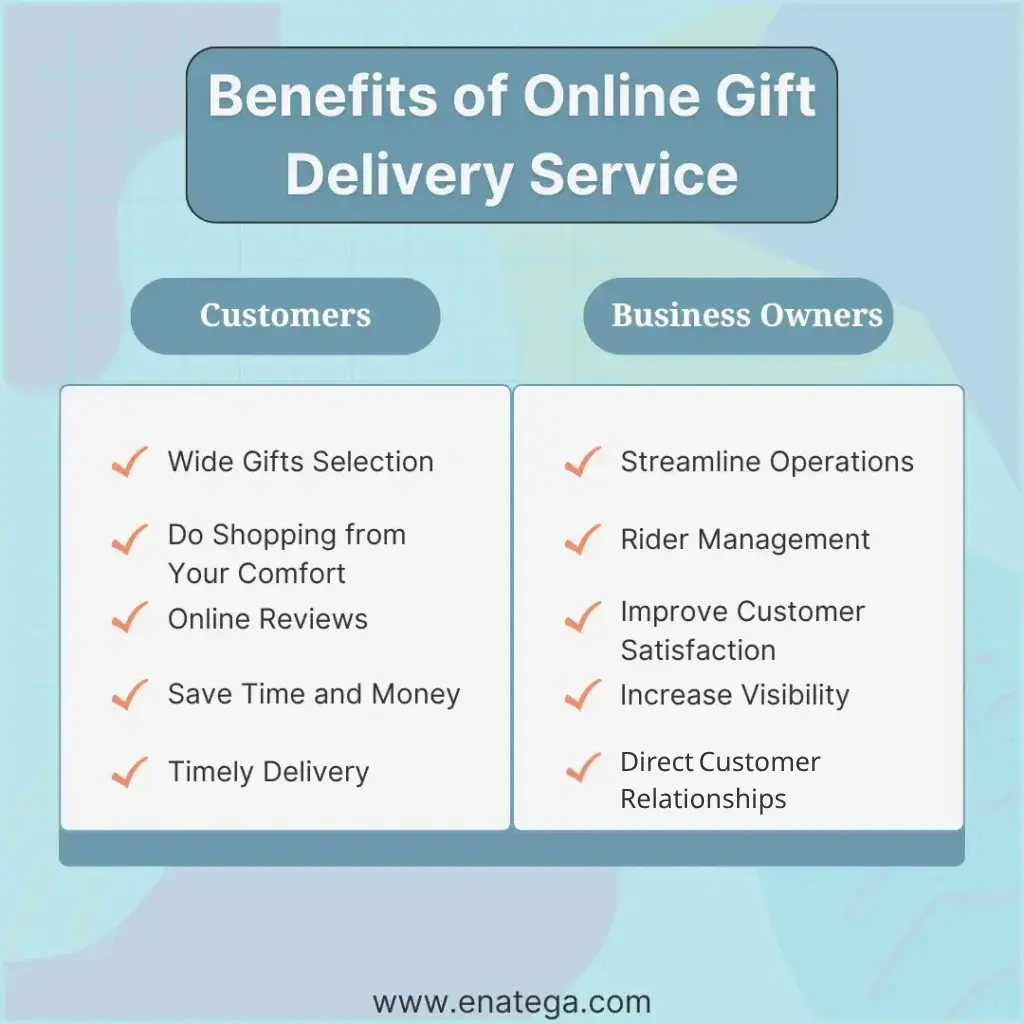
For Customers
- Wide Gift Selection
Online gift delivery platforms can give customers access to a broader selection of products than a single physical store, particularly when the platform works with multiple vendors.
In traditional shopping, customers can see the item they’re planning to give, but if their options are from two separate places, customers can’t compare them. Put another way, it would require a lot of footwork.
- Order and Delivery Tracking
Real-time order updates allow customers to monitor the progress of their purchases from confirmation to fulfillment and delivery. Delivery notifications can also reduce uncertainty when a gift is being sent directly to another person.
- Shop from Your Comfort
Convenience is one of the biggest advantages of online gift delivery services. Customers can easily buy gifts online in the comfort of their home or workplace, especially when they don’t have time to go to the store and buy gifts.
In addition, using online gift stores, customers can place an order at any time they want and send it to their loved ones’ doorstep on time.
- Online Reviews
Checking online customer reviews is a crucial advantage when using an online gift delivery service. Reading reviews allows customers to understand the quality and condition of the gifts being offered, helping them make informed purchasing decisions.
Reviews provide insights into the trustworthiness and reliability of the online gift retailer, including factors like customer service, shipping times, and overall satisfaction.
Moreover, negative reviews can alert customers to any common problems with the delivery, packaging, or gifts themselves, so they can avoid potential disappointments.
Supercharge your deliveries with Enatega.
Register Now- Save Time and Money
Don’t have time to go to the store to buy gifts? With an online gift delivery service, customers can buy gifts online and save valuable time.
Additionally, enhance your corporate events by using gift-sending software to send personalized welcome gifts to attendees’ homes or hotel rooms before the event starts.
Most of the gift stores offer attractive offers and deals on online shopping. Therefore, customers can get a lot of discounts and special offers like buy one get one free, etc.
However, such exclusive offers and discounts aren’t available to customers at local gift shops. By using online gift delivery, customers can take advantage of unique offers and deals to save a significant amount of money.
- Timely Delivery
Another main advantage of online gift delivery apps is timely delivery. If a customer lives far away from their loved ones and wants to give them a surprise on their special day, using the online gift sending app will help them. They offer quick and efficient gift delivery to make the gifting experience convenient and hassle-free.
For Business Owners
- Streamline Operations
Business owners can streamline their entire order fulfillment process using the gift delivery service. From the initial placement of customer orders to the management of their product, the gift delivery service provides a comprehensive solution to help optimize these core business operations.
The service handles the logistics of receiving, processing, and shipping out customer orders, freeing up business owners to focus on other important aspects of running their company.
- Rider Management
Using the gift delivery service, business owners can centralize the management of their entire delivery operation. This includes coordinating all delivery riders, their schedules, and key performance metrics in a single platform.
Additionally, real-time tracking of rider location and status gives business owners full visibility into the delivery process.
- Improve Customer Satisfaction
The online gift app ensures reliable and timely deliveries through real-time tracking of all shipments. This visibility allows businesses to proactively communicate accurate delivery ETAs to customers, enhancing the overall experience.
Also, the service provides the ability to offer same-day or next-day delivery options, meeting consumer expectations for faster fulfillment.
- Increase Visibility
The online gifting platform provides detailed reporting that allows businesses to closely monitor delivery metrics, costs, and customer feedback. This information enables companies to optimize their gift fulfillment workflows and identify areas for improvement.
- Direct Customer Relationships
Selling through an app or website gives businesses a direct customer channel rather than relying entirely on third-party marketplaces. This can provide greater control over the customer experience, promotions, product presentation, and communication.
Online Gift Delivery Services vs. Traditional Gift Shops
Online gift delivery services and traditional gift shops can both serve customers, but they offer different purchasing and fulfillment experiences. The exact advantages depend on the individual business, product range, and geographic coverage.
Look at the table below to understand the differences between online gift delivery services and traditional gift shops.
| Factor | Online Gift Delivery Service | Traditional Gift Shop |
| Convenience | Customers can browse and order through a website or app without visiting a store. | Customers can browse products in person, with some stores also offering phone or online ordering. |
| Product Variety | Can display products from multiple categories and, in a marketplace, multiple vendors. | Selection generally depends on the store’s physical inventory and available shelf space. |
| Price Comparison | Customers can compare products and prices across different online sellers more easily. | Customers may need to visit or contact multiple stores to compare products and prices. |
| Personalization | Can support custom messages, personalized products, gift wrapping, photo gifts, and other digital customization options. | Personalization may be available, depending on the store and the services it offers. |
| Delivery Options | Can support scheduled, same-day, express, or standard delivery depending on the business’s logistics network. | Some stores offer local delivery, while others may primarily focus on in-store purchases or pickup. |
| Order Tracking | Apps can provide digital order updates and delivery tracking where the logistics system supports it. | Tracking may be limited or handled manually, depending on the store’s delivery process. |
| Geographic Reach | Can serve customers across multiple cities or regions when supported by its vendor and delivery network. | Usually focused on a local area, although some established retailers may serve wider regions. |
| Operating Hours | Customers can usually browse products and place orders online at any time, although fulfillment depends on business operating hours. | Shopping is generally tied to the store’s opening hours. |
| Promotions | Can offer digital coupons, personalized promotions, loyalty rewards, and seasonal campaigns. | Can offer in-store discounts, loyalty programs, seasonal promotions, and other offers depending on the retailer. |
How Does a Gift Delivery App Make Money?
A gift delivery app can generate revenue through several business models. The right approach depends on whether you operate your own gift inventory, work with multiple vendors, or combine both models.
1. Vendor Commission
In a multi-vendor marketplace, the platform can charge vendors a commission on every completed order. For example, if a customer places a $100 order and the platform charges a 10% commission, the platform earns $10 before other applicable costs.
2. Delivery Fees
The platform can charge customers a delivery fee based on factors such as distance, delivery speed, location, and order size. Same-day or express delivery can also carry an additional fee.
3. Vendor Subscription Plans
Instead of relying only on commissions, you can offer vendors monthly or annual plans that provide access to features such as product management, order analytics, promotions, and advanced reporting.
4. Featured Listings and Promotions
Gift vendors can pay to promote their products in search results, category pages, seasonal collections, or the app’s home screen. This creates an additional revenue stream while giving vendors greater visibility.
5. Personalization Fees
Customers may be willing to pay extra for personalized gifts, custom packaging, engraving, photo printing, or handwritten notes. The platform can charge a separate personalization fee where these services are available.
6. Corporate Gifting
Businesses can use the platform to send gifts to employees, clients, and partners in bulk. You can generate revenue through bulk-order fees, corporate packages, subscription plans, or customized gifting services.
7. Premium Memberships
A subscription or membership program can offer benefits such as:
- Free delivery
- Exclusive discounts
- Early access to seasonal collections
- Special rewards in exchange for a recurring fee
Features of Gift Delivery Service
One of the world’s most competitive industries is gift and flower delivery. Customers are increasingly using online channels to discover and purchase gifts because they can browse products, compare available options, and order without visiting a physical store. Prices can vary between online and offline retailers depending on the product, seller, delivery charges, and promotions.
To build a successful app, incorporating user-friendly features is essential. Here are some top-notch features that must be added to your gift delivery solution app.
| Features | Description |
| User Profile and Registration | Easy user registration is crucial for the success of the online gifting app. It allows users to create an account on the app effortlessly using their email or social media logins. This feature improves user engagement and streamlines the ordering process. |
| Gift Catalog | A well-structured present catalog serves as the central component of gift delivery software. Each catalog contains comprehensive descriptions, price details, and excellent photos. This feature enables customers to explore a variety of choices without hassle. |
| Advanced Search and Filters | Implement this functionality to help users find the perfect gift quickly. This feature allows users to search by keywords, price, occasions, and specific categories. It makes it easier for users to find relevant and appealing gift options. |
| Order Tracking | It is a very useful feature of the apps to send gifts. This feature allows users to track their deliveries in real-time and stay updated with their orders. |
| Secure Payment Methods | Implement a secure and user-friendly payment gateway. Provide various payment options, such as credit/debit cards, digital wallets, and other popular methods. A secure and smooth payment process is vital for building trust and satisfaction among customers. |
| Personalization Options | Improve the gift-giving experience by providing personalization options. With this feature, users can add custom messages, special designs, and more that can put a unique touch on the gifts and make them special for the recipients. |
| Push Notifications | The push notifications keep users informed about order status, special deals, discounts, new items, or updates of the app. With this feature, users stay connected and engaged with the app. |
| Review and Rating System | Integrating the review and rating system in the app allows users to share their experiences, provide feedback, and rate products according to their experience. Showing genuine user feedback builds trust and helps future customers make informed decisions. |
| 24/7 Support | Consumers appreciate it when you respond to their questions and issues right away. Therefore, if you want to grow your user base and provide the best service possible for your clients, developing a chatbot function or offering 24/7 help for users would be a wise choice. |
| Order Scheduling | Let customers choose a preferred delivery date and, where operationally possible, a delivery time slot. This is especially useful for birthdays, anniversaries, holidays, and corporate gifting. |
| Recipient Management | This feature helps customers enter recipient names, phone numbers, addresses, delivery instructions, and other information required to complete the delivery. |
| Occasion Reminders | Customers optionally save important dates, such as birthdays and anniversaries, and receive reminders before those occasions. |
| Inventory and Availability Management | Keep product availability updated so customers are less likely to order gifts that are out of stock or unavailable for their selected delivery date. |
Single-Vendor vs. Multi-Vendor Gift Delivery App
Before starting development, decide whether your gift delivery app will operate as a single-vendor store or a multi-vendor marketplace. This decision affects the platform’s features, business model, operations, and development requirements.
Single-Vendor Gift Delivery App
A single-vendor app is operated by one business that manages its own products, pricing, inventory, orders, and fulfillment.
This model is suitable for gift shops, flower stores, personalized gift businesses, and retailers that want to sell their own products through a mobile app or website.
The main advantage is operational control because the business manages the products and customer experience directly. However, the business is also responsible for sourcing inventory, fulfillment, delivery operations, and maintaining product availability.
Multi-Vendor Gift Delivery Marketplace
A multi-vendor platform allows multiple gift shops, florists, bakeries, specialty stores, and other sellers to list their products on the same platform.
The multi-vendor model can provide a wider product selection without requiring the platform owner to maintain all inventory.
Which Model Should You Choose?
Choose a single-vendor model if you already own a gift business and want to create a direct online ordering and delivery channel.
Choose a multi-vendor model if your goal is to create a marketplace where multiple businesses can sell gifts and customers can compare products from different sellers.
You can also start with a single-vendor MVP and introduce multiple vendors later. However, this decision should be considered early because marketplace functionality can affect the platform’s architecture and database design.
How to Develop a Gift Delivery App in 9 Easy Steps
Building an on-demand gift delivery app is a requirement to remain competitive and successful online. It involves several steps that guide you in building it.
Here are some steps to help you develop a top-notch gift delivery app.
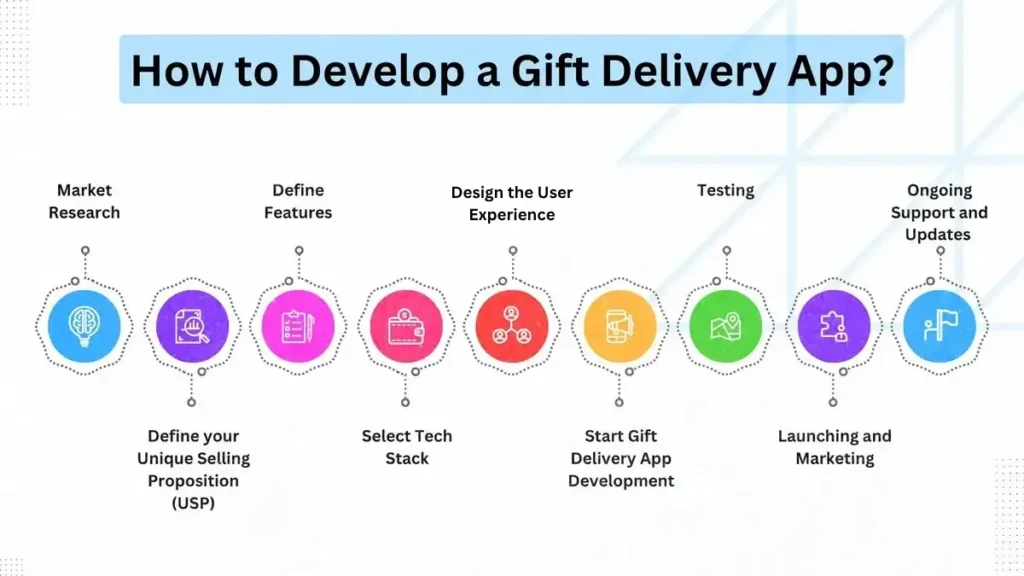
1. Research the Gift Delivery Market
First, you have to conduct market research to understand the demand for gift delivery services. Determine who your target market is, research your competition, and evaluate any obstacles or possibilities that may arise.
Define your target market based on factors such as:
- Customer location
- Age and purchasing behavior
- Common gifting occasions
- Average order value
- Preferred delivery options
- Product categories
- Customer pain points
Also determine whether you want to operate as a single-vendor store or a multi-vendor marketplace. This decision will influence your platform features and revenue model.
2. Define your Unique Selling Proposition (USP)
Identify the specific reason customers or vendors should choose your platform instead of existing alternatives.
Your USP could focus on a particular niche, such as:
- Same-day personalized gifts
- Corporate gifting
- Local artisan products
- Affordable gifts
- Premium luxury gifts
- Eco-friendly gifts
- Last-minute gifting
- Occasion-based gift recommendations
Avoid trying to serve every customer from the beginning. A clearly defined target market can make it easier to build the product and develop a focused marketing strategy.
3. Define Features
Brainstorm the features and functionalities you want to add to your app. This may include order tracking, user registration, gift catalog, push notifications, and payment processing. Always add the relevant features that make your app unique and keep users engaged.
Customer App
- Gift catalog
- Search and filters
- Personalized gifts
- Scheduled delivery
- Multiple payment options
- Order tracking
- Ratings and reviews
- Push notifications
Vendor Panel
- Product management
- Inventory management
- Order management
- Pricing and discounts
- Earnings reports
Delivery/Rider App
- Order assignment
- Route navigation
- Delivery status
- Real-time location sharing
- Earnings tracking
Admin Panel
- User management
- Vendor management
- Rider management
- Commission management
- Order monitoring
- Analytics and reports
4. Choose the Technology Stack
Choose the databases, frameworks, and programming languages that make up the technology stack for your application. The exact needs of your app and the level of experience of your development team will determine which technology stack to choose.
Here is the technology stack that you will use for your gift app.
| Component | Recommended Technologies | Purpose |
| Customer Mobile App | React Native or Flutter | Build cross-platform iOS and Android applications |
| Web Applications | React.js / Next.js | Build customer, vendor, and admin interfaces |
| Backend | Node.js / NestJS | Handle authentication, orders, payments, vendors, and delivery workflows |
| Database | PostgreSQL or MongoDB | Store users, products, orders, vendors, and other application data |
| Caching | Redis | Improve performance and support real-time or frequently accessed data |
| Cloud Infrastructure | AWS, Azure, or Google Cloud | Host application services, databases, storage, and other infrastructure |
| Payments | Stripe or a regional payment gateway | Process online payments securely |
| Maps & Routing | Google Maps Platform or Mapbox | Support addresses, location tracking, distance calculations, and delivery routes |
| Notifications | Firebase Cloud Messaging, email, or SMS providers | Send order updates, delivery alerts, and promotional notifications |
| Testing | Jest, React Testing Library, Playwright, or similar tools | Test application functionality and user workflows |
The final stack does not need to include every technology listed above. For example, a development team might choose Node.js with PostgreSQL or MongoDB for the backend, rather than using multiple backend frameworks such as Node.js, Django, and Ruby on Rails together.
For an MVP, prioritize technologies that allow your team to develop, test, and maintain the core ordering and delivery workflows. As the platform grows, you can introduce additional infrastructure and services based on performance, traffic, and operational requirements.
5. Design the User Experience
Create wireframes and prototypes for the main customer and operational workflows before development begins.
Important customer screens may include:
- Home screen
- Gift categories
- Search results
- Product details
For a multi-vendor platform, also design vendor, rider, and admin workflows.
The design should make the gifting journey simple, particularly when customers are purchasing under time pressure. Important information such as delivery availability, estimated delivery date, personalization requirements, and total price should be clear before checkout.
6. Start Gift Delivery App Development
In this phase, start the app development. Divide this step into two phases:
- Design the User Interface
Sketch out the key screens and user flows, such as the home page, product catalog, shopping cart, and checkout. Choose an intuitive and visually appealing design that aligns with your target audience. Ensure the UI is optimized for mobile use with large buttons, clear labels, and easy navigation.
- Develop the Backend Infrastructure
Set up a database to store product information, user accounts, and order details. Build APIs to handle tasks like authentication, inventory management, and order processing. Integrate with any necessary third-party services, such as payment gateways and mapping/routing APIs.
7. Testing
After building the app, conduct thorough testing to remove bugs and issues. Test the app on different devices and ensure the app’s functionality and stability.
8. Launching and Marketing
Launch the gift app when the testing is finished. Develop a marketing plan to raise awareness of your app among customers. Promote your app on different social media channels, such as Facebook, Instagram, and Twitter. Use influencer marketing by partnering with relevant social media personalities to promote the app.
Build an email list of interested users and send regular updates, special offers, and personalized recommendations. Use email campaigns to drive app downloads, promote new features, and encourage repeat business. Offer incentives or discounts to encourage customers to refer their friends and family.
9. Ongoing Support and Updates
Provide ongoing support and update the app according to the customer’s requirements. Actively monitor user reviews and ratings on app stores and social media platforms. Also, analyze customer support inquiries and user reviews to identify areas for improvement.
What is the Cost of Building the Gift Delivery App?
A basic gift delivery app MVP generally costs between $50,000 and $150,000, depending on feature scope, chosen platforms (iOS, Android, or both), and whether development is outsourced or in-house. A full-featured multi-vendor platform with separate customer, vendor, rider, and admin apps costs $200,000 or more.
| App Type | Estimated Cost |
| Basic MVP | $50,000–$150,000+ |
| Full-featured app | $200,000–$500,000+ |
What Affects Gift Delivery App Development Cost?
Here are a few key factors that would impact the development costs.
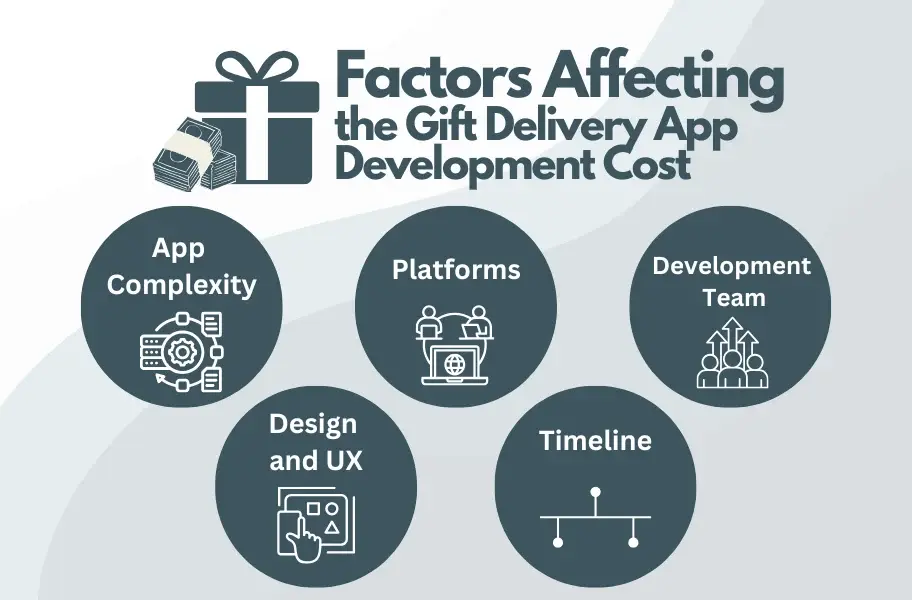
App Complexity
The more features and functionality the app has, the higher the development costs will be. Basic gift delivery apps with simple ordering, payment, and delivery tracking will be less expensive than more advanced apps with features like gift recommendations, subscription models, or integration with other services.
Number of Platforms
Will the app be developed for iOS, Android, or both? Building for multiple platforms increases the overall cost. Native app development tends to be more expensive than cross-platform frameworks like React Native or Flutter.
Development Team
The size and experience level of the development team will greatly impact costs. Hiring a team of seasoned mobile app developers will be more expensive than using junior or outsourced developers.
Design and UX
A thoughtfully designed user interface and experience add to development costs but are crucial for an app’s success. Hiring a dedicated UX/UI designer increases the budget.
Timeline
Rushed development cycles tend to cost more. Allowing sufficient time for planning, development, testing, and deployment keeps costs down.
Examples of Online Gifting Platforms
Looking to send a thoughtful gift? Here are some great online gifting apps you can use to send presents to the USA, Dubai, or anywhere else.
- Sugarwish – Send Personalized Gifts
Sugarwish is the online gift delivery service that makes gift-giving personal. It uses a recipient-choice model in which the sender selects a gift category or experience and the recipient chooses what they prefer. This approach can reduce the risk of sending a gift the recipient does not want.
- Giftagram – Corporate Gifting for Clients and Employees
Giftagram is your go-to for corporate gifting. It focuses heavily on corporate gifting and offers curated gift options for businesses. Its model is useful to study if you plan to target companies sending gifts to employees, clients, or business partners.
- Handwrytten – Handwritten Note Service and Card Automation
Handwrytten adds a heartfelt touch to your gifts with real handwritten notes. You can automate the process, making it easy to send personalized messages alongside your gifts. It’s a lovely way to show you care.
- Snappy – Send Gift Choices Wrapped in a Unique Experience
Snappy turns gifting into an exciting experience. It uses a recipient-choice approach for corporate gifting, allowing recipients to select a gift from available options. This model shows how businesses can combine corporate gifting with recipient preferences.
- Sendoso – Gifting and Direct Mail Platform
Sendoso combines gifting with the power of direct mail. You can send personalized gifts and thoughtful messages all in one go. It’s perfect for making your gifts feel even more special and memorable.
Example: What We Can Learn From Giftagram’s Corporate Gifting Model
Giftagram is an example of a digital gifting business that focuses on corporate gifting. Its model provides useful ideas for businesses planning a gift delivery platform, particularly those interested in serving companies rather than only individual customers.
Business Challenge
Corporate gifting can involve more complexity than an individual gift order. Businesses may need to manage multiple recipients, gift selections, delivery addresses, and orders for different occasions.
A digital platform can help organize these processes in one place instead of relying entirely on manual communication and individual orders.
Platform Approach
Giftagram’s corporate gifting model provides an example of how a gifting platform can structure its offering around business customers.
For a gift delivery app targeting this market, useful capabilities could include:
- Curated corporate gift collections
- Bulk ordering
- Multiple recipient addresses
- Personalized gift messages
- Recipient gift selection
- Scheduled deliveries
- Order management
- Corporate account management
- Delivery status updates
- Reporting and order history
What Businesses Can Learn From This Model
The main lesson is that a gift delivery platform does not have to target only individual customers. Corporate gifting can represent a separate customer segment with different requirements and purchasing workflows.
If you plan to target corporate customers, design the platform around their actual needs rather than simply adding a “corporate gifts” category to a customer app.
Before launching, validate which features businesses are willing to use and pay for. For example, some companies may prioritize bulk ordering and centralized billing, and others may care more about personalization, delivery scheduling, or reporting.
Why Use a White-Label Solution for Gift Delivery?
Building a complete delivery marketplace from scratch requires development across multiple applications and operational systems. A white-label solution can provide an existing foundation, allowing businesses to focus more of their resources on vendor acquisition, marketing, and operations.
However, a white-label platform is not automatically the right choice for every business. Before selecting one, evaluate its:
- Source-code access
- Customization options
- Scalability
- Integrations
- Deployment model
- Support
- Total cost of ownership
For businesses that want to launch a gift delivery marketplace without developing every delivery component from the ground up, Enatega can serve as a starting point that can be customized around their specific business requirements.
FAQs
Creating a gift delivery app takes 3 to 6 months, depending on features, complexity, and team expertise. The timeline depends on the scope and size of the development team.
A basic MVP can take several months to design, develop, test, and launch. A more complex platform may take longer.
Below are some steps to help you start an online gift business.
Identify a niche or target market that interests you.
Create a business plan.
Source or create unique products.
Set up an e-commerce platform like Shopify or Etsy.
Develop a marketing strategy using social media and SEO to attract customers.
A gift card to a popular online retailer or a subscription service is often the best last-minute online gift, as it allows the recipient to choose what they want.
You can send a variety of thoughtful gifts on someone’s birthday, such as:
Personalized gifts (like custom mugs or photo albums)
Gift cards to their favorite stores or restaurants
Experience gifts (like tickets to a concert or a spa day)
Books in a genre they love
Flowers or plants for a touch of nature
Gourmet treats or a cake delivery
Yes. Scheduled delivery is useful for birthdays, anniversaries, holidays, corporate gifting, and other planned occasions. The platform can allow customers to select an available delivery date and, where operationally possible, a delivery time slot.
Supercharge your deliveries with Enatega.
Register NowConclusion
Creating the gift delivery app is a proven strategy to grow your user base and business worldwide. A well-crafted gift app helps to drive more sales and revenue.
The global personalized gifts market size is projected to reach USD 57.85 billion by 2031, according to Data Bridge Market Research.
If you're planning to launch a gift delivery, flower delivery, or other on-demand delivery business, you can explore a ready-made delivery platform to reduce the amount of custom development required.
Register now to discuss your requirements and determine which features and setup are appropriate for your business.
About the author

Hudaibia Khalid is a senior content writer with several years of experience in creating clear and easy-to-understand content. Over the years, she has worked closely with startups, restaurants, and entrepreneurs, helping them simplify complex digital and technical topics into actionable insights.
Her expertise lies in writing about on-demand platforms, food delivery solutions, and business growth strategies in a way that is accessible even to non-technical readers. With her experience in the industry, she focuses on guiding businesses step by step, from understanding ideas to turning them into fully working solutions.
SHARE






 IOS
IOS Android
 Web
Web