

Uber Eats makes a profit by using these strategies:
- Earning commissions from restaurants
- Charging delivery and service fees to customers
- Subscriptions and ads
Here’s the interesting part: one simple food order creates multiple streams of income. The restaurant pays to reach more customers, the customer pays for convenience, and Uber Eats earns from both, at the same time.
So, it looks like a basic delivery service; it’s actually a smart system built to turn every order into profit in more than one way.
Let’s explore it in more detail.
What is Uber Eats?
Uber Eats is an online food delivery platform that connects customers with local restaurants and delivery drivers.
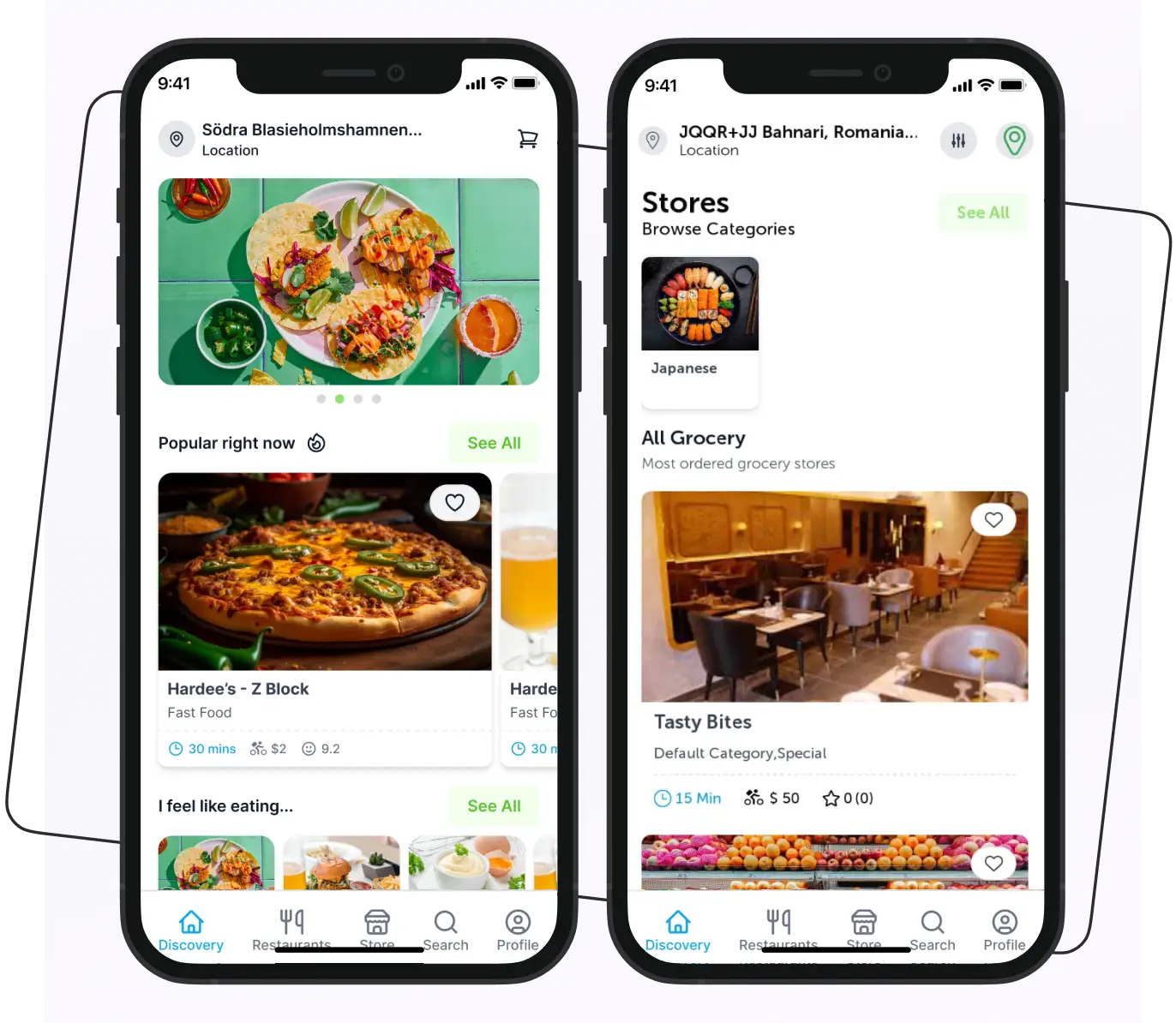
It allows users to browse menus, place orders through a mobile app or website, and get food delivered right to their doorstep. Restaurants use it to reach more customers, while independent drivers (delivery partners) handle the delivery.
Supercharge your deliveries with Enatega.
Register NowHow Uber Eats Works?
Uber Eats business model operates as a three-sided marketplace that connects customers, restaurants, and delivery partners, all through one platform.
Customer Browses and Places an Order
- The customer opens the Uber Eats app or website and searches for nearby restaurants.
- They can browse menus, check prices, read reviews, and customize their order.
- Once ready, they place the order and pay through the app using a card, a wallet, or cash.
- The app shows an estimated delivery time immediately after order confirmation.
Restaurant Receives and Prepares the Order
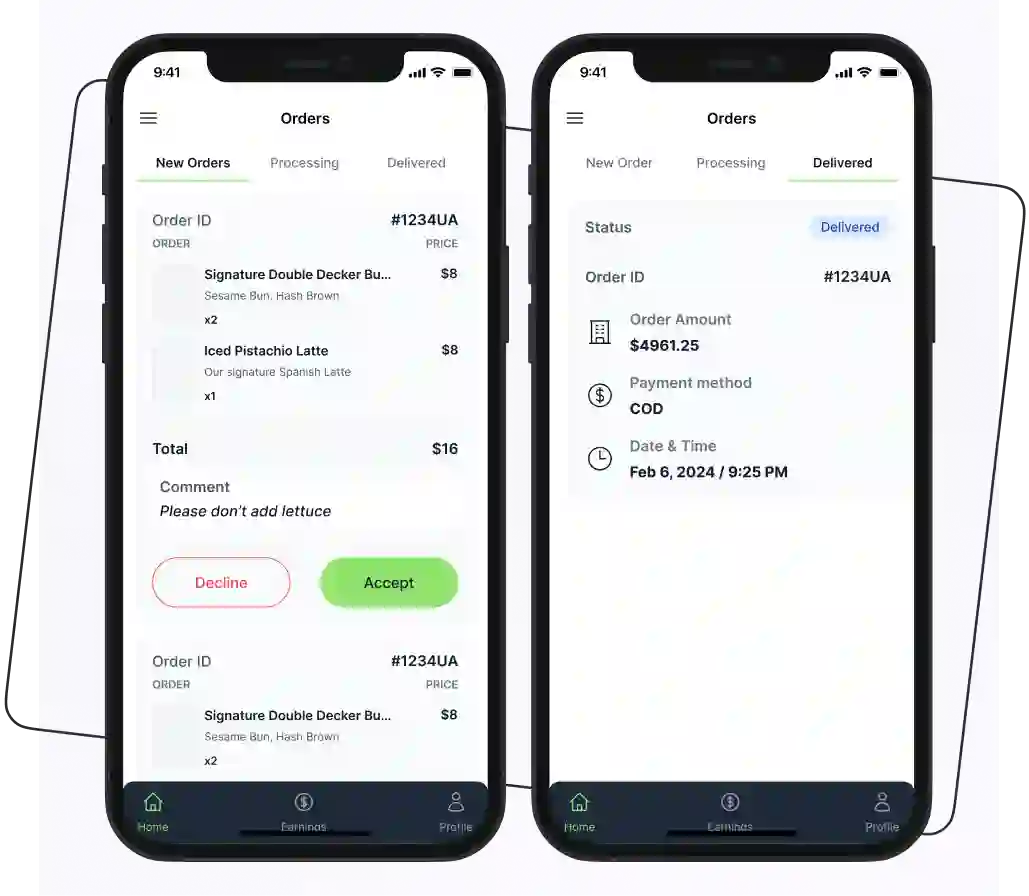
- The restaurant gets the order instantly on a tablet or POS system.
- They confirm the order and start preparing the food according to customer instructions.
- The app updates the customer on the estimated preparation time in real time.
- Once ready, the restaurant marks it as prepared for pickup by the driver.
Driver (Delivery Partner) is Assigned
- Uber Eats finds the nearest available driver using smart algorithms.
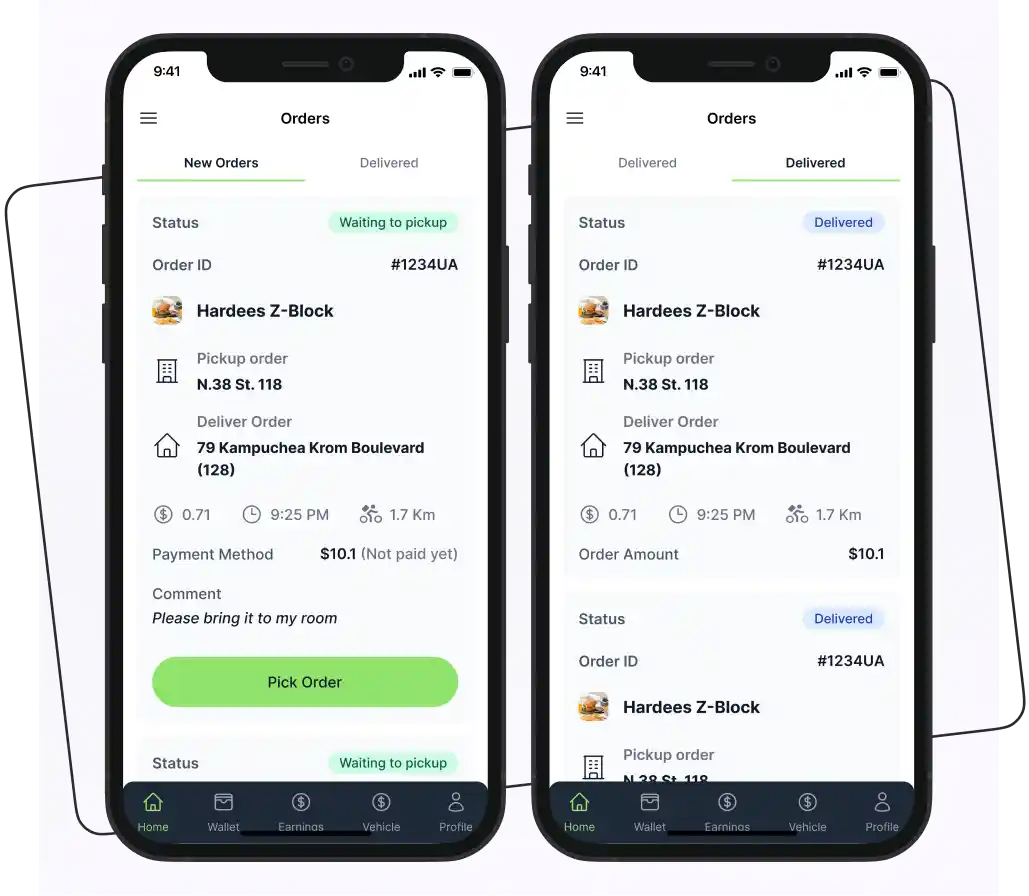
- The driver accepts the delivery request and prepares to pick up the food.
- The system considers distance, availability, and estimated earnings to assign drivers.
Driver Picks Up the Food
- The driver arrives at the restaurant to collect the order.
- They confirm pickup in the app, which notifies the customer in real time. If the food isn’t ready yet, the driver may wait briefly at the restaurant.
Real-Time Delivery Tracking
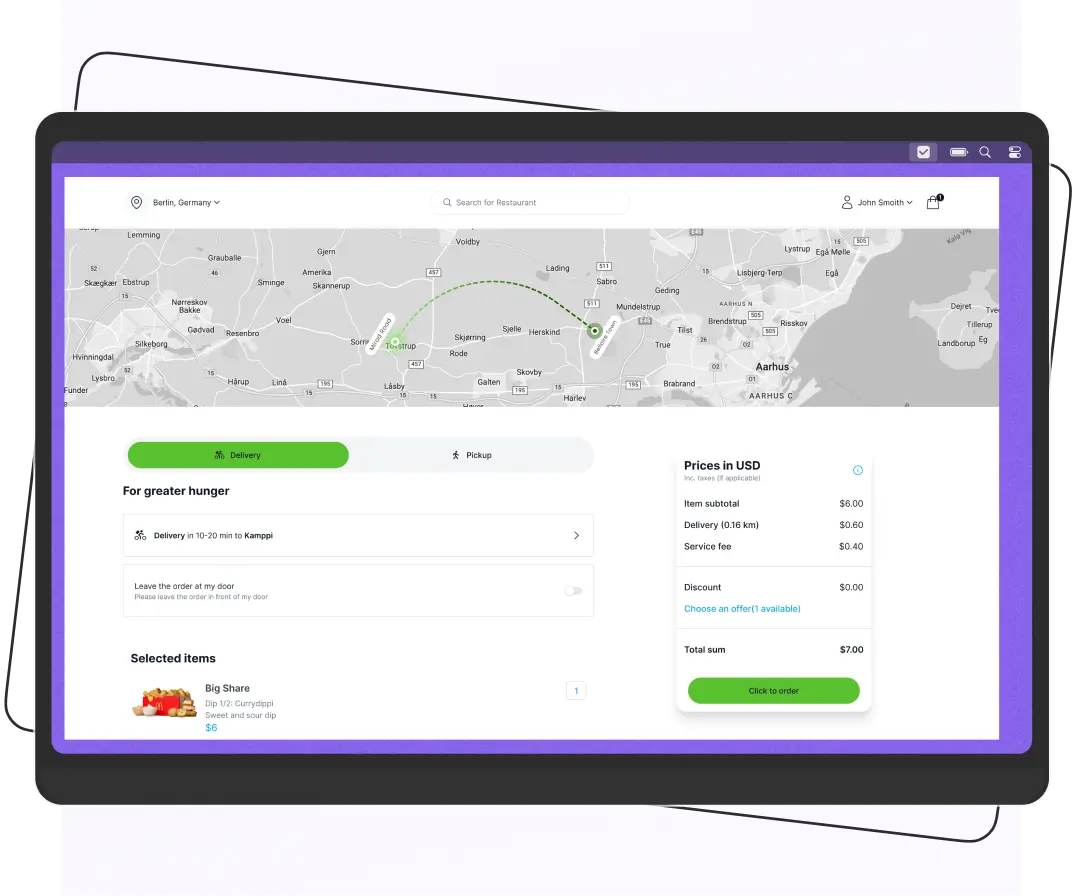
- Once on the way, the customer can track the driver on a live map.
- The app shows estimated arrival time and updates like “On the way” or “Arriving soon.”
- Drivers use GPS navigation to find the fastest route to the customer.
Food Delivery to Customer
- The driver delivers the food to the customer’s doorstep.
- Customers can choose hand-to-hand or contactless delivery for safety.
- The driver marks the order as delivered in the app.
- The customer may also tip the driver through the app if they wish.
Payment Distribution
- Uber Eats keeps a commission from the restaurant, usually a percentage of the order.
- Customers pay delivery and service fees, which go to Uber Eats revenue.
- The restaurant receives the remaining payment for the meal.
- Drivers are paid for their delivery, sometimes with bonuses for busy periods.
Ratings and Feedback
- After delivery, customers rate food quality and delivery experience.
- Restaurants and drivers may also give feedback on customers.
- Ratings affect restaurants’ visibility and drivers’ reputations.
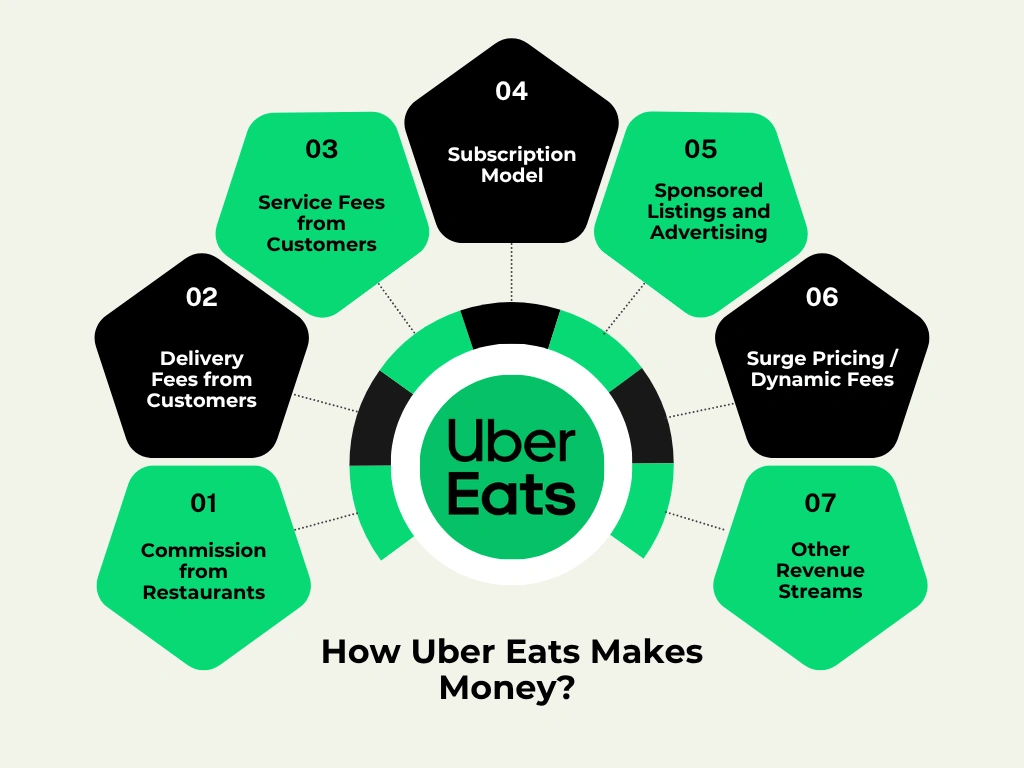
How Uber Eats Makes Money? Main Revenue Streams
Uber Eats generates revenue through multiple channels, making it more than just a delivery service. Every order involves several ways Uber Eats earns money.
The main ways that Uber Eats uses to generate money are:
Commission from Restaurants
This is the primary revenue source for Uber Eats. The more orders restaurants receive, the more Uber Eats earns.
Uber Eats charges restaurants a percentage of every order, usually between 15–30%. Restaurants pay this fee for access to Uber Eats’ large customer base and order management system.
Delivery Fees from Customers
Delivery fees make every order profitable, even for small items. Customers pay a delivery fee for each order, which varies based on distance, demand, and time. This fee covers the cost of the driver and contributes to Uber Eats’ revenue. High-demand periods may increase delivery fees through dynamic pricing.
Service Fees from Customers
In addition to delivery fees, Uber Eats adds a service fee to orders. This fee helps cover app maintenance, tech development, and customer support. Service fees are a fixed percentage of the order subtotal.
Subscription Model (Uber One)
Uber Eats offers Uber One, a paid monthly subscription. Subscribers get benefits like free delivery, discounts, and exclusive promotions. Subscriptions also encourage customers to order more frequently, increasing revenue.
Sponsored Listings and Advertising
Restaurants can pay for better visibility on the app. Sponsored listings appear at the top of search results or in promotional sections. Uber Eats earns additional revenue from these advertising fees.
Surge Pricing / Dynamic Fees
During busy times (like lunch or dinner rush), Uber Eats can increase delivery fees. Surge fees incentivize more drivers to accept orders. Customers still pay, and Uber Eats earns extra revenue during high-demand periods.
Other Revenue Streams
Uber Eats uses different revenue streams to generate revenue, including:
- Partnerships with grocery or retail stores for delivery services.
- Promotions and referral programs that encourage app usage.
- Occasional fees for premium features or order priority.
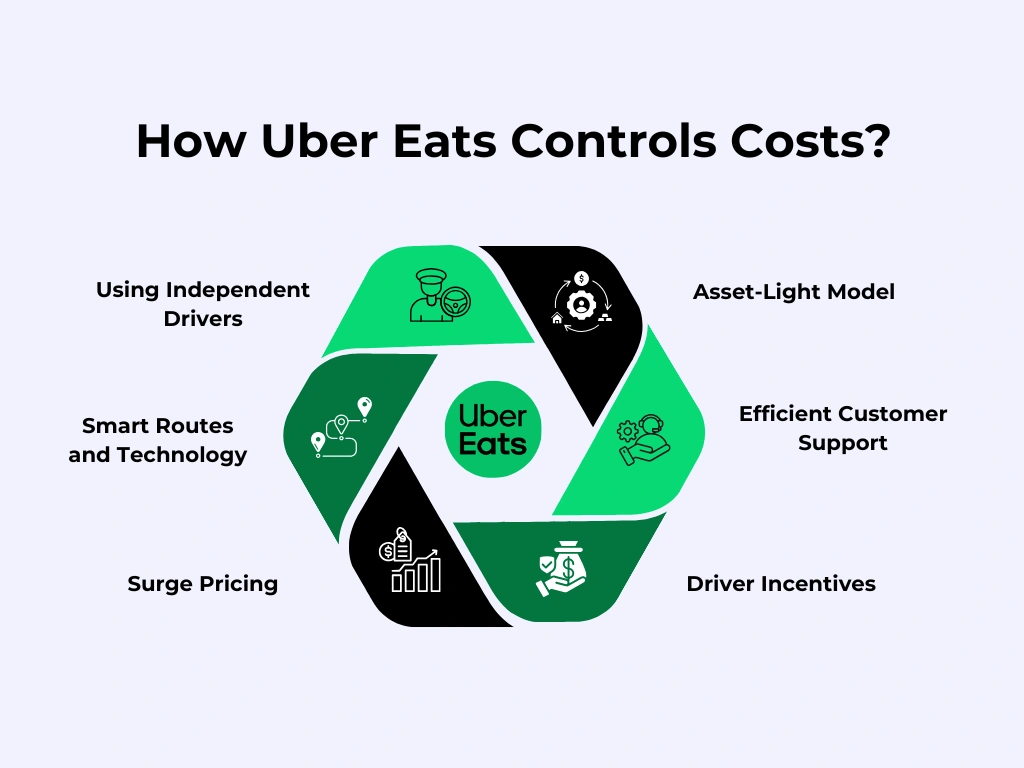
How Uber Eats Controls Costs?
Uber Eats keeps its business efficient and profitable by using these smart strategies:
Using Independent Drivers
Uber Eats doesn’t hire drivers as full-time employees. Drivers work per delivery, so the platform only pays when food is delivered. This saves on salaries and benefits, keeping costs flexible. It also allows Uber Eats to scale easily without extra fixed expenses.
Smart Routes and Technology
Uber Eats uses AI to find the fastest routes for drivers. This reduces delivery time, fuel usage, and waiting at restaurants. Faster deliveries help drivers complete more orders in less time, and customers also get their food quicker.
Surge Pricing (Dynamic Fees)
During busy hours, Uber Eats increases delivery fees to attract more drivers. This balances supply and demand without hiring extra staff. The platform also earns extra revenue from these higher fees.
Asset-Light Model
Uber Eats doesn’t own restaurants, kitchens, or vehicles. It provides the platform, and restaurants and drivers handle the food and delivery. This avoids big expenses like buying equipment or maintaining fleets.
Efficient Customer Support
Uber Eats uses AI chatbots and centralized systems to handle customer issues. This reduces the need for a large support team. Automation speeds up responses and keeps customers happy. It lowers operational costs.
Driver Incentives
Drivers are paid per delivery and can earn bonuses or surge pay. This motivates them to work during high-demand periods. Uber Eats only pays when deliveries happen, keeping labor costs flexible.
Challenges in Uber Eats Profitability
Uber Eats faces various profitability challenges, which include:
| Challenge | Impact on Profitability | Possible Solutions |
| High Operational Costs | Reduces overall profit due to tech, marketing, and support expenses | Optimize tech spending Use AI for efficiency Reduce unnecessary promos |
| Intense Competition | Forces lower margins due to promotions and discounts | Focus on unique offerings Loyalty programs Better user experience |
| High Commissions for Restaurants | May discourage restaurants from joining or staying | Offer tiered commission models Subscription plans for restaurants |
| Customer Price Sensitivity | High delivery/service fees can reduce order frequency | Introduce flexible fees Subscription discounts and bundle offers |
| Driver Retention and Availability | Fewer drivers can delay deliveries, hurting customer satisfaction | Provide fair incentives and bonuses Flexible work options for drivers |
Is Uber Eats Actually Profitable?
Uber Eats has grown rapidly, but profitability is a complex challenge. It generates revenue from commissions, delivery fees, subscriptions, and advertising. However, its high operational costs, including driver incentives, marketing, technology, and promotions, often offset these earnings.
In some regions, Uber Eats manages to be profitable per order. When delivery fees and commissions exceed costs, especially during peak hours or with frequent subscribers.
Competitors of Uber Eats
Uber Eats faces strong competition in the food delivery market from both global and local players. These competitors challenge its market share, pricing, and profitability.
Below is a list of Uber Eats’ competitors that have a strong global presence.
DoorDash
DoorDash is a major competitor in the U.S. and some international markets. It has a strong network of restaurants and drivers, often offering aggressive promotions. DoorDash competes directly on speed, variety, and app experience.
Grubhub
Grubhub is another U.S.-based Uber Eats alternative, especially in large cities. It focuses on restaurant partnerships and subscription models like Grubhub+ for loyal customers. Grubhub often attracts restaurants with lower commission fees than Uber Eats.
Deliveroo
Deliveroo is a strong competitor in Europe, the Middle East, and Asia. It emphasizes fast delivery and corporate partnerships. Deliveroo also uses dark kitchens to expand menu variety and reduce delivery time.
Zomato
Zomato is a leading food delivery platform, especially in India and parts of Asia. It competes with Uber Eats on speed, app features, and exclusive restaurant partnerships.
Foodpanda
Foodpanda operates mainly in Asia and parts of Europe. It focuses on quick delivery, a wide variety of restaurants, and user-friendly apps. Foodpanda competes by offering attractive promotions and corporate deals.
Delivery Hero
Delivery Hero is a global delivery giant operating in Europe, Asia, Latin America, and the Middle East. It owns several local platforms and focuses on fast delivery and tech-driven operations.
Delivery Hero competes by using strategic partnerships and marketing campaigns. Its strong international presence makes it a rival to Uber Eats in multiple markets.
FAQs
Uber One is a paid subscription by Uber that offers savings and perks on rides and food delivery. It benefits customers with free delivery on eligible orders, discounts, ride credits, and exclusive offers.
Restaurants don’t pay a fixed “joining fee” in most cases, but they pay a commission on each order. Uber Eats charges around 15%–30% per order (sometimes up to ~30%+), depending on the plan, plus optional fees like marketing or onboarding costs.
Uber Eats focuses on a global, platform-based model integrated with Uber’s ride-hailing network. DoorDash, on the other hand, is more US-focused and emphasizes logistics control (Dashers), subscription programs, and strong local market penetration.
Supercharge your deliveries with Enatega.
Register NowConclusion
The Uber Eats business model shows how a simple idea of delivering food can turn into a multi-revenue system. By combining technology, logistics, and a strong restaurant network, it has created a platform that earns from every step of the customer journey.
For restaurant owners, it offers a way to reach more customers and increase sales. For entrepreneurs, it provides a clear blueprint of how a scalable, on-demand business can work. From commissions and delivery fees to subscriptions and advertising, every element is designed to support growth while managing costs.
If you’re planning to enter the food delivery market, understanding how Uber Eats operates can help you avoid common mistakes.
And if you’re thinking about creating your own Uber Eats–style app, the right approach can help you build a successful platform.
About the author

Hudaibia Khalid is a senior content writer with several years of experience in creating clear and easy-to-understand content. Over the years, she has worked closely with startups, restaurants, and entrepreneurs, helping them simplify complex digital and technical topics into actionable insights.
Her expertise lies in writing about on-demand platforms, food delivery solutions, and business growth strategies in a way that is accessible even to non-technical readers. With her experience in the industry, she focuses on guiding businesses step by step, from understanding ideas to turning them into fully working solutions.
SHARE






 IOS
IOS Android
 Web
Web