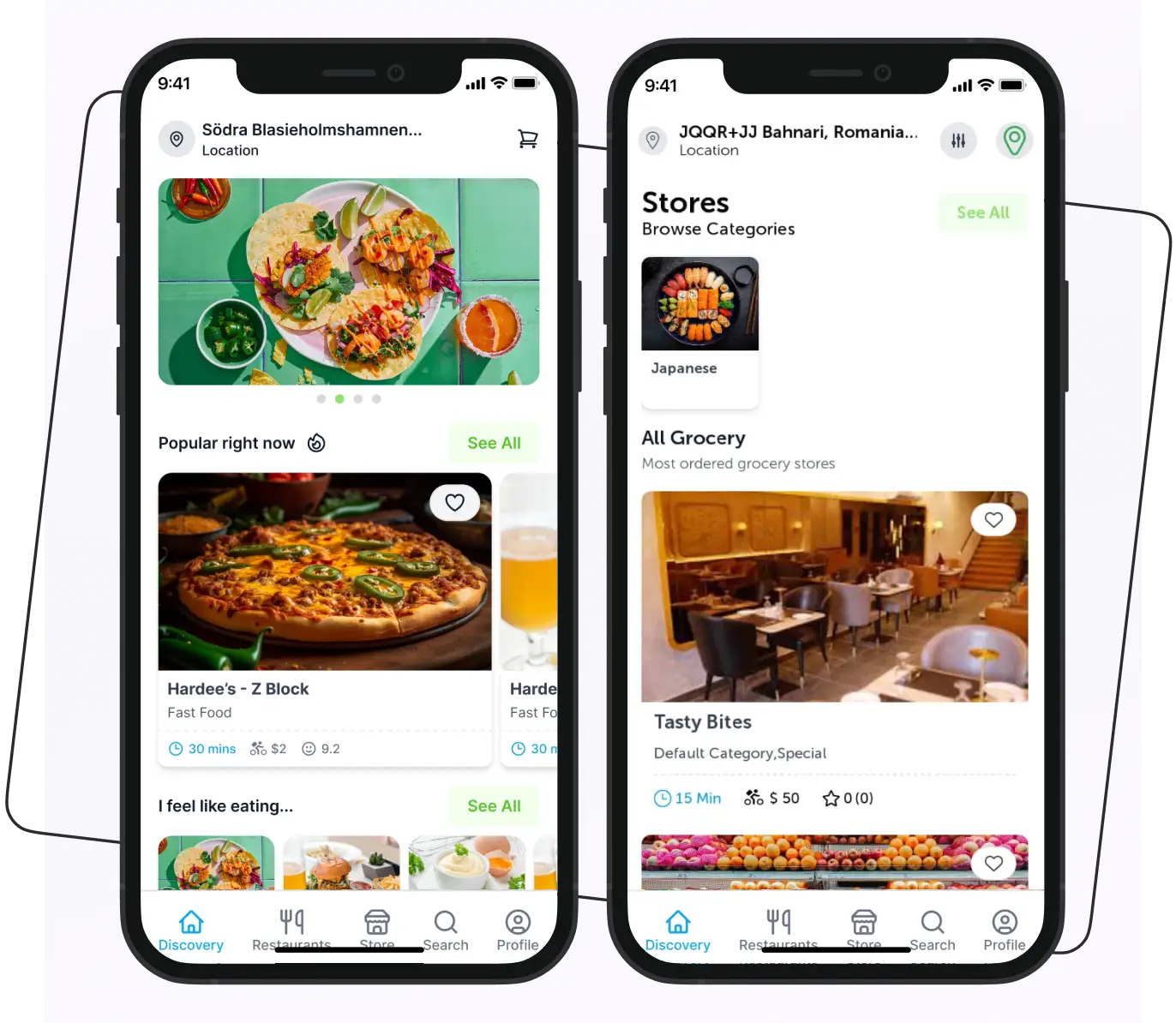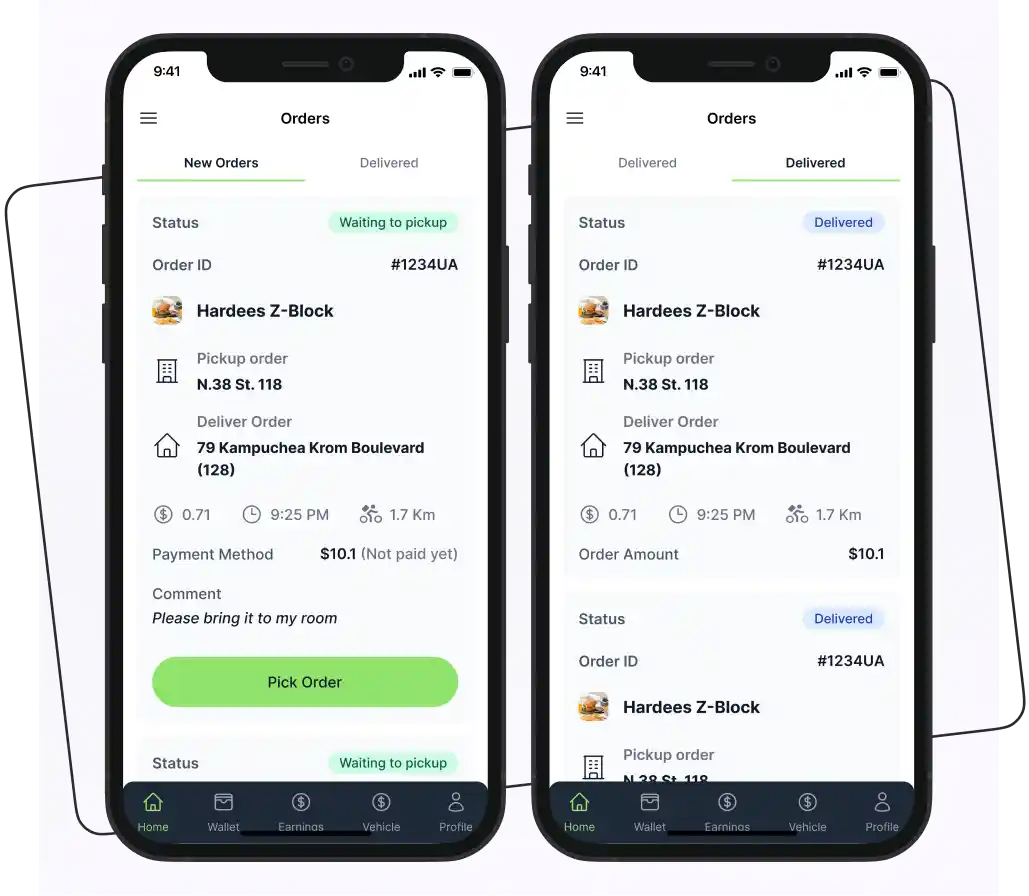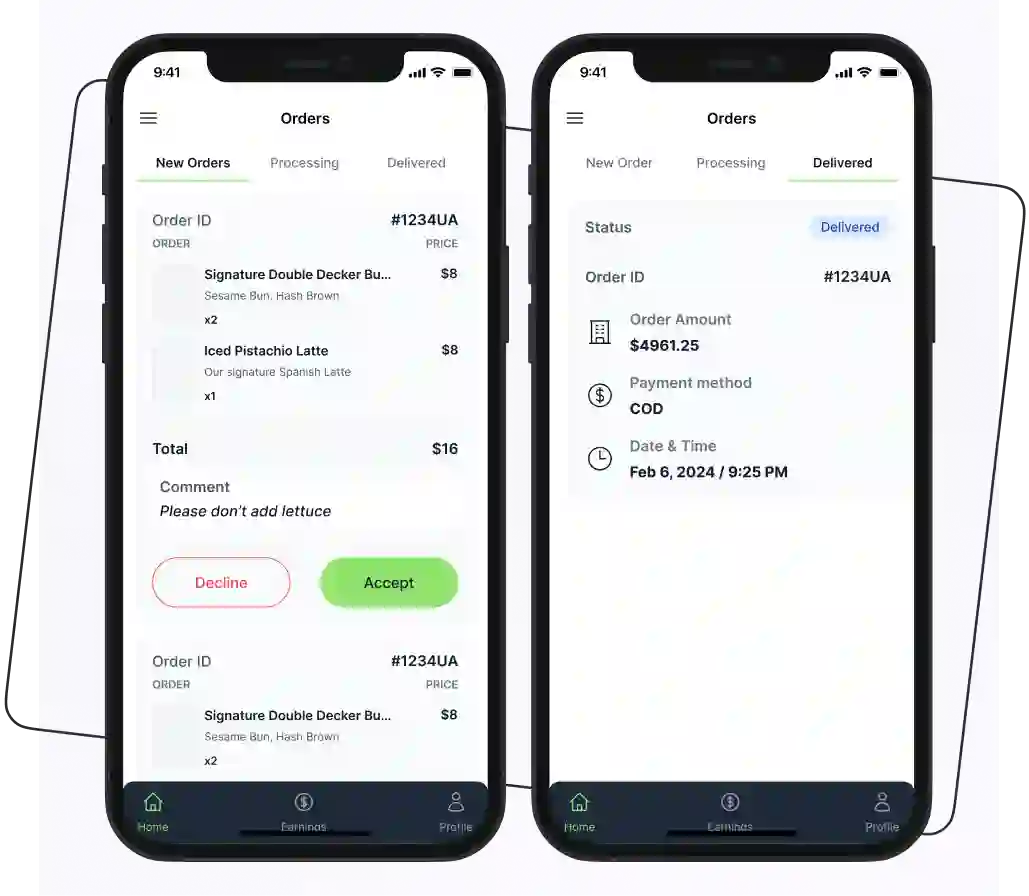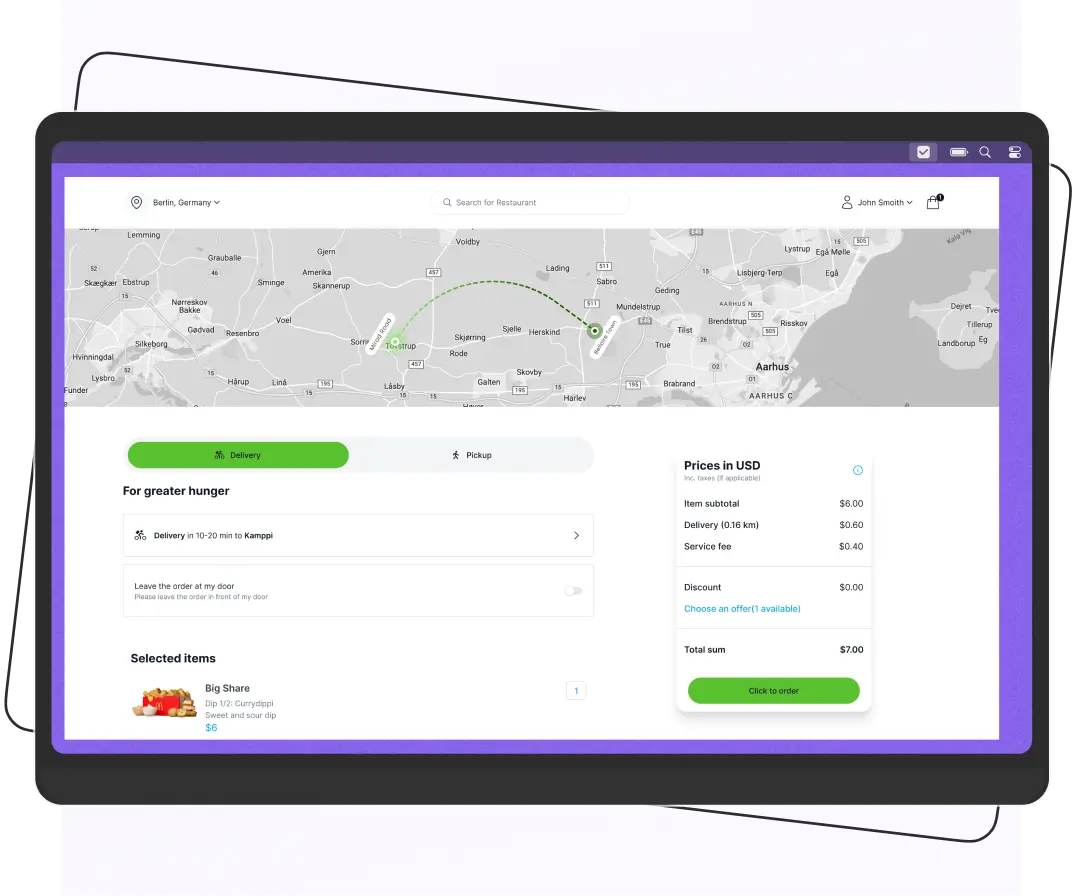



Launch your carpooling and ridesharing app in just 7 days with a BlaBlaCar clone app script.
Traveling doesn’t have to be expensive or stressful. Carpooling and ride-sharing make it easier for people to get from one place to another while saving money and reducing traffic. BlaBlaCar has shown how connecting drivers with empty seats to passengers can create a trusted and popular platform for long-distance travel.
If you want to start your own ride-sharing business, building an app from scratch can be complicated and expensive. A BlaBlaCar clone app solves this problem.
With a ready-made, white-label solution, you can launch your carpooling app in your city quickly. You can handle scheduling, tracking, and managing rides efficiently while focusing on growing your business.
In this blog, we’ll show you how a BlaBlaCar clone works, why it’s a smart idea, and how it can help you start a carpool and ride-sharing service in your city.
What is a BlaBlaCar Clone App?
A BlaBlaCar clone app is a ready-made ride-sharing (carpooling) software solution. It replicates the core functionality of BlaBlaCar. It allows businesses or startups to launch their own platform where drivers and passengers can share rides.
Instead of building a ride-sharing platform from scratch, a BlaBlaCar clone provides you with a pre-built system that includes:
- Mobile apps (Android and iOS)
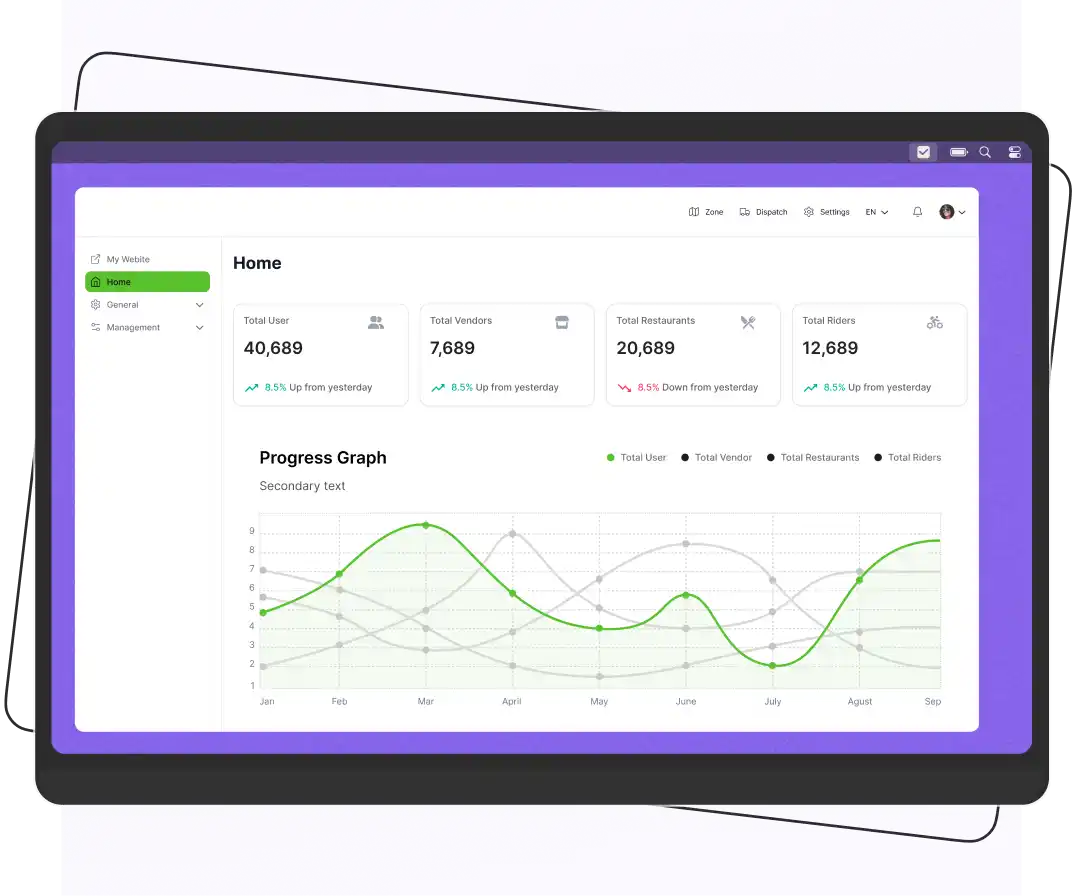
- Admin dashboard
- Backend infrastructure
You can fully customize the platform with your own:
- Brand name
- Logo
- Features
- Pricing model
Supercharge your deliveries with Enatega.
Register NowUse Cases of Car Pooling App Like BlaBlaCar
A BlaBlaCar clone app caters to a wide range of users and scenarios. A professionally built ride-sharing platform supports a range of use cases.
- Daily Commuting
Passengers can share rides for their daily office or college commute, reducing travel costs and traffic congestion.
- Intercity Travel
Users can book shared rides for long-distance travel between cities, making trips affordable and convenient.
- Airport Transfers
Drivers can offer airport rides, and passengers benefit from cost-effective and direct transport.
- Event Transportation
Carpooling for concerts, conferences, weddings, or festivals allows groups to travel together efficiently.
- Tourist Travel
Tourists or travelers can find rides with locals, making it easier to explore cities affordably while socializing.
How Does a BlaBlaCar Clone Work?
A BlaBlaCar clone app follows a simple peer-to-peer ride-sharing model, similar to BlaBlaCar.
Below is a clear, step-by-step process of how the system functions from both user and system perspectives.
User Roles and Onboarding
- Passenger and Driver accounts: Users begin by signing up on the platform using their email or phone number. They can choose to register as a passenger, a driver, or both, depending on their needs.
- Verification: The platform ensures trust and safety by verifying user details, including phone or email confirmation. For drivers, additional checks such as ID verification, a driving license, and vehicle documents.
- Profiles: After registration, users create detailed profiles where they can add their photo, bio, and preferences. Drivers also include vehicle details like model, seat capacity, and luggage allowance.
Trip Creation (Driver Flow)
- Driver posts a trip: Drivers can easily create and publish trips by entering information such as origin, destination, travel date and time, price per seat, and the number of available seats.
Additional preferences like luggage rules, smoking, or pets can also be defined to set clear expectations.
- Visibility: Trip appears in the search results for matching routes and dates. The driver can edit or cancel the trip.
Trip Search and Discovery (Passenger Flow)
- Passenger searches: Passengers search for rides by entering their travel details, and the platform displays relevant results based on factors like price, timing, driver ratings, and route proximity.
- Matching and presentation: App shows a list of matching trips ordered by relevance (price, time, rating, proximity). Each listing displays total price, available seats, driver info, estimated travel time, and route map.
Booking and Seat Management
- Request vs instant booking: When a passenger selects a ride, they can book a seat either by sending a request that the driver must approve or through instant booking if that option is enabled.
- Seat allocation: The system automatically updates seat availability after each confirmed booking.
- Waiting lists: In some cases, passengers can join a waiting list if a trip is fully booked and receive notifications if seats become available.
Payment Processing
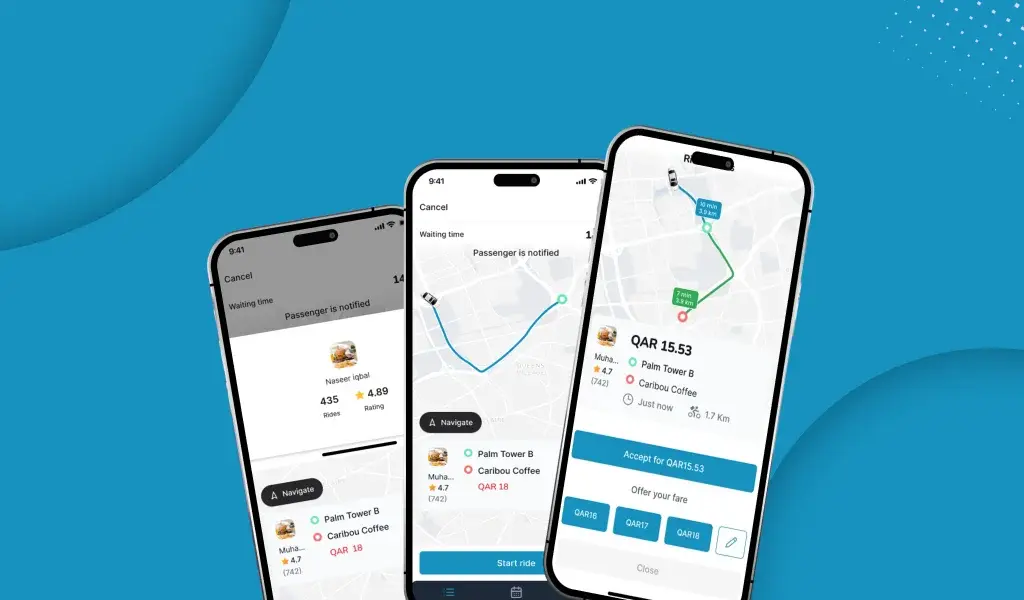
- Fare calculation: The platform may let drivers set prices or suggest fares; the platform may add service fees.
- Payment options: In-app payments (credit/debit cards, mobile wallets), cash-on-meetup, or hybrid.
- Escrow and payouts: The platform uses an escrow model to hold funds securely until the trip is completed.
- Refunds and disputes: After the journey, payments are released to the driver after deducting the platform’s commission.
Communication and Notifications
- In-app messaging: Passengers and drivers can communicate through in-app messaging or masked calls. It allows them to coordinate pickup locations, timing, and other travel details while maintaining privacy.
- Notifications: Users receive notifications via push alerts, SMS, or email for booking confirmations, reminders, and any updates or cancellations.
Trip Execution and Tracking
- Route and navigation: During the trip, features like navigation support and live tracking may be available. It enables passengers to monitor the journey in real time.
- Check-in/boarding: The system allows drivers to mark passengers as boarded and track the trip from start to finish.
- Safety features: Safety features such as emergency buttons and trip-sharing options further enhance user confidence.
Ratings and Feedback
- Post-trip rating: After the journey is completed, both passengers and drivers can leave ratings and reviews for each other.
Business Models for Ride-Sharing Apps like BlaBlaCar Clone
Ride-sharing apps, like a BlaBlaCar clone, can adopt multiple business models to generate revenue.
Here are the most common ride-sharing business models.
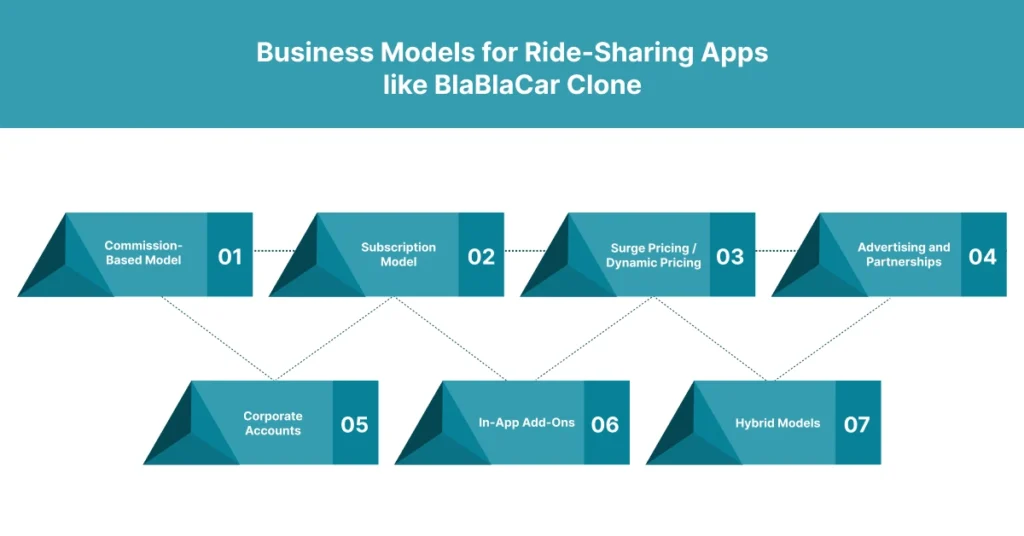
Commission-Based Model
This is the most popular model. The platform charges a percentage of each ride fare as a commission.
Subscription Model
Drivers or passengers pay a fixed subscription fee for premium features, such as priority listing, access to more routes, or reduced service charges.
Surge Pricing / Dynamic Pricing
During high-demand periods, the app adjusts prices to balance demand and supply. This increases driver earnings and platform revenue.
Advertising and Partnerships
Revenue can be generated through in-app advertisements, sponsored listings, or collaborations.
Corporate Accounts
Ride-sharing platforms can offer corporate packages for companies. It allows employees to use the service regularly with customized plans, billing, and priority support.
In-App Add-Ons
Charge extra for optional features like priority bookings, premium support, or luggage/pet accommodations.
Hybrid Models
Many successful platforms combine two or more of the above models. For example, commission-based revenue with optional subscription plans for premium users.
Features of a BlaBlaCar Clone App
A BlaBlaCar clone app, inspired by BlaBlaCar, has features designed to deliver a smooth and secure ride-sharing experience. These features are divided across passengers, drivers, and admin.
Passenger App Features
- Ride search and filters
- Ride listings
- Seat booking (instant and request)
- Secure in-app payments
- In-app messaging and calls
- Real-time notifications
- Ratings and reviews
Driver App Features
- Trip creation and management
- Booking approvals / instant booking
- Earnings dashboard
- Route navigation
- Ride history
- In-app communication
- Ratings and feedback
Admin Panel Features
- User management
- Commission and fee management
- Analytics and reports
- Dispute and refund management
- Fraud detection and moderation
- Platform settings management
Advanced Features
- Real-time GPS tracking
- AI-based ride matching
- SOS and safety features
- Multi-language and multi-currency support
How to Start a Carpooling Platform Using a BlaBlaCar Clone Script?
Starting your own carpooling platform using a BlaBlaCar clone script is a cost-effective and time-saving way to launch a ride-sharing business.
Below is a step-by-step process to help you start.
1. Conduct Market Research
Before launching, study your target market. Identify the cities, routes, and demographics with high demand for carpooling. Analyze competitors, understand passenger and driver needs, and define your unique value proposition.
2. Choose a BlaBlaCar Clone Script
Select a ready-made, customizable BlaBlaCar clone script from a trusted provider. Ensure it includes essential features such as user registration, trip creation, booking, payment gateways, real-time tracking, and ratings.
3. Customize the Platform
Brand your clone app with your company logo, colors, and name. Customize features according to your target audience. This could include payment options, language preferences, or regional travel rules.
4. Set Up Payment and Commission Structure
Decide how you will monetize your platform. Common models include a commission on each ride, subscription plans for drivers, or premium features for passengers. Integrate secure payment gateways for smooth transactions.
5. Test the App Thoroughly
Before going live, test all functionalities: user registration, trip posting, search, booking, payment, notifications, and ratings. Ensure the app is bug-free, fast, and secure across devices.
6. Launch the Platform
Deploy your app on Android, iOS, and web platforms. Start small by focusing on a few key routes or cities to build traction and collect initial feedback.
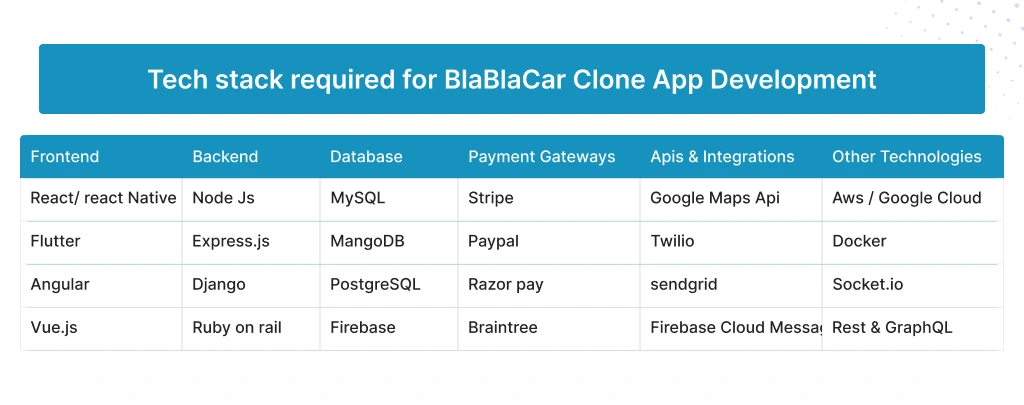
Tech Stack Required for BlaBlaCar Clone App Development
The table below shows the technology stack for building a BlaBlaCar-like carpooling app.
| Component | Technology / Tool | Purpose |
| Mobile App | Flutter | Build both iOS and Android apps from a single codebase |
| Backend | Node.js | Handles app logic, APIs, and trip management |
| Database | MySQL | Stores users, trips, bookings, and payments |
| Maps and Navigation | Google Maps API | Displays routes, calculates distance, and tracks rides |
| Payments | Stripe / PayPal | Securely processes in-app payments |
| Real-Time Updates | Firebase | Manages notifications, ride tracking, and chat |
| Hosting | AWS / Google Cloud | Hosts the backend and stores files securely |
| Security | SSL / JWT | For data security and user authentication |
Cost to Develop a BlaBlaCar Clone App
The cost of developing a ridesharing clone app depends on several factors, including:
- Platform choice
- App complexity
- Features
- Development team location
- Use a ready-made clone script or build from scratch
Development Approach
- Ready-Made Clone Script
Using a pre-built BlaBlaCar clone script is the fastest and most cost-effective option. Prices range from $2,000 to $8,000, depending on customization and features.
- Custom Development from Scratch
Building a fully custom app allows maximum flexibility and scalability, but is more expensive. Costs can range from $30,000 to $80,000 or more, depending on features and complexity.
Platform Choice
- Single Platform (iOS or Android)
Developing for a single platform reduces cost by 30–40%.
- Cross-Platform (iOS + Android)
Using frameworks like Flutter or React Native allows simultaneous development for both platforms. It increases reach but slightly raises development costs.
App Features
The cost varies based on the features you include:
- Basic Features: Lower cost. User registration, trip posting, booking, payments, ratings
- Advanced Features: Higher cost. Real-time GPS tracking, chat, SOS/emergency button, AI-based ride matching
App Design
- Basic UI/UX: $1,000–$3,000
- Custom/High-End Design: $5,000–$10,000
Development Team
- Freelancers: Lower hourly rates ($15–$40/hour) but may require more management.
- Agencies/Software Companies: Higher cost ($40–$150/hour) but offer full-service development including design, testing, and support.
Maintenance and Updates
- Post-launch maintenance and updates cost 15–20% of the initial development cost per year. This includes server hosting, bug fixes, feature updates, and customer support.
Estimated Total Cost
| Option | Estimated Cost |
| Ready-Made Clone Script | $2,000 – $8,000 |
| Custom Development (Single Platform) | $30,000 – $50,000 |
| Custom Development (iOS + Android) | $50,000 – $80,000+ |
Why Choose a Ready-Made BlaBlaCar Clone?
Launching a ride-sharing platform can be challenging if you start from scratch. A ready-made ride-sharing clone offers a faster and cost-effective way to enter the market valued at over $144 billion in 2025.
Below are some reasons that show why it’s a smart choice.
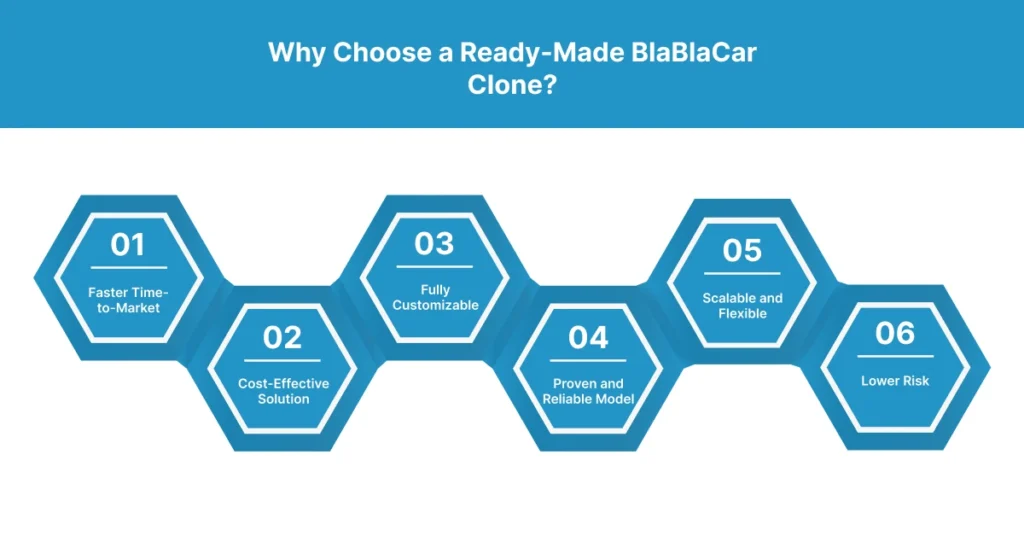
Faster Time-to-Market
A ready-made clone comes pre-built with essential features like ride posting, booking, payments, real-time tracking, and ratings. You can launch your platform quickly and start generating revenue.
Cost-Effective Solution
Developing a carpooling app from scratch can cost more. A ready-made ridesharing clone reduces development costs, making it ideal for startups and small businesses.
Fully Customizable
Despite being pre-built, these clones are highly customizable. You can add your branding, adjust features, integrate preferred payment gateways, and implement new functionalities according to your business needs.
Proven and Reliable Model
BlaBlaCar’s business model has already been validated globally. Using a clone script ensures you are using a tested system with features designed to meet both passenger and driver expectations.
Scalable and Flexible
Most ready-made clone scripts are built to scale. You can start with a single city and gradually expand to multiple regions or countries as your user base grows, without needing to rebuild the app.
Lower Risk
With a pre-built solution, technical errors and development risks are minimized. The script is usually tested and optimized.
FAQs
BlaBlaCar is a French company, founded in France in 2006.
Yes, there are several apps similar to BlaBlaCar that offer ride-sharing and carpooling services. Some popular alternatives include:
Waze carpool
Lyft shared rides
Uber pool
Carpoolworld
GoCarma
No. BlaBlaCar is not operational as a ride‑sharing service in the United States.
Supercharge your deliveries with Enatega.
Register NowConclusion
Ride-sharing has changed the way people travel, especially for long-distance trips. A platform like BlaBlaCar is a great business idea for entrepreneurs and transport companies.
If you want to start your own carpooling service, using a BlaBlaCar clone script from Enatega is an easy solution. These ready-made platforms are simple to use, secure, and customizable, letting you connect drivers and passengers quickly without building an app from scratch.
With a BlaBlaCar clone, you can launch your ride-sharing service faster and create a trusted community of drivers and passengers.
About the author

Hudaibia Khalid is the creative force behind the blog—a maestro of words and ideas. Her distinctive style not only imparts wisdom but also leaves an indelible mark, transforming each post into a captivating journey through her unique perspective on the world.
SHARE










 IOS
IOS Android
 Web
Web