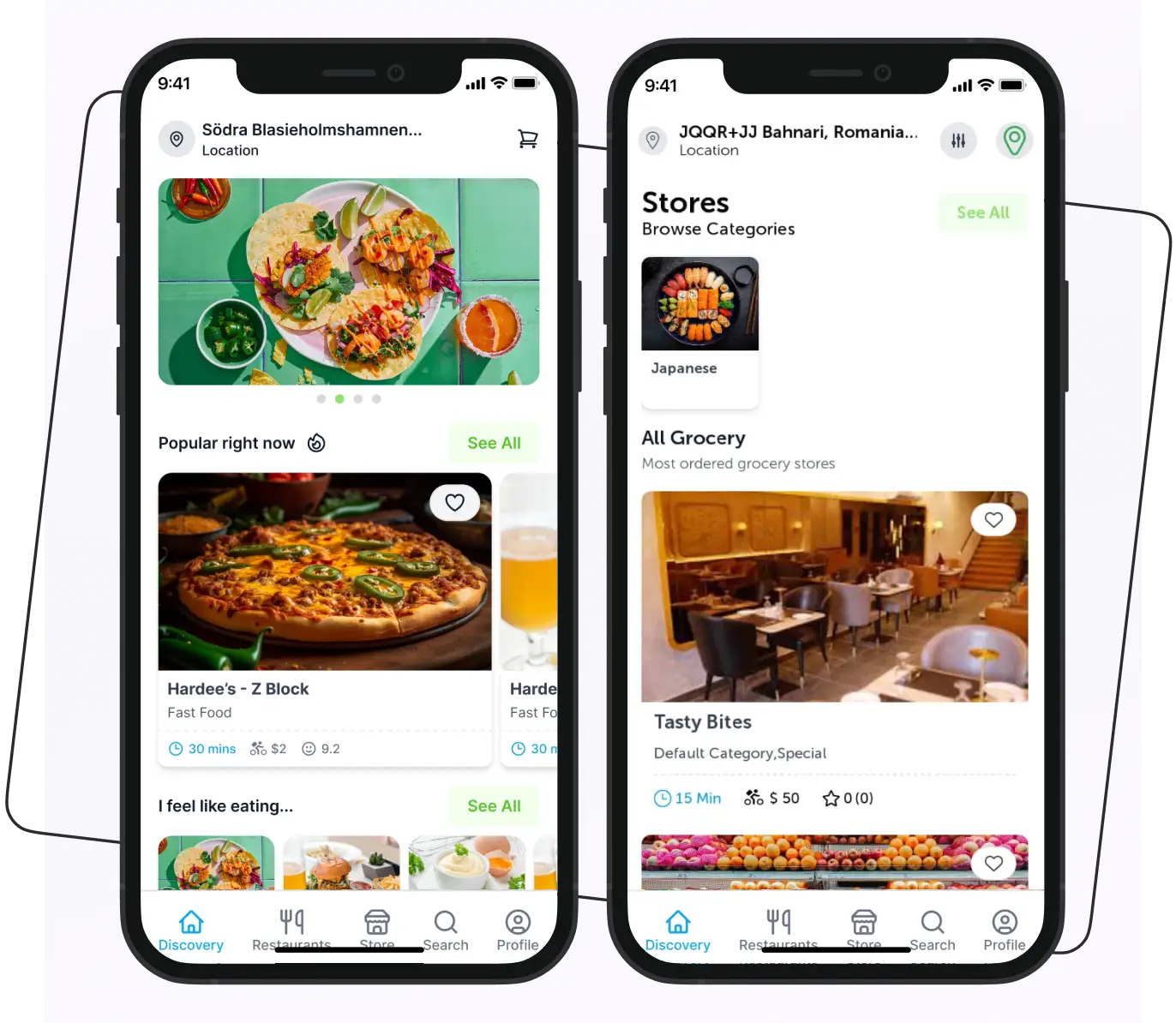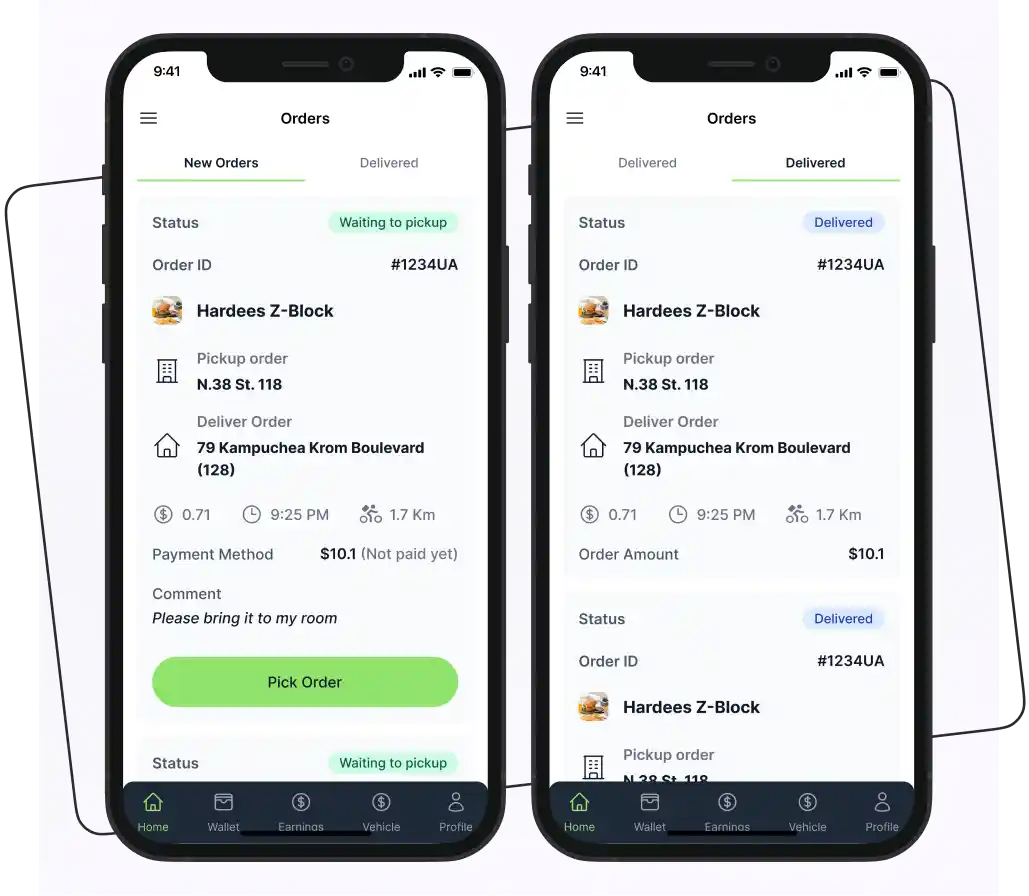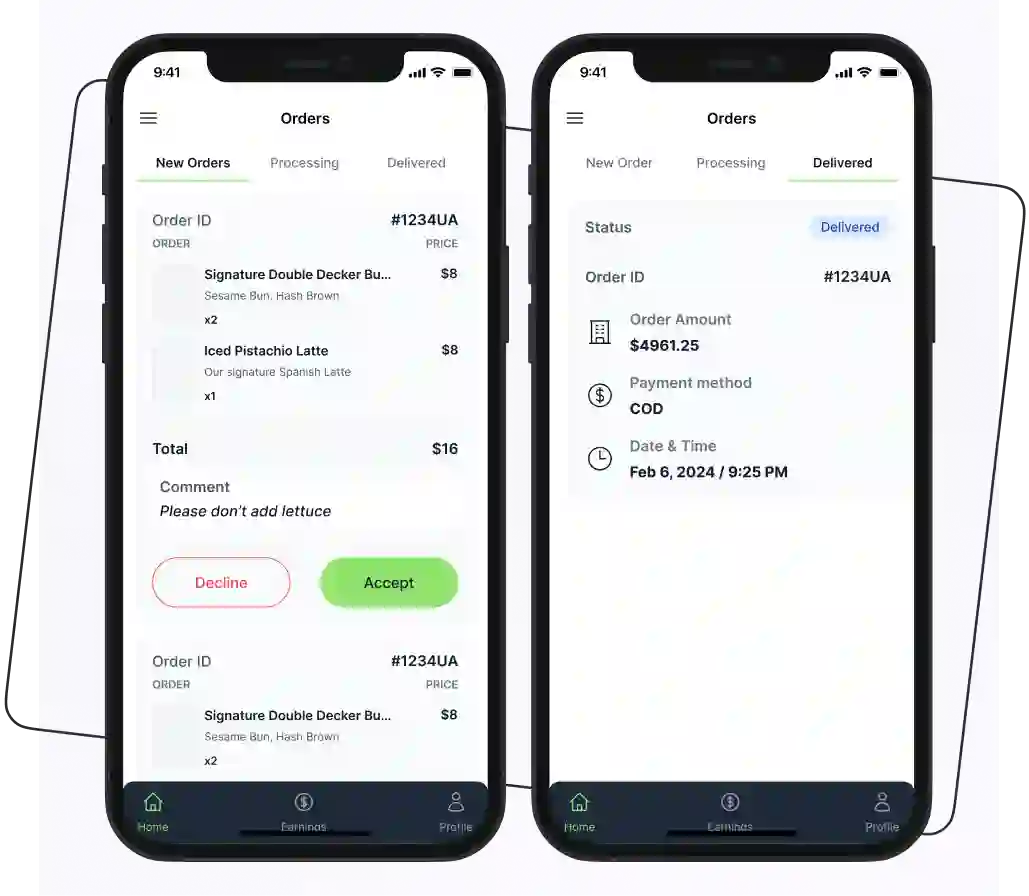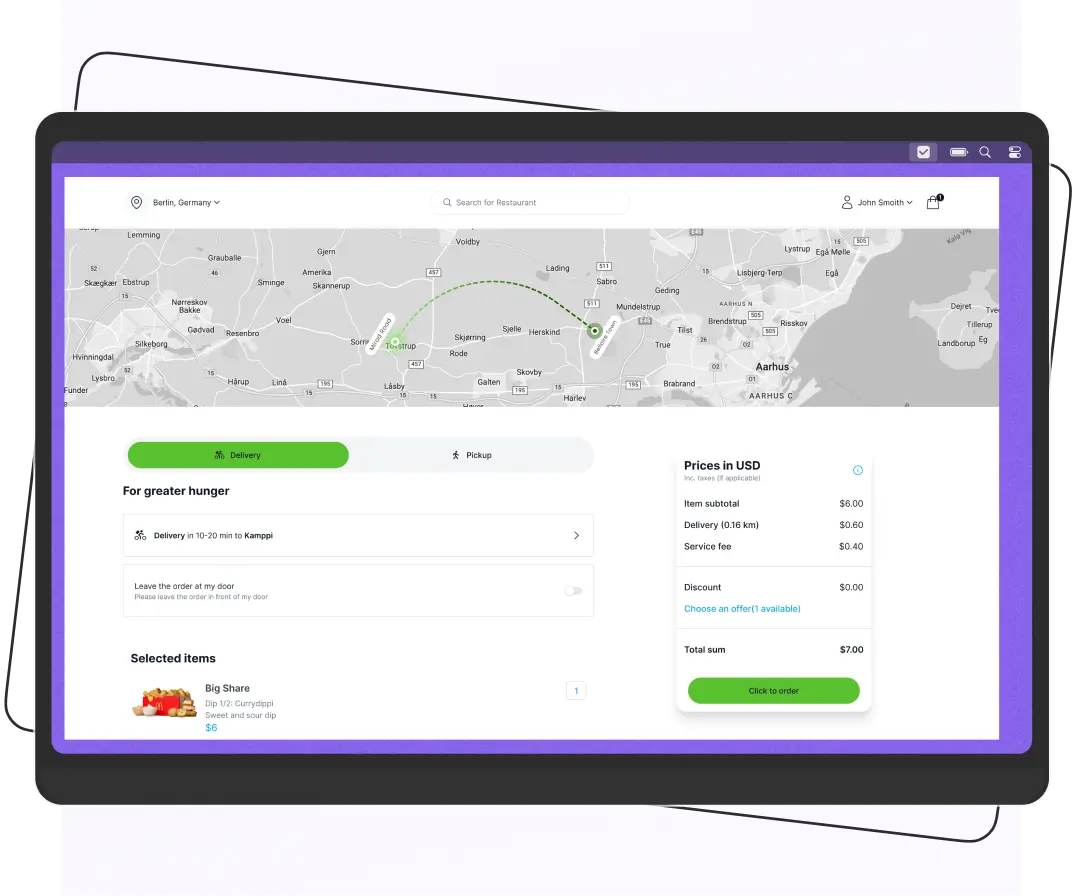


Building a DoorDash clone app costs around $20,000 to $150,000+, depending on the features, platforms, technology, development team, and level of customization. A basic MVP costs less, while a full-featured multi-vendor platform with customer, restaurant, and driver apps can require $80,000 to $150,000+.
Are you running a food delivery business and dreaming of creating your app just like DoorDash? Curious about the costs involved in bringing your vision to life? You’ve come to the right place! This blog will guide you through everything from app creation to the estimated development costs.
Did you know that the revenue in the online food delivery market is projected to reach US$1.51tn in 2026, according to Statista? This booming industry presents a fantastic opportunity for entrepreneurs like you.
When it comes to developing an app similar to DoorDash, prices can fluctuate based on several factors. These include the features you want to include, the location of your development team, and the number of platforms you wish to target. On average, you might expect to invest anywhere from $20,000 to $150,000.
Now, explore it in detail and get an estimated cost of building an app like DoorDash.
Key Takeaways
- Development Cost: A DoorDash-like food delivery app can cost approximately $20,000–$150,000+, depending on scope and customization.
- MVP Cost: A basic MVP may start around $20,000–$40,000 when limited to essential features and a focused launch scope.
- Advanced Platform: A customized multi-vendor platform with customer, restaurant, driver, and admin applications can cost $80,000–$150,000+.
- Enterprise Scale: Advanced logistics, real-time dispatch, extensive integrations, high traffic, and multi-market support can push development costs significantly higher.
- Main Cost Drivers: Features, number of platforms, development team, technology, integrations, location, and customization level all affect the final budget.
- Development Time: A basic MVP may take around 3–6 months, while a more advanced platform can take 6–12+ months.
- Additional Costs: Budget separately for hosting, maps, payment processing, SMS/OTP, maintenance, security, customer support, legal requirements, and marketing.
Cost to Develop a Food Ordering App Like DoorDash
How much does it cost to build an app like DoorDash?
The cost to develop a food delivery app like DoorDash ranges from $20,000 to $150,000+, depending on the scope of the platform. A basic MVP with essential ordering features will cost less, while a full-featured multi-vendor platform with customer, restaurant, driver, and admin applications requires a larger development budget.
The following estimates are based on the scope and complexity of the platform:
| App Type | Estimated Cost | What It Includes |
| Basic MVP | $20,000–$40,000 | Customer ordering Restaurant management Basic admin panel Payments Notifications Essential backend functionality |
| Mid-Range App | $40,000–$80,000 | Customer app Restaurant panel Driver app Order tracking Notifications Payment integration Advanced admin features |
| Advanced App | $80,000–$150,000+ | Full multi-vendor platform Advanced delivery management Real-time tracking Analytics Promotions Multiple integrations Extensive customization |
These numbers give you an estimate of what it costs to build an app like DoorDash. The final price will vary based on the app’s specific needs and complexities.
What Makes DoorDash’s Model Different (And Why It Affects Cost)
Unlike a basic food ordering app, DoorDash’s platform is built around a few specific mechanics that add development complexity:
Dasher (driver) logistics engine
DoorDash uses a real-time dispatch system that matches drivers to orders based on location, batching multiple orders when routes overlap.
Building this well requires more than a simple ‘assign nearest driver’ feature it needs route optimization logic, which adds development time beyond a basic driver app.
DashPass subscription model
DoorDash’s subscription tier (free delivery for a monthly fee) requires recurring billing infrastructure, subscription management, and logic to apply subscriber benefits at checkout; this is a separate build from one-time payment processing.
Multi-sided commission structure
DoorDash charges restaurants commission per order (varying by service tier), charges customers delivery and service fees, and offers restaurants paid advertising placement. Replicating this means your admin panel needs configurable commission rules per restaurant, not just a flat fee system.
Non-restaurant expansion
DoorDash also delivers from grocery, convenience, and retail stores, not just restaurants. If you want this flexibility, your catalog and inventory system needs to support different product types (perishables, SKU-based retail items) rather than just restaurant menus.
Building these specific features into your MVP or full platform will affect both your cost estimate and your development timeline. If you only need the core ordering-and-delivery loop, you can launch cheaper and add these mechanics later.
How to Calculate Your DoorDash App Development Budget
A practical way to estimate the budget is to calculate the development effort for each major component of the platform and then add the associated design, testing, infrastructure, and project management costs.
Estimated Development Budget = Development Hours × Hourly Rate + Design + QA + Project Management + Integrations + Infrastructure + Contingency
For example, a DoorDash-like platform may require separate development work for:
- Customer mobile app
- Restaurant dashboard or app
- Driver or delivery partner app
- Admin dashboard
- Backend APIs and database
- Payment and map integrations
- Real-time order tracking
- UI/UX design
- Quality assurance and testing
- Cloud infrastructure and deployment
For example, an MVP requiring 800–1,200 development hours at an average rate of $25–$50 per hour could require approximately $20,000–$60,000 for development.
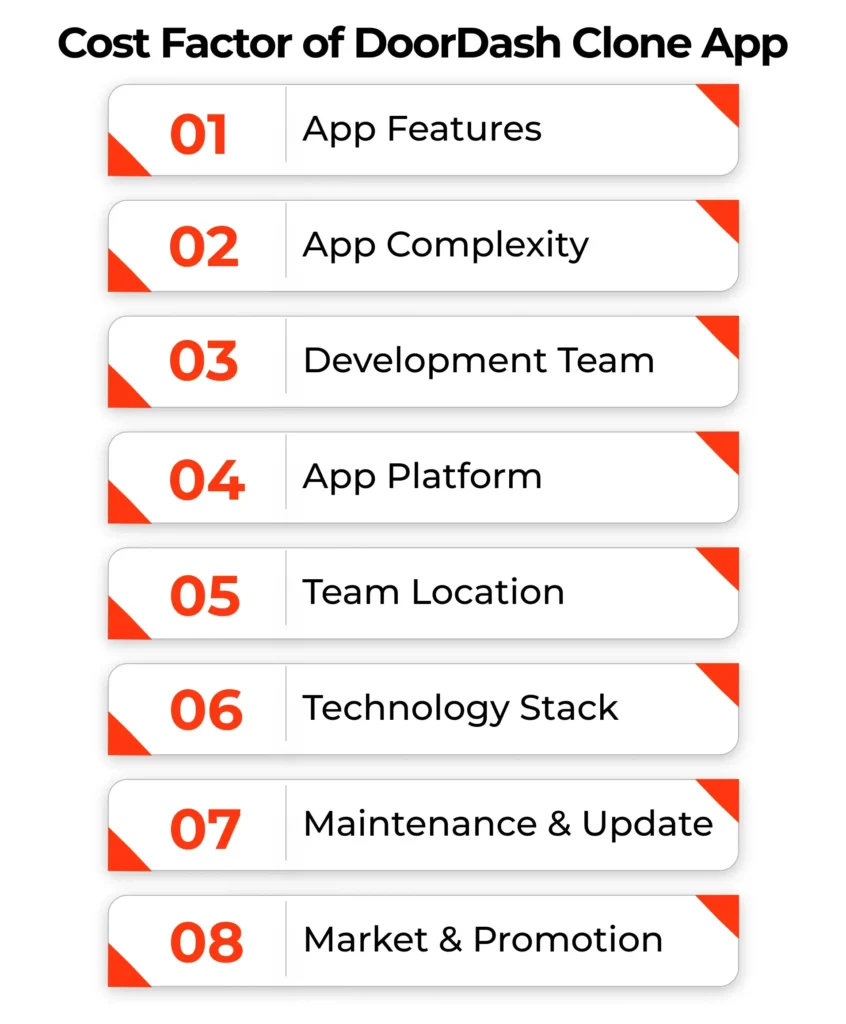
Factors Affecting the Cost of DoorDash App Development
Building a food delivery app like DoorDash involves several factors and influences the overall cost. Understanding these factors helps to know the accurate budget.
Let’s check out the factors that influence the cost of DoorDash-like app development.
1. App Features
The app features can play an important role in determining the cost. Depending on how many and how complicated the features you want to include are, the cost of the food app may change.
Here are some of the basic features that you can integrate into the food delivery app.
- User registration
- Menu browsing
- Order placement
- Push notifications
- Reviews and feedback
- Multiple payment options
Moreover, you can integrate advanced features in your app to help you stand out in the competitive market. Some of the advanced features that you can add to your app are:
- Real-time order tracking
- In-app chat
- Order scheduling
- Personalized recommendations
Supercharge your deliveries with Enatega.
Register Now2. App Complexity
An app’s complexity is another crucial factor to consider while estimating costs for your food delivery app. More time and resources are needed if you build a more complex app.
3. Development Team
It is another factor that influences the cost of app development. Selecting the right type of development team helps you save money and can lead to successful project outcomes. You can either choose an in-house development team, outsource developers from a food app development company, or hire freelancers.
The cost of each team varies and depends on the team size, hourly rates, and project complexity. For example, hiring a team in China through a China Employer of Record (EOR) will usually cost less than hiring one in the US or Europe.
A typical team may include:
| Role | Primary Responsibility |
| Project Manager | Manages requirements, timelines, communication, and project delivery |
| UI/UX Designer | Designs the customer, restaurant, driver, and admin interfaces |
| Mobile App Developers | Builds the iOS and Android customer and driver applications |
| Backend Developer | Develops APIs, databases, authentication, order management, and business logic |
| Web Developer | Builds restaurant dashboards and web-based admin interfaces |
| QA Engineer | Tests functionality, performance, security, usability, and integrations |
| DevOps Engineer | Manages cloud infrastructure, deployment, monitoring, and scalability |
For a focused MVP, some team members can work part-time or handle multiple responsibilities. As the platform becomes more complex, dedicated specialists may be required.
Choosing the Right Development Model
You can build your team in several ways:
- In-House Team
Gives you greater control and direct communication but usually involves higher long-term costs such as salaries, benefits, recruitment, office expenses, and training.
- Development Company
Provides access to a complete team of developers, designers, QA engineers, and project managers without requiring you to hire every specialist internally. This can be practical for businesses that want to launch faster or lack an internal technical team.
- Freelancers
Can be suitable for smaller projects or specific development tasks. However, managing several freelancers can become challenging when the project requires coordination between mobile development, backend development, design, QA, and DevOps.
The cost of each team varies and depends on the team size, hourly rates, and project complexity.
Here are some pros and cons to consider for selecting the right development team.
| In-House Development Team | |
| Pros | Cons |
| Better communication and collaboration | Higher fixed costs (salaries, benefits) |
| Greater control over the development process | Longer recruitment time |
| Direct access to the team for quick adjustments | |
| Outsourcing a Development Company | |
| Pros | Cons |
| Access to a full team of experts | Potential communication barriers |
| Cost-effective, especially for complex projects | Less control over the development process |
| Reduced overhead costs | |
| Hiring Freelancers | |
| Pros | Cons |
| Flexibility in hiring based on specific needs | Varying levels of quality and reliability |
| Lower costs for smaller projects | Possible challenges in project management and communication |
Moreover, some tips mentioned below to keep in mind help you choose the right team for your app development.
Research and Reviews
Look into the company’s portfolio, client reviews, and case studies. This will give you insight into their reliability and expertise.
Expertise
Choose a DoorDash clone app development company that specializes in the platform you need (Android or iOS). Each has unique requirements and guidelines.
Communication
Ensure there is a clear communication plan. Regular updates and feedback loops can help keep the project on track.
Cost vs. Quality
It may be tempting to go with the lowest bid, but prioritize quality. A higher upfront cost can save you money in the long run by reducing bugs and improving user experience.
Post-Launch Support
Inquire about post-launch services, including maintenance and updates. A dependable partner will provide ongoing support.
Cultural Fit
Ensure the company aligns with your values and work style for smoother collaboration.
4. App Platform
The platform you choose can affect the development cost of a DoorDash-like app. You can develop for iOS, Android, or both, using either native or cross-platform technologies.
If you need to launch on both iOS and Android, cross-platform frameworks such as React Native or Flutter can reduce duplicated development work by allowing developers to share much of the codebase across platforms. This can lower development time and costs compared with building two separate native applications.
However, cross-platform development is not always the cheapest option. Apps with complex platform-specific requirements may require additional native development.
| Development Approach | Potential Cost Impact | Best For |
| Single Native Platform | Lower initial scope | Businesses launching on either iOS or Android first |
| Cross-Platform | Can reduce duplicated development work | Businesses targeting iOS and Android with a shared codebase |
| Separate Native Apps | Higher development effort | Apps requiring extensive platform-specific functionality |
5. Location of the Development Team
The development team’s location significantly impacts the cost. For instance, if you hire developers from Eastern Europe or Asia, they can charge comparatively less than in Canada, the USA, and the UK.
The table below shows the estimated cost of the food delivery app based on location.
| Location | Estimated Cost (USD) per Hour |
| Eastern Europe | $25 – $50 |
| Asia | $20 – $40 |
| Canada | $50 – $100 |
| USA | $75 – $150 |
| UK | $60 – $120 |
6. Technology Stack
The choice of tech stack for a DoorDash clone app can vary significantly based on whether you’re going for a cross-platform or native approach, as well as the expertise of your development team.
Moreover, cross-platform can speed up development and reduce costs, while native might offer better performance and user experience.
A typical food delivery platform may use the following technologies:
| Component | Technology Options | Purpose |
| Customer & Driver Apps | React Native, Flutter, Swift, Kotlin | Builds mobile applications for customers and delivery partners |
| Restaurant & Admin Web Apps | React, Next.js, Vue.js | Builds web-based dashboards and management interfaces |
| Backend | Node.js, Python, Java, PHP | Handles APIs, business logic, authentication, orders, payments, and users |
| Database | PostgreSQL, MySQL, MongoDB | Stores users, restaurants, menus, orders, payments, and other application data |
| Real-Time Communication | WebSockets, Socket.IO, Firebase | Supports live order status and delivery tracking |
| Maps & Location | Google Maps Platform, Mapbox | Provides maps, geolocation, routing, and distance calculations |
| Cloud Infrastructure | AWS, Google Cloud, Microsoft Azure | Provides hosting, storage, databases, scaling, and other infrastructure services |
| Payment Processing | Stripe, PayPal, or regional gateways | Handles online payments and transaction processing |
| Push Notifications | Firebase Cloud Messaging, Apple Push Notification service | Sends order and delivery updates to users |
7. Maintenance and Update Cost
The food ordering and delivery app development cost doesn’t end with the launch. Bug fixes, incorporating new features, server maintenance, and regular updates are necessary to keep the app updated and functional. Budgeting for these ongoing costs is crucial for long-term success.
| Maintenance Area | Estimated Annual Cost |
| Bug Fixes and Technical Support | $2,000–$8,000+ |
| Security and Dependency Updates | $1,000–$5,000+ |
| Server and Infrastructure Maintenance | $1,000–$10,000+ |
| Third-Party Integration Maintenance | $1,000–$5,000+ |
| OS and App Store Updates | $1,000–$5,000+ |
| Minor Feature Improvements | $2,000–$10,000+ |
These figures are planning estimates and can overlap depending on the maintenance agreement and project scope. A simple MVP may remain closer to the lower end. A full multi-vendor platform with customer, restaurant, driver, and admin applications can require a substantially larger maintenance budget.
8. Marketing and Promotion
Great marketing strategies are essential for attracting users and increasing brand awareness. After the app launch, you will use different marketing strategies like paid advertising, social media marketing, email marketing, etc, to increase your reach. The cost of marketing and promotion depends on the chosen marketing strategy.
Hidden Costs of Building an App Like DoorDash
The initial development budget is not the only expense when launching a food delivery platform. Several ongoing and third-party costs can increase the total investment. These expenses depend on your location, user volume, technology choices, and the services you integrate.
| Hidden Cost | Estimated Cost |
| Cloud Hosting and Database | $100–$2,000+/month |
| Maps and Location Services | $100–$2,000+/month |
| SMS/OTP Services | $50–$500+/month |
| Payment Gateway Fees | Variable per transaction |
| Monitoring and Analytics | $0–$500+/month |
| Security and Compliance | $1,000–$10,000+/year |
| Customer Support | $500–$5,000+/month |
| Marketing and User Acquisition | $2,000–$20,000+/month |
| Legal and Business Setup | $2,000–$10,000+ initially |
These figures are planning ranges rather than fixed prices. Actual costs can be lower or higher depending on the country, transaction volume, and business requirements.
How Long Does It Take to Build a Food Ordering App Like DoorDash?
A basic MVP takes 3–6 months. A full platform with customer, restaurant, driver, and admin apps, plus real-time tracking and dispatch logic, usually takes 7–12 months or more. Timeline depends heavily on team size, feature scope, and how much custom logistics logic (like driver batching) you need.
The table below summarizes the estimated timeline for building a food-ordering app like DoorDash.
| Factor | Estimated Time |
| MVP (Minimum Viable Product) | 3-6 months |
| Full Product | 7-12 months or more |
| Advanced Features | 6-12 months |
| Team Size and Expertise | Varies (affects overall timeline) |
| Design | Additional weeks to months |
| Testing and Iteration | Several weeks to months |
DoorDash Clone App Development Process
An outstanding app will help you stay ahead of the competition and increase your customer base. Developing the DoorDash clone app involves some steps to help you create a top-notch app. These steps include planning, designing, developing, testing, and deploying.
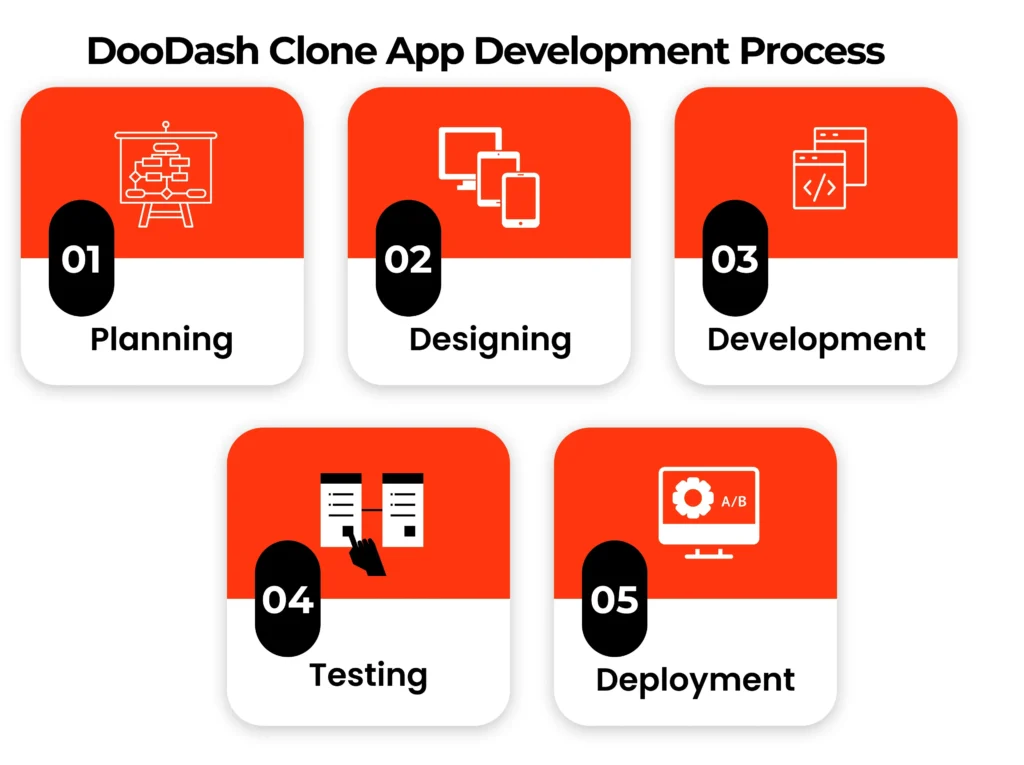
Let’s explore these steps in detail that are involved in the DoorDash clone app development process.
1. Planning
It is the first step in developing the DoorDash app clone. With planning and research, you have to understand your target audience, the latest market trends, competitor apps’ strengths/weaknesses, and more. Also, you have to identify what key features you should add to your DoorDash clone app.
2. Designing
After gathering all the information and deciding on the app features, select the app design phase. In this phase, you have to do these things:
- Create wireframes that represent the skeletal framework of your app.
- Develop interactive prototypes to help you visualize the basic structure of the website/mobile app.
- Design the visual app elements, which include buttons, icons, etc.
3. Development
This phase is the most time-consuming part of app development. In this phase, you have to write the actual code to implement the app functionality. Divide this step into three steps:
Frontend Development: In this phase, implement the user interface and user experience for both iOS and Android platforms.
Backend Development: Create servers to handle requests, work with the database, and app logic.
Integration: Integrate third-party services such as maps, payment gateways, etc.
4. Testing
After building the app, test it and remove all the bugs and errors. In this phase, use various testing techniques such as functional, security, usability, and performance testing to make the app free of bugs. Regular testing throughout the development lifecycle will help maintain a high standard of reliability and user satisfaction.
5. Deployment
Once the app testing is complete, start the deployment phase. This phase involves publishing the app to the Apple App Store and Google Play Store. In addition, after deployment, monitor the app for any issues and gather user feedback for future updates.
By following these steps, you can create a competitive DoorDash clone app that meets user needs and stands out in the market.
Tips to Reduce the Cost of Developing a Food App Like DoorDash
You know the cost and the factors that affect the app development cost of building a DoorDash clone app. Now, it is crucial to know the strategies that help you reduce the cost of app development.
Here are some effective strategies to help reduce the cost of developing a DoorDash clone app.
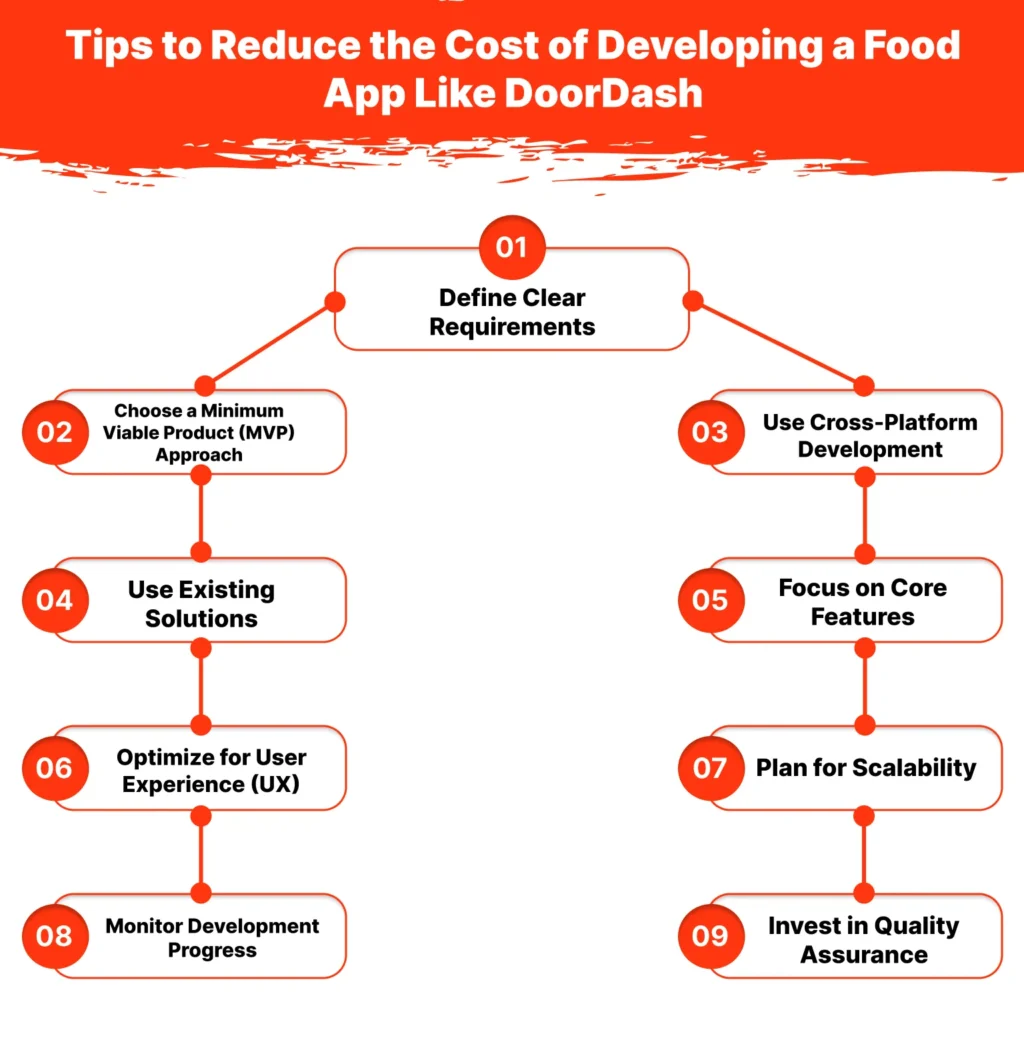
Define Clear Requirements
Outline your app’s features and functionalities in detail. This helps avoid scope creep and reduces the need for costly changes later.
Choose a Minimum Viable Product (MVP) Approach
Start with essential features that address the core problem. An MVP allows you to test the market with lower initial costs.
Use Cross-Platform Development
Opt for frameworks like React Native or Flutter to build apps for both iOS and Android simultaneously, reducing development time and cost.
Use Existing Solutions
Consider using ready-made templates or third-party services for features like payment processing, notifications, and maps, instead of building everything from scratch.
Focus on Core Features
Prioritize features that provide the most value to users. Avoid unnecessary features in the initial version.
Optimize for User Experience (UX)
Invest in good UX design from the start to minimize future redesign costs. A well-thought-out user interface can reduce user confusion and support costs.
Plan for Scalability
Design the app architecture to accommodate future growth. This prevents costs when you need to add new features later.
Monitor Development Progress
Regularly check in on the development process to ensure it stays on schedule and within budget.
Invest in Quality Assurance
Conduct thorough testing to catch bugs early. Fixing issues during development is usually cheaper than post-launch fixes.
FAQs
Below are the steps to help you build an app like DoorDash.
Do research
Select the business model
Identify the unique selling point
Select the app features
Choose the tech stack
Start app development
Testing and launch
Yes, DoorDash can be profitable by optimizing delivery logistics, expanding partnerships with restaurants, and increasing customer loyalty.
The cost to fully develop an app can range from $20,000 to $150,000+, depending on factors like complexity, features, platform, and developer location.
The most cost-effective approach is starting with a true MVP: one core ordering flow, one payment method, and manual (rather than automated) driver assignment in the early stage. This lets you validate demand before investing in real-time dispatch, subscription billing, or multi-vendor features.
No-code platforms can work for very simple ordering apps, but they typically can’t support the real-time logistics DoorDash-style platforms need at scale.
DoorDash generates revenue through several key channels, such as:
Delivery Fees: Customers pay a delivery fee for each order. This fee can vary based on factors like distance and restaurant popularity.
Service Fees: DoorDash charges service fees, which are usually a percentage of the order total. This fee helps cover operational costs.
Subscription Services: DoorDash offers a subscription service called DashPass, which provides customers with free delivery on eligible orders for a monthly fee.
Restaurant Partnerships: DoorDash partners with restaurants and charges them a commission on each order placed through the app.
Advertising: Restaurants can pay for advertising placements within the app to increase visibility and attract more customers.
Supercharge your deliveries with Enatega.
Register NowConclusion
Building a food delivery app like DoorDash is a golden opportunity to enter the on-demand food delivery market. Understanding its cost is also an important factor to consider when creating it. It’s an investment that can significantly shape the future of your business. Knowing the app development price helps you make informed decisions and allocate resources more efficiently.
If you're planning to build a food delivery platform, having a clear cost breakdown upfront makes the process far less stressful.
Enatega has worked on the Yalla food and grocery delivery platform project. Feel free to reach out if you'd like a tailored estimate for your specific idea.
About the author
Hudaibia Khalid is a senior content writer with several years of experience in creating clear and easy-to-understand content. Over the years, she has worked closely with startups, restaurants, and entrepreneurs, helping them simplify complex digital and technical topics into actionable insights.
Her expertise lies in writing about on-demand platforms, food delivery solutions, and business growth strategies in a way that is accessible even to non-technical readers. With her experience in the industry, she focuses on guiding businesses step by step, from understanding ideas to turning them into fully working solutions.
SHARE






 IOS
IOS Android
 Web
Web