


Instacart earns revenue primarily through transaction fees, Instacart+ memberships, advertising, retailer technology partnerships, and product markups.
This business model allows Instacart to earn revenue from multiple sides of the grocery system. It connects customers with retailers through its marketplace, helps retailers manage online grocery operations through its technology, and gives brands access to shoppers through its advertising platform.
In Q2 2026, Instacart generated $1.043 billion in total revenue from $10.351 billion in gross transaction value (GTV). Transaction revenue accounted for $746 million, while advertising and other revenue contributed $297 million.
Unlike a traditional grocery retailer, Instacart does not primarily make money by owning and selling grocery inventory. Instead, it connects customers with retail partners, coordinates order fulfillment through shoppers, and monetizes the transactions and customer demand flowing through its platform.
So, let’s take a closer look at how the Instacart business model works, where its revenue comes from, how its three-sided marketplace operates, and what businesses can learn from its approach when building a grocery delivery platform.
What is Instacart?
Instacart is a grocery technology and marketplace company that connects customers with retailers for online grocery shopping, delivery, and pickup across the United States and Canada.
The platform represents more than 2,200 retail banners and approximately 100,000 stores, giving customers access to products from local, regional, and national retailers. Instacart also works with approximately 600,000 shoppers who pick, pack, and deliver customer orders.
Customers can use Instacart to shop for groceries and other everyday products. Choose delivery or pickup where available, and communicate with shoppers about substitutions and order changes.
Instacart’s business now extends beyond its consumer marketplace. Through Instacart Enterprise, the company provides retailers with technology for ecommerce, fulfillment, in-store operations, advertising, and customer engagement.
Instacart also operates an advertising business that allows brands and retailers to promote products to shoppers using Instacart’s shopping platform and first-party transaction data.
| Category | Highlight |
| Founded | 2012 by Apoorva Mehta, Max Mullen, and Brandon Leonardo |
| Headquarters | San Francisco, California, USA |
| Service Area | United States and Canada |
| Retail Partners | 1,400+ retail banners |
| Shoppers | 600,000+ independent contractors |
| Revenue Streams | Delivery fees, service fees, Instacart+ membership, advertising, retailer partnerships, product markups |
| Competitors | Amazon Fresh, Walmart Grocery, Shipt, DoorDash, FreshDirect |
Supercharge your deliveries with Enatega.
Register NowInstacart Facts and Statistics
According to the Business of Apps report:
- Gross Transaction Value (GTV): Reached $37.2 billion in 2025, with projections estimating consumer spending on the platform to hit $42.0 billion in 2026.
- Net Income: Posted a net income of $447 million for the 2025 fiscal year and $144 million in Q1 2026.
According to Instacart:
- Revenue: Generated $3.74 billion in revenue for fiscal year 2025. Instacart has now posted over $1 billion in quarterly revenue for three consecutive quarters: $1.019 billion in Q1 2026 and $1.043 billion in Q2 2026, after first crossing that threshold in Q4 2025.
Instacart Funding History
Instacart has raised significant funding over the years to expand its grocery marketplace, grow its retailer network, and scale its technology.
Here are some of its major funding milestones.
| Funding Round | Date | Amount Raised | Valuation |
| Seed | October 2012 | $2.3 million | — |
| Series A | July 2013 | $8.5 million | — |
| Series B | June 2014 | $44 million | — |
| Series C | December 2014 | $100 million | $2 billion |
| Series D | February 2016 | Undisclosed | — |
| Series E | February 2018 | $200 million | — |
| Series F | December 2018 | $871 million | $7.9 billion |
| Series G | June 2020 | $225 million | $13.5 billion |
| Series G | July 2020 | $100 million | $13.7 billion |
| Series G | October 2020 | $200 million | $17.5 billion |
These funding rounds supported Instacart’s expansion and helped it build the technology and retailer partnerships behind its marketplace.
How Does the Instacart Business Model Work? A Step-by-Step Process
Here is how the model works.
| Step | What Happens | Business Role |
| 1. Customer places an order | Customers browse products from participating retailers and choose delivery or pickup. | Creates demand on the marketplace |
| 2. Retailer provides the products | Retailers make their catalogs available through Instacart and receive customer orders through the platform. | Supplies inventory and fulfills the retail side |
| 3. Shopper fulfills the order | A shopper or other third-party provider picks and packs the items. Customers can communicate with shoppers about substitutions or changes. | Handles order fulfillment |
| 4. Order is delivered or picked up | The completed order is delivered to the customer or prepared for pickup where available. | Completes the transaction |
| 5. Instacart monetizes the transaction | Instacart generates revenue through transaction-related revenue, memberships, advertising, and other services. | Monetizes marketplace activity |
| 6. Retail technology creates another revenue stream | Instacart also provides retailers with ecommerce, fulfillment, in-store technology, advertising, and AI solutions through its Enterprise platform. | Extends the business beyond consumer delivery |
How Does Instacart Make Money?
Instacart makes money through:
- Delivery fees
- Service fees
- Instacart+ memberships
- Retailer commissions
- Advertising
- Product markups
Delivery and Service Fees
Instacart can earn transaction revenue from fees associated with customer orders. Delivery and service fees vary based on factors such as:
- The retailer
- Order size
- Delivery window
- Location
- Customer has an Instacart+ membership
For eligible orders, standard same-day delivery fees can start at $3.99 for orders over $35, although the actual fee shown at checkout can vary.
Instacart+ members can receive $0 delivery fees on eligible orders of $10 or more per retailer, subject to applicable restrictions and exceptions. Customers may still pay service fees and other applicable charges.
The delivery fee is separate from the tip, which customers can choose to give to their shopper. The service fee also helps cover the costs of operating the Instacart platform and providing services related to the order.
Because Instacart’s pricing can change by market, retailer, order, and membership status, customers should check the final checkout screen for the exact fees on an order.
Instacart+ Membership
Instacart+ is Instacart’s paid membership program for customers who order regularly. Members pay a recurring monthly or annual fee in exchange for benefits such as $0 delivery fees on eligible orders and reduced service fees.
The current standard pricing is $9.99 per month or $99 per year, although promotional and partner pricing may vary.
With Instacart+, eligible grocery and retail orders of $10 or more per retailer can qualify for $0 delivery fees. Costco orders have a $35 minimum, and other fees, taxes, and tips may still apply. Service fees are also separate from delivery fees, although Instacart+ members receive reduced service fees.
Additional membership benefits can include partner offers and perks such as Peacock in the U.S. and a one-year New York Times Cooking subscription for eligible annual members. These benefits can change over time and may have separate eligibility requirements.
From a business-model perspective, Instacart+ gives Instacart a recurring revenue stream while encouraging customers to order more frequently. Customers who place multiple orders can potentially save on delivery fees, while Instacart benefits from greater customer retention and order frequency.
Partnerships with Retailers
Retailers are another important source of Instacart’s transaction revenue. Instead of relying on one standard commission rate, Instacart can charge retailers through different arrangements depending on the services they use.
These arrangements can include service fees, fulfillment fees, revenue-sharing agreements, and other transaction-related fees. The exact structure can vary by retailer and partnership.
Instacart also generates revenue by providing retailers with technology through Instacart Enterprise. These tools can support ecommerce, fulfillment, in-store operations, customer engagement, and other parts of a retailer’s digital shopping experience.
This gives Instacart two ways to earn from its retail relationships:
- Marketplace revenue: Fees and revenue-sharing arrangements connected to customer orders.
- Technology revenue: Fees for retail technology and services provided through Instacart Enterprise.
This retailer-focused model is important because Instacart is not only earning money when a customer places an order. It can also generate revenue by providing retailers with the technology and infrastructure they need to run and grow their online grocery business.
Advertising Revenue
Advertising is one of Instacart’s major revenue streams and has become an increasingly important part of its business.
In Q2 2026, Instacart generated $297 million in advertising and other revenue, up 16% year over year. For the full year 2025, the company generated more than $1 billion in advertising and other revenue.
Instacart earns advertising revenue by helping brands and retailers promote products to shoppers throughout the grocery shopping journey. Its advertising platform uses placements across search, browsing, product discovery, and other shopping experiences.
Instacart offers different advertising strategies to drive sales and help brands engage with customers. These are:
- Sponsored Products: Brands can promote specific products within the Instacart platform, increasing visibility and driving sales through targeted placements.
- Display Ads: These ads appear on various pages of the Instacart site, allowing brands to reach customers.
- Search Ads: Brands can bid on keywords to appear at the top of search results, ensuring their products are seen first by potential buyers.
- Promotions and Discounts: Brands can run special promotions, such as discounts or limited-time offers, to entice customers and boost sales.
- Brand Pages: Dedicated brand pages allow companies to showcase their products, tell their story, and engage directly with customers.
- Retargeting Ads: Instacart uses data to retarget users who have previously engaged with a brand, reminding them of products they may want to purchase.
Product Markup and Fees
Instacart may also earn revenue from product markups or additional fees on certain items. The fees can vary depending on the retailer.
Instacart applies a markup of 15% or more on the items sold through its platform. This markup contributes to Instacart’s revenue, which is then used to pay the customers. However, not all retailers on Instacart disclose this markup.
Some retailers, such as Whole Foods, collaborate with Instacart and ensure no markup is applied. Other retailers, like Costco, do impose a markup.
What Startups Can Learn From the Instacart Business Model
Instacart’s growth offers several useful lessons for startups planning to build a marketplace or delivery business.
1. Don’t Depend on One Revenue Stream
Instacart does not rely only on delivery fees. Its revenue comes from transactions, memberships, advertising, and retail technology. For a startup, having multiple revenue streams can reduce dependence on a single source of income.
2. Build Strong Partner Relationships
Retailers are a key part of Instacart’s marketplace. A delivery platform needs reliable businesses on the supply side to offer customers enough products and choices.
Startups should focus on building partnerships that create value for both the platform and its business partners.
3. Focus on Repeat Customers
Getting a customer to place one order is not enough. Long-term growth depends on encouraging customers to return. Memberships, personalized recommendations, convenient ordering, and reliable delivery can help improve customer retention.
4. Solve More Than One Problem
Instacart started with grocery delivery but expanded into advertising and retail technology. This shows that a startup can grow by solving related problems for the same system instead of constantly trying to enter completely different markets.
5. Use Technology to Scale
A delivery marketplace needs technology to manage customers, retailers, shoppers, orders, payments, and deliveries.
Building a scalable platform from the beginning can make it easier to support more users and business partners as the company grows.
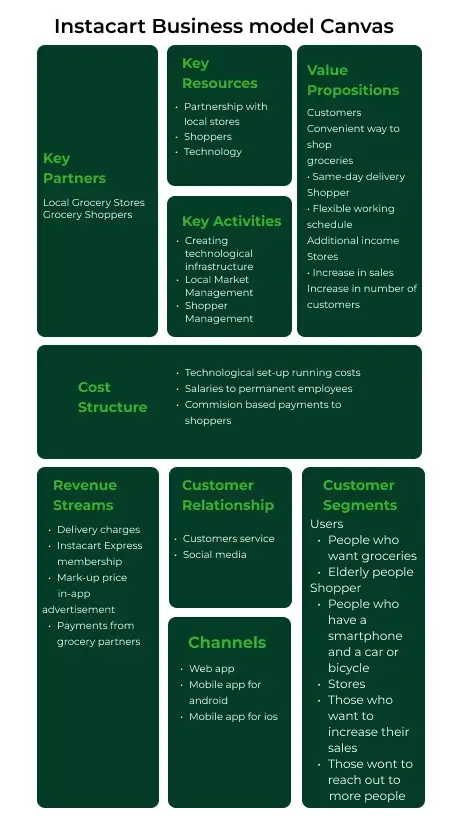
Instacart Business Model Canvas
Below is an Instacart business model canvas.
Features Behind the Instacart Business Model
Features can make the app successful and add unique value to it. It is an important thing that differentiates your app from your competitors. Therefore, always offer something distinct and valuable to your customers.
The following are the features that you should incorporate in the Instacart clone app.
| Customers | Retail Partners | Riders | Admin Dashboard |
| Sign Up | Sign Up | Registration | Payment management |
| Search and Filter | Order management | Route optimization | Commission management |
| Order cancellation | Inventory management | Chat/call with the customer | Reports and analytics |
| Delivery tracking | Product listing | Accept/Reject order | |
| Return and replacement | |||
| Contactless delivery |
Instacart Competitors’ Analysis
Instacart competes with different companies depending on which part of its business is being considered. Its competitors include:
- Grocery marketplaces
- Delivery platforms
- Retailers with their own digital storefronts
- Retail technology providers
- Advertising platforms
Instead of comparing Instacart with every food delivery app, it is more useful to look at the companies competing with Instacart across its main business areas.
Below is a comparison analysis of Instacart and its competitors.
| Competitor | Strengths | Weaknesses | Market Position |
| DoorDash | Large customer network, strong restaurant presence, and growing grocery and retail services | Faces strong competition and has less grocery specialization than Instacart | One of the leading food, grocery, and local delivery platforms in North America |
| Amazon Fresh | Backed by Amazon’s massive logistics, Prime integration, and wide product variety | Limited to Amazon Prime members in select areas; struggles with perishable delivery quality | Strong global brand, aggressive expansion in grocery delivery |
| Walmart Grocery | Huge store network, competitive pricing, curbside pickup, strong rural presence | Delivery speed is slower than Instacart in some regions; less flexible delivery windows | Leading U.S. grocery retailer with growing online adoption |
| Shipt (Target-owned) | Strong integration with Target, fast delivery, user-friendly app | Smaller retailer network compared to Instacart; limited geographic reach | Niche player but solid in Target-heavy regions |
| FreshDirect | Focused on high-quality fresh produce, a loyal customer base in the Northeast U.S. | Limited geographic reach; higher prices | Strong regional player but lacks Instacart’s national scale |
| Uber Eats (Grocery) | Uses a global delivery network, integrates food + grocery delivery in one app | Grocery delivery is not its core focus; the retailer network is weaker than Instacart | Secondary grocery option for Uber Eats users, growing steadily |
Instacart vs. DoorDash
DoorDash is one of Instacart’s closest competitors. Both platforms connect customers with retailers or merchants and delivery workers.
The main difference is their focus. DoorDash started with restaurant delivery and has expanded into grocery and other local services. Instacart has a stronger focus on grocery and has built its platform around grocery retailers and their needs.
Instacart vs. Walmart
Walmart competes with Instacart in online grocery shopping and delivery, but the two use different business models.
Instacart connects customers with many different retailers through its marketplace. Walmart sells its own products through its own stores and online platform.
This gives Walmart more control over its inventory, stores, and fulfillment. Instacart’s advantage is its large network of retail partners, which gives customers more choices in one marketplace.
Instacart vs. Amazon
Amazon competes with Instacart in grocery, ecommerce, delivery, and advertising.
The biggest difference is that Amazon operates its own ecommerce marketplace, retail businesses, and fulfillment network. Instacart mainly works with existing grocery retailers and provides them with technology for online shopping, fulfillment, and other digital services.
Instacart vs. Shipt
Shipt is another direct competitor in grocery delivery and same-day fulfillment. Its connection with Target also gives it access to a large retail network.
Instacart’s main advantage is the size of its retailer network. Instacart works with more than 2,200 retail banners, giving customers access to products from a wide range of retailers through one platform.
Instacart Challenges
Instacart’s business model has driven rapid growth. However, it also faces several challenges, such as:
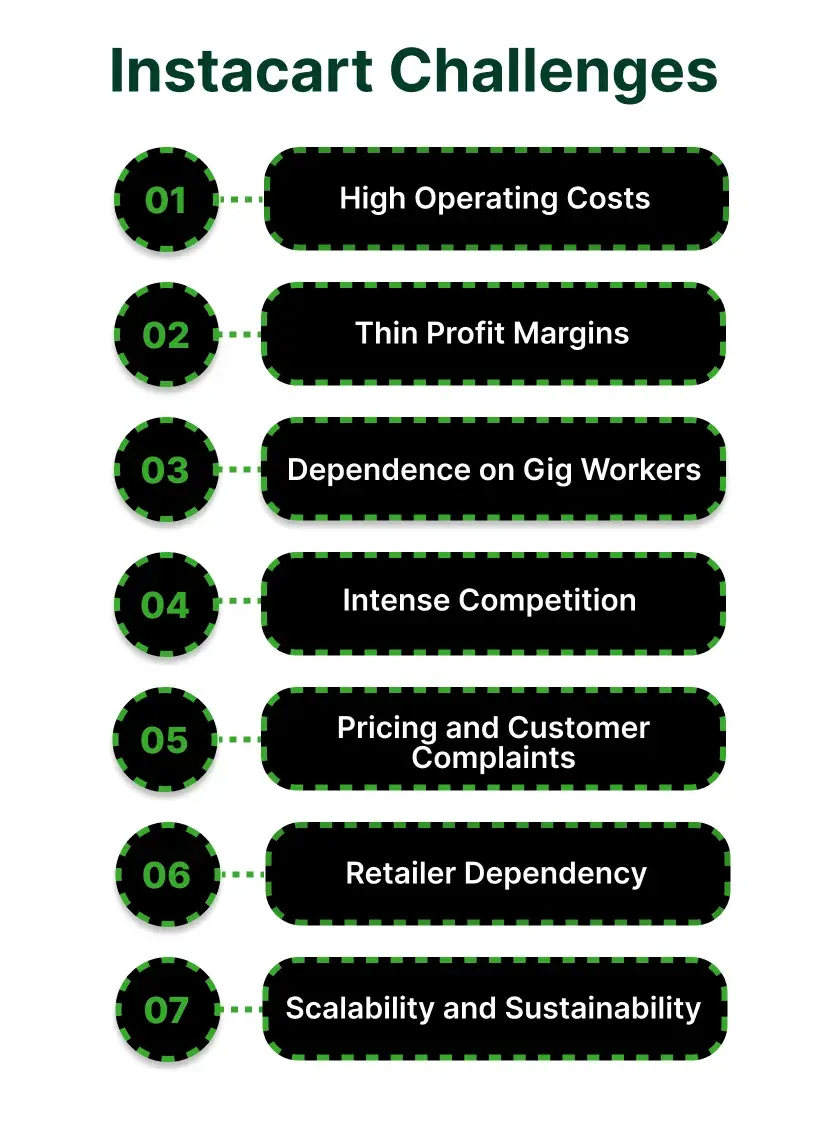
High Operating Costs
- Managing logistics, delivery fleets, and order fulfillment is expensive.
- Even with multiple revenue streams, rising fuel costs, labor expenses, and technology upgrades put pressure on margins.
Thin Profit Margins
- Grocery delivery has low profit margins compared to other industries.
- Heavy reliance on promotions, discounts, and competitive pricing makes it difficult to maintain consistent profitability.
Dependence on Gig Workers
- Instacart relies heavily on independent contractors (shoppers).
- Issues like worker dissatisfaction, legal disputes over classification, and fluctuating labor availability can disrupt operations.
Intense Competition
- Competitors like Amazon Fresh, Walmart Grocery, DoorDash, and Shipt are aggressively expanding.
- These companies often have stronger logistics networks and larger customer bases.
Pricing and Customer Complaints
- Markups on certain products (sometimes 15–25%) and service fees make Instacart more expensive than in-store shopping.
- Many customers complain about hidden costs and varying produce quality due to the shopper’s selection.
Retailer Dependency
- Instacart doesn’t own inventory; it relies on partnerships with retailers.
- If a major retailer ends its partnership (like Whole Foods did after Amazon’s acquisition), it poses a big risk to Instacart’s model.
Scalability and Sustainability
- Scaling beyond urban areas is difficult due to lower-order volumes in rural markets.
- Ensuring fast delivery across all geographies is a constant logistical challenge.
FAQs
To start a grocery delivery business like Instacart:
Choose your target market
Define your revenue model
Partner with local retailers
Set up the customer, vendor, and delivery operations
You’ll also need a mobile app, admin dashboard, payment system, and delivery management tools. Starting with one city can help you test demand before expanding.
Building an app like Instacart can cost around $50,000 to $250,000+ for a custom platform, depending on its features, integrations, and level of customization.
A white-label or ready-made solution can reduce the initial cost significantly. The final cost also depends on whether you need separate customer, vendor, rider, and admin applications.
Instacart is successful for these reasons:
User-friendly platform that offers convenience and time savings for customers
Partnerships with major grocery chains
Wide selection of options
Fast delivery
Instacart’s main competitors include Amazon Fresh, Walmart Grocery, Shipt, FreshDirect, and DoorDash. These services also offer grocery delivery and pickup options, competing for market share in the online grocery sector.
Instacart is the free-to-use marketplace; anyone can place an order without signing up for anything extra. Instacart+ is the optional $9.99/month (or $99/year) subscription layered on top, which removes delivery fees on qualifying orders and lowers service fees.
Instacart depends on retail partners because it does not own the grocery inventory, so losing major partners could affect its business. It also relies on independent-contractor shoppers, making labor laws and worker classification an ongoing challenge.
In addition, high delivery and operating costs can put pressure on marketplace profitability. Strong competition from companies like Amazon, Walmart, and DoorDash adds further pressure.
For grocery orders, Instacart may be cheaper in some cases because it is built mainly around grocery shopping and delivery. DoorDash started with restaurant delivery, although it now also offers groceries and other retail products.
For other items, such as convenience and retail products, prices can be more similar. The final cost depends on the order, delivery and service fees, item prices, and whether you have Instacart+ or DashPass.
So, there is no single cheaper option. Compare the final checkout price for your specific order to see which one costs less.
Supercharge your deliveries with Enatega.
Register NowConclusion
Instacart's business model is built around more than grocery delivery. It connects customers, retailers, shoppers, and brands through one technology platform and makes money from transaction revenue, memberships, advertising, and retail technology.
Its biggest strength is the combination of these revenue streams. Instacart can earn from customer orders while also helping retailers with ecommerce and fulfillment and helping brands reach shoppers through advertising.
For businesses planning to build a grocery delivery platform, Instacart shows the value of creating a model that can serve multiple sides of the market and generate revenue from more than one source.
About the author

Hudaibia Khalid is a senior content writer with several years of experience in creating clear and easy-to-understand content. Over the years, she has worked closely with startups, restaurants, and entrepreneurs, helping them simplify complex digital and technical topics into actionable insights.
Her expertise lies in writing about on-demand platforms, food delivery solutions, and business growth strategies in a way that is accessible even to non-technical readers. With her experience in the industry, she focuses on guiding businesses step by step, from understanding ideas to turning them into fully working solutions.
SHARE






 IOS
IOS Android
 Web
Web