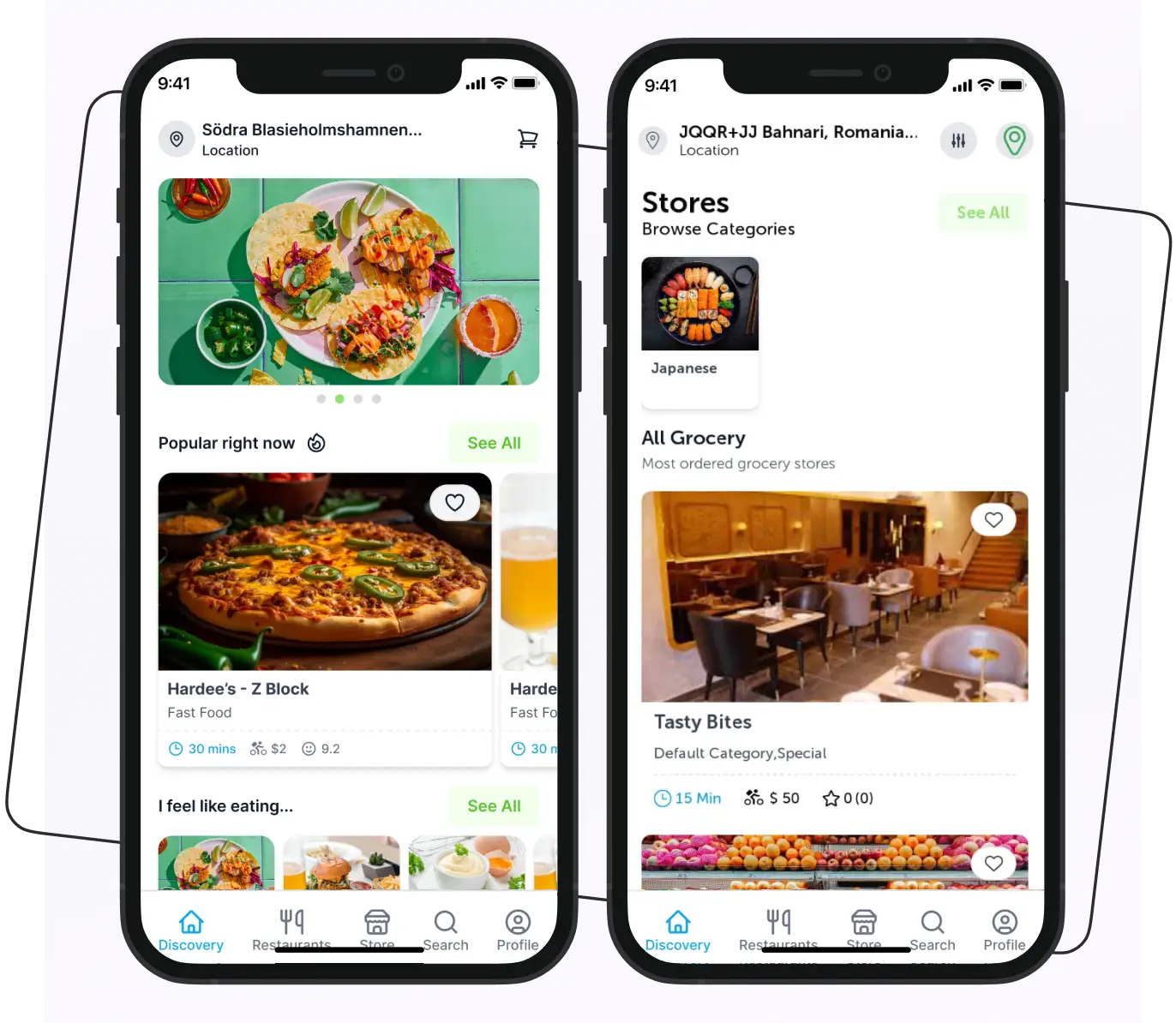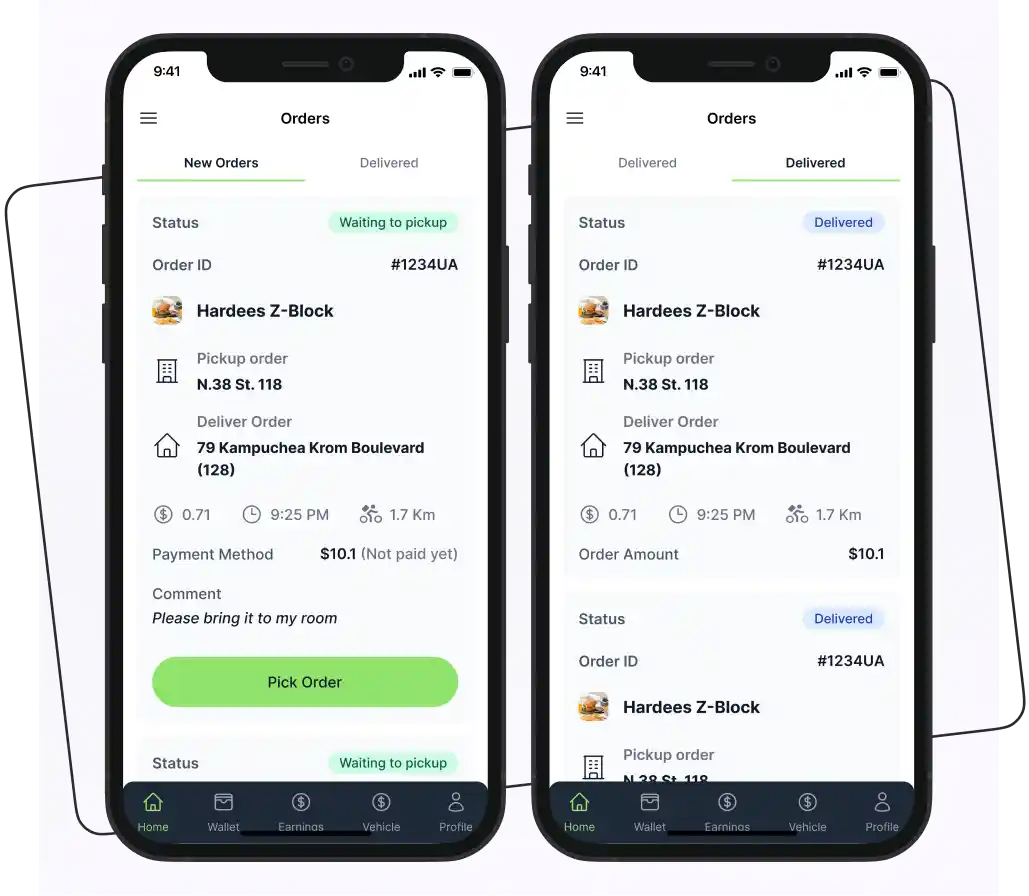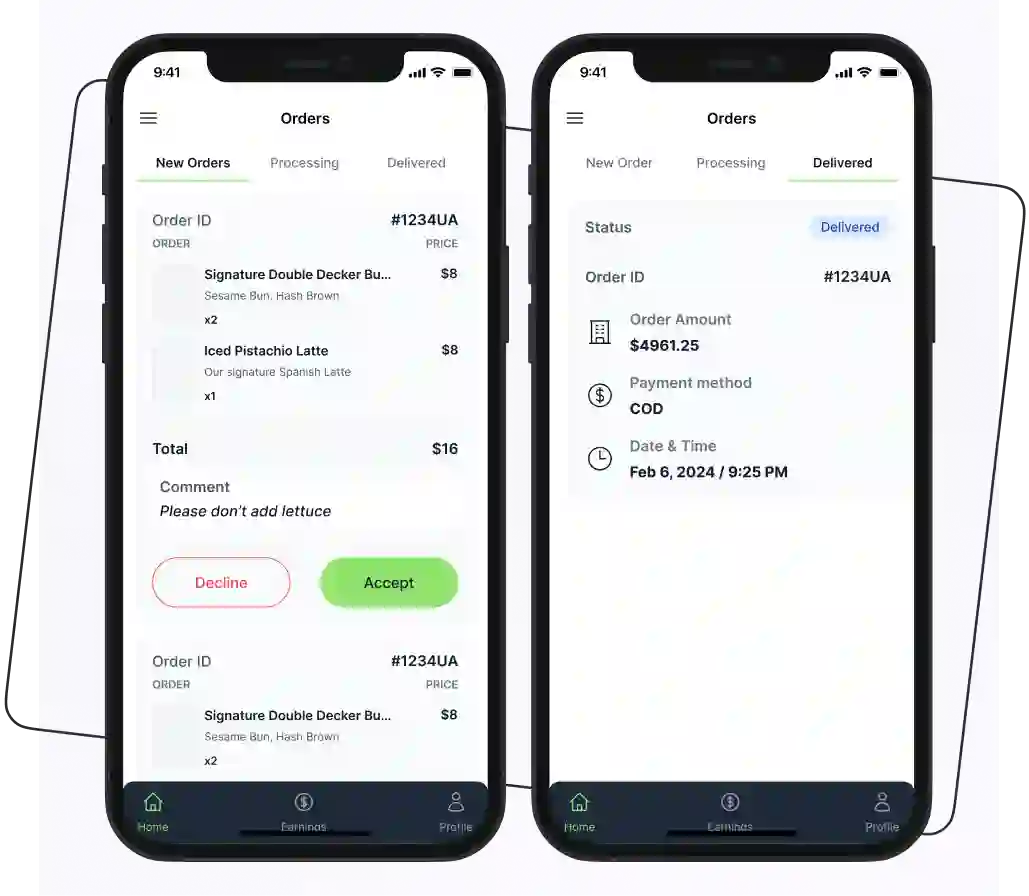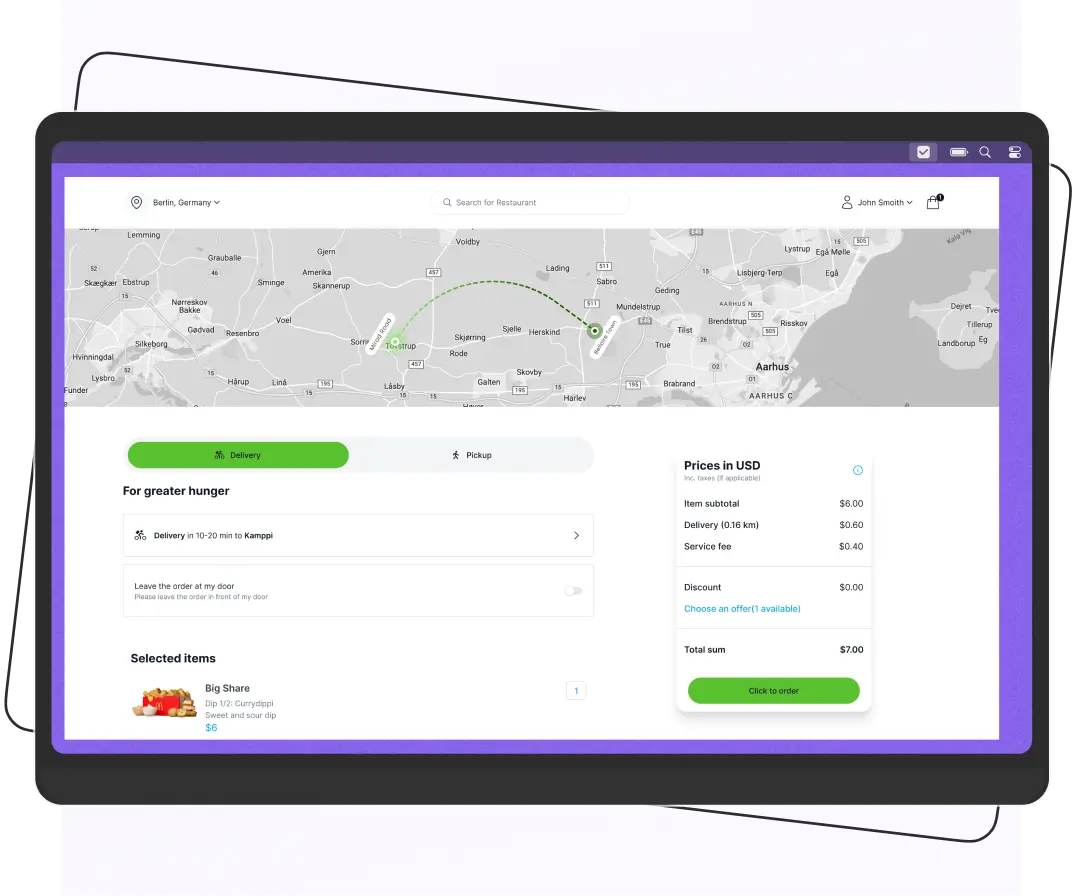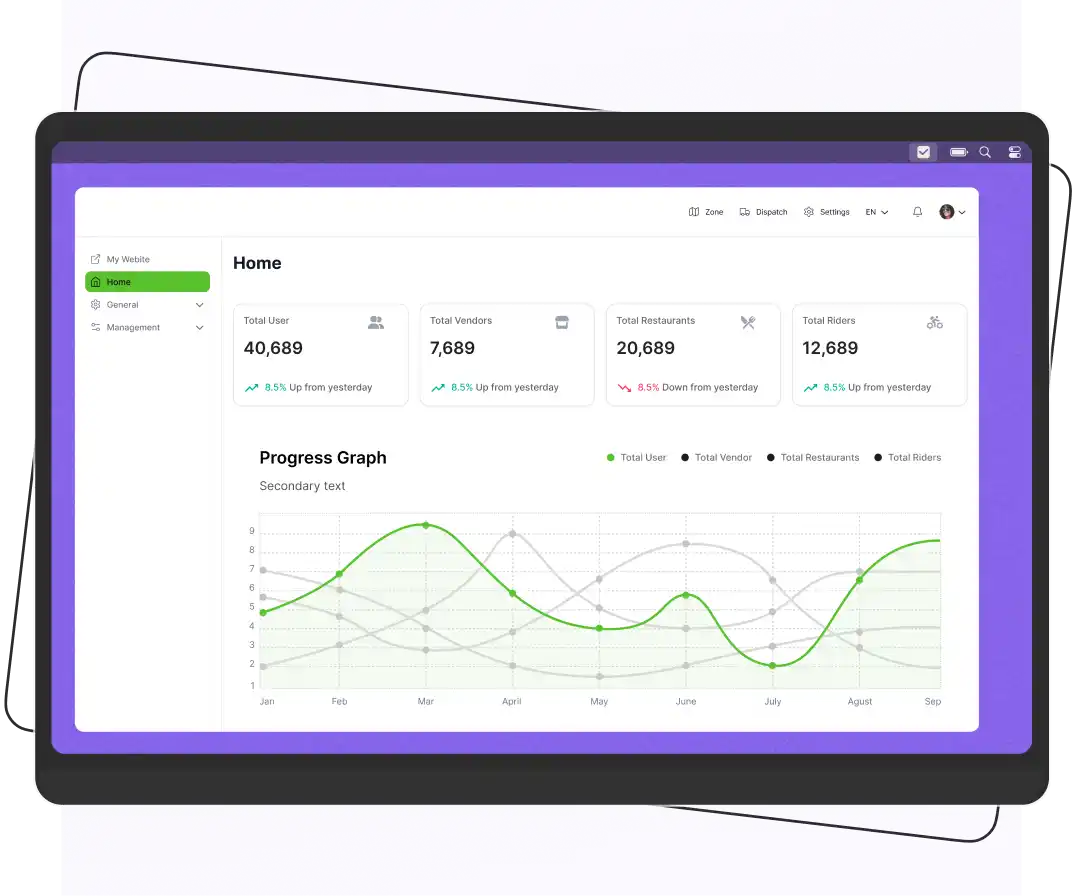



Ready to take your restaurant online and increase your sales in 2025?
Did you know that nearly 60% of consumers in the USA prefer to order food online rather than dine in? As the demand for convenience grows, restaurants must adapt to this digital shift to stay competitive. Whether you’re a seasoned restaurateur or just starting, choosing the right food ordering systems For restaurants can be a game-changer for your business.
In this blog, we’ll explore the top 8 food ordering systems for 2025. We’ll look at their best features, benefits, and why they are important for modern restaurants. Whether you need real-time order tracking, custom branding, or detailed analytics, the right platform can change how you serve your customers.
What is the Food Ordering System?
The food ordering system is a digital solution that allows customers to place orders directly from the restaurant website or app. It helps restaurants manage their tasks easily and without difficulty.
Investing in online food delivery management software is the main factor in your restaurant’s success and growth.
The food ordering software’s main purpose is to:
- Allow customers to browse digital menus
- Accept and manage orders online
- Allow customers to order food and get it delivered to their doorstep
- Help restaurants make informed decisions
Restaurant Online Ordering Stats
- According to Statista, revenue in the online food delivery market is projected to reach US$1.40tn in 2025.
- Since 2014, online food ordering has grown 300% faster than dine-in services.
- According to Statista, the number of users in the online food delivery industry is expected to reach 2,656 million by 2026.
- 51 percent of Americans felt comfortable ordering for pick-up during the pandemic.
Types of Food Ordering Systems for Restaurants
There are several types of food ordering systems used by restaurants, each catering to different service styles and customer preferences.
Here are some common types.
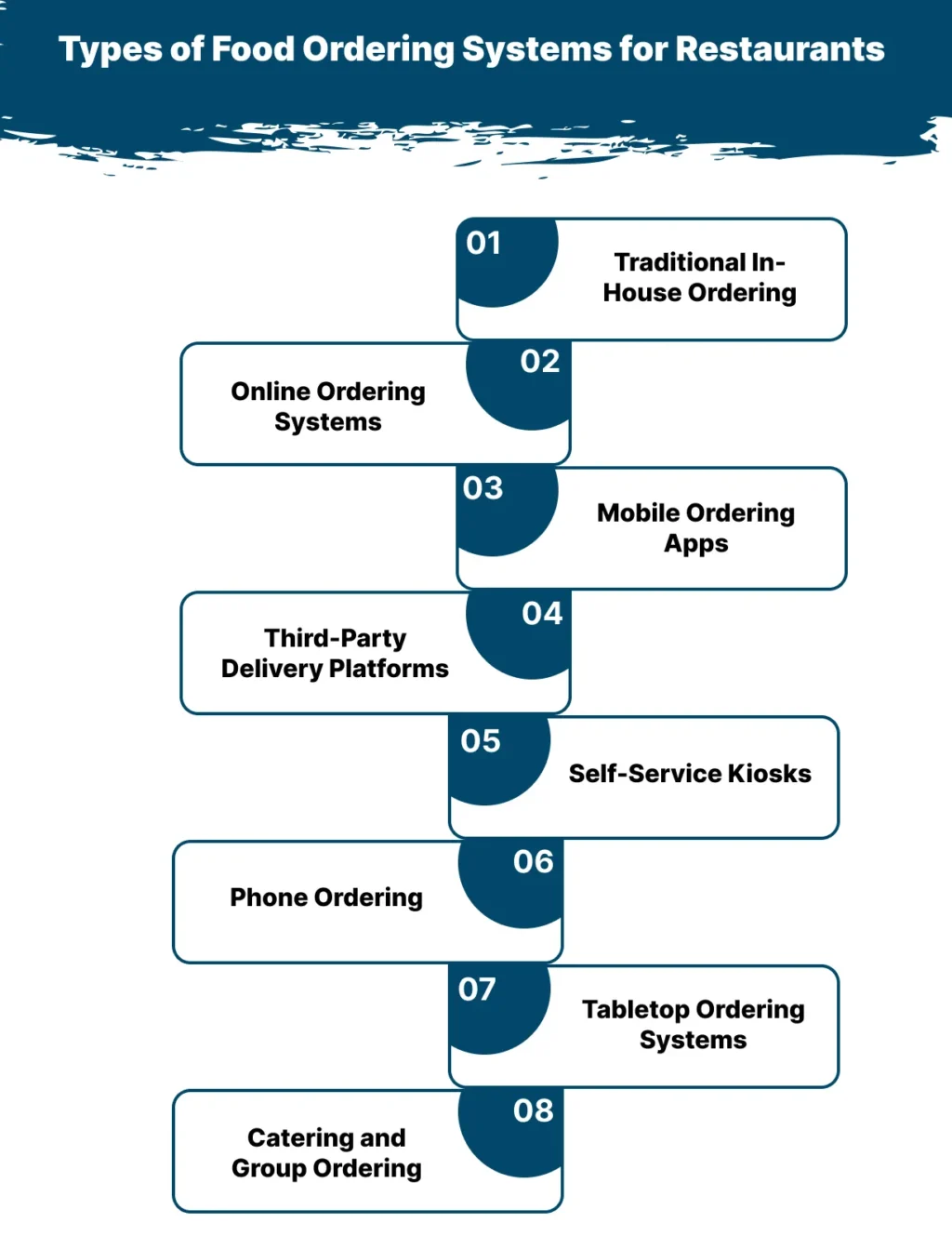
Traditional In-House Ordering: Customers place orders directly with waitstaff at the restaurant.
Online Ordering Systems: Customers place orders through a restaurant’s website or app.
Mobile Ordering Apps: Standalone apps that allow users to order food from their smartphones.
Third-Party Delivery Platforms: Services like Uber Eats, DoorDash, or Grubhub that facilitate online ordering and delivery from multiple restaurants.
Self-Service Kiosks: Customers place orders via touch-screen kiosks in the restaurant.
Phone Ordering: Customers call the restaurant to place their orders.
Tabletop Ordering Systems: Tablets placed at tables for customers to browse the menu and place orders.
Catering and Group Ordering: Systems specifically designed for large orders, often for events.
In-House Ordering Platform Vs. Third-Party Ordering Platform: Which is Right for You?
The table below shows the differences between the in-house and third-party ordering platforms.
| Feature/Aspect | In-House Ordering Platform | Third-Party Ordering Platform |
| Ownership | Owned and controlled by the business | Owned by a third-party service provider |
| Customization | Highly customizable to specific business needs | Limited customization; depends on the platform |
| Branding | Full control over branding and user experience | Branding is controlled by a third party |
| Cost Structure | Higher initial development costs; lower long-term fees | Lower initial costs; commission fees per order |
| Integration | Can be tailored to integrate with existing systems | May have predefined integrations; less flexibility |
| User Data Control | Full control over customer data | Data often owned by a third-party, may limit access |
| Scalability | Scalable but requires ongoing investment | Easier to scale with existing infrastructure |
| Maintenance | Requires in-house technical support and resources | Maintenance is handled by a third party |
| Speed of Launch | Longer time to develop and implement | Quick to launch; often within days |
| Support | In-house support can be tailored to business needs | Support provided by a third-party may vary in quality |
| Payment Processing | Full control over payment systems and fees | Payment processing fees apply; they may vary by platform |
| Marketing and Promotion | Full control over marketing strategies | Dependent on third-party marketing efforts |
| Flexibility | High flexibility to adapt features as needed | Limited flexibility; changes depend on the provider |
What is The Best Online Ordering System For Restaurants?
Food ordering systems have revolutionized how restaurants operate and cater to customer needs. Explore some of the best online food ordering platforms that transform the restaurant experience.
| Features | Enatega | Grubhub | UberEats | Delivery | DoorDash | GloriaFood | MenuDrive | Flipdish |
| Single-vendor support | Yes | No | No | No | No | Yes | Yes | Yes |
| Multi-vendor support | Yes | Yes | Yes | Yes | Yes | No | No | No |
| Role-based access | Yes | No | No | No | No | No | No | No |
| Multi-language support | Yes | No | No | No | No | Yes | No | Yes |
| Tipping option | Yes | Yes | Yes | No | Yes | No | No | No |
| Real-time order tracking | Yes | Yes | Yes | Yes | Yes | Yes | No | Yes |
| User-friendly interface | Yes | Yes | Yes | Yes | Yes | Yes | Yes | Yes |
| Marketing/promotional plan | No | No | No | No | No | No | No | Yes |
| Integrations with POS | Yes | Yes | Yes | Yes | Yes | No | Yes | Yes |
| Customization options | High | Medium | Medium | Medium | Medium | Medium | High | High |
| Pricing | Varies | Varies | Varies | Varies | Varies | Affordable | Affordable | Affordable |
1. Enatega
Best for
- Single or multi-vendor restaurants
- Cloud kitchens
- Restaurants want full control over branding and tech
Enatega is a popular restaurant food ordering system that provides food delivery services to customers. From order management to real-time tracking, all your delivery needs are covered. The Enatega app lets customers easily order food, browse menus, and enjoy a seamless dining experience.
Features
- Ratings and reviews
- In-app chat
- Advanced search functionality
- Analytics and reporting
- Pick-up and delivery options
- Push notifications
- Order history
Pros
- One-time payment, no hidden charges
- Role-based access
- Multi-language support
- Tipping option management
- Real-time order receiving updates
- User-friendly interface
Cons
- The marketing and promotional plan is not included
- Training is required to run the ordering system
Enatega Pricing for Restaurants
Enatega offers three flexible pricing plans, which include:
1. Budget-friendly plan (Perfect for startups and small businesses looking for a powerful yet affordable solution)
- Full source code
- Unlimited users and listings
- Customer app, rider app, store app, admin panel, and website
- Complete control over deployment and modification
2. Feature-rich delivery suite (Ideal for growing businesses looking for advanced features, scalability, and long-term value)
- Lifetime access to all future updates
- Openly Available Documentation and Tutorials
- Includes Customer app, rider app, admin panel, and website
- Free 2-hour technical consultation with Enatega developers
3. Custom plan – tailored for you (Best for enterprises that need advanced features and deployment support)
- Full source code
- Custom Pricing (Installments available – Pay only for deployment and modifications upfront)
- Feature integration tailored to your business needs
- Full system modification as per your requirements
- Continuous collaboration with Enatega developers
- Advanced support and personalized technical guidance
Supercharge your deliveries with Enatega.
Register Now2. Grubhub

Best for
- Small to mid-sized restaurants
- Restaurants looking to expand reach quickly with minimal setup
Grubhub is a well-known name in the online food ordering apps. It helps customers connect with local restaurants. Grubhub works with 375,000 merchants in over 4,000 U.S. cities.
In addition, Grubhub, the online food ordering service, has used the latest technology and tools to grow its business and reach new diners.
Features
- Order management
- Order tracking
- Online payments
- Alerts/notifications
Pros
- Great customer service
- A wide variety of restaurants are available
- Easy-to-use app/website
- The menu is well-displayed
- Store customer information for quick ordering
Cons
- Restaurants do not have full control over customers’ user experience
- Sometimes delayed deliveries
- Restaurants become dependent on the platform
Grubhub Pricing for Restaurants
Grubhub offers flexible pricing plans for restaurants, with marketing commission rates ranging from 5% to 20% per order, depending on the selected package. In addition to the marketing commission, restaurants may incur the following fees:
Delivery Fee: If using Grubhub’s delivery services, there’s a 10% delivery commission per order.
Order Processing Fee: This fee covers credit card processing and fraud monitoring; specific rates may vary.
3. Uber Eats
Best for
- Restaurants in urban areas
- Fast food chains and franchises
- Restaurants prioritizing speed and audience reach
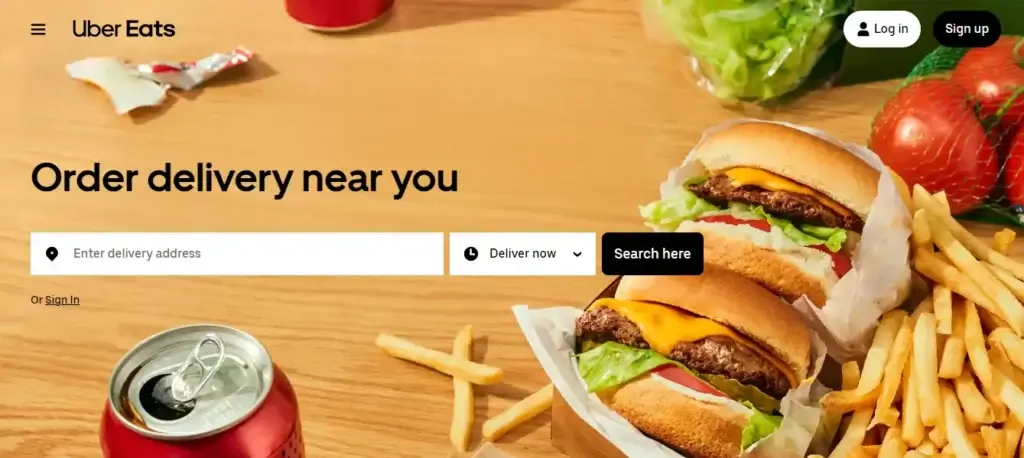
Uber Eats is another one of the best food ordering systems for restaurants. It is available in over 6,000 cities across 45 countries and serves millions of customers monthly.
Uber Eats uses AI assistants to help customers plan meals, discover new dishes, quickly order ingredients for their favorite recipes, and find sales on grocery items.
Restaurants can easily partner with Uber Eats to reach a broader audience. Also, they benefit from the platform’s extensive delivery network.
Features
- Customizable restaurant menu
- Marketing and promotional tools
- Flexible pricing and commission structure
Pros
- Get a notification when the rider delivers the food
- Extremely flexible
- Bank verification
Cons
- Customer support issues
- Technical problems in the app
- Restaurants may face challenges in maintaining the quality of their food during the delivery process
Uber Eats Pricing for Restaurants
Uber Eats offers several pricing plans for restaurants, each tailored to different business needs:
Uber Eats offers several pricing plans for restaurants, each tailored to different business needs:
- Lite Plan
- Delivery Orders: 15% fee
- Pickup Orders: 6% fee
- Plus Plan
- Delivery Orders: 25% fee
- Pickup Orders: 6% fee
- Premium Plan
- Delivery Orders: 30% fee
- Pickup Orders: 6% fee
- Self-Delivery Option
- Delivery Orders: 15% fee
- Pickup Orders: 6% fee
Additionally, there’s an order processing fee of 2.5% + $0.29 per transaction.
4. Delivery.com

Best for
- Restaurants + alcohol/grocery businesses
- Businesses targeting group orders
Delivery.com is an online ordering platform that helps restaurants manage menus and orders. From the Delivery.com platform, customers can order food from restaurants and groceries from their preferred grocery stores. This cloud-based solution is easy to use and allows group orders.
Features
- Kitchen/menu management
- Multi-channel marketing
- Reporting and statistics
Pros
- Email notifications
- Excellent customer service
- Ease of use
- Free app
- No hidden fees
Cons
- Commission fees
- Restaurants have less control over the customer experience
Delivery.com Pricing for Restaurants
Businesses partnering with Delivery.com incur a 15% commission fee per order, along with a credit card processing fee of 2.75% plus $0.25 per transaction.
5. DoorDash
Best for
- National chains and large restaurant groups
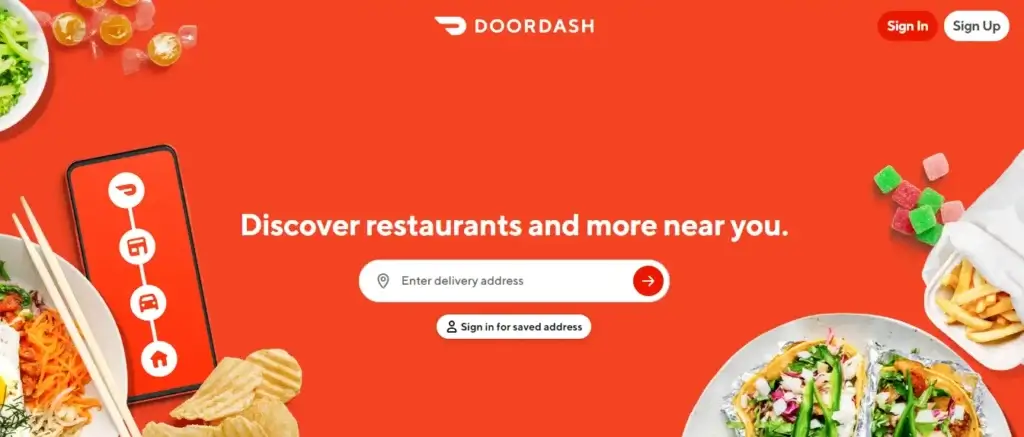
Several DoorDash alternatives are available. However, DoorDash is considered to be the best online food ordering and delivery platform in the United States.
The company partners with several restaurants which allows you to reach a broader customer base. Its easy-to-use interface and broad network enable customers to browse menus, place orders, and track their deliveries.
In 2015, DoorDash partnered with remarkable restaurant chains, like KFC and Taco Bell, to increase its restaurant network and improve its brand visibility.
DoorDash operates under an on-demand business model and provides various features to its customers. This includes users who can pay through different payment methods, giving exclusive deals to its users, providing subscription services, and more.
Features
- Inventory tracking
- Reporting/analytics
- Inventory management
- Customer history
Pros
- Smooth operations
- Easy customization
- Integrate with existing systems
- Affordable pricing
Cons
- High commission charged by delivery services
- Dependent on third-party delivery drivers
- Limited customization options
DoorDash Pricing for Restaurants
DoorDash offers various pricing plans for merchants, each designed to cater to different business needs:
Basic Plan
- Commission: 15% per delivery order after a 7-day free trial.
- Features: Access to DoorDash’s customer base, online ordering, and delivery services.
Plus Plan
- Commission: 25% per delivery order after a 30-day free trial.
- Features: All Basic Plan features plus access to DashPass customers (who enjoy $0 delivery fees and reduced service fees), extended delivery range, and marketing tools.
Premier Plan
- Commission: 30% per delivery order after a 30-day free trial.
- Features: All Plus Plan features, with added benefits like a “Growth Guarantee” (refund of commission costs if at least 20 orders are accepted in a month) and priority customer support.
6. GloriaFood
Best for
- Small local restaurants and cafes
- Restaurants with limited budgets
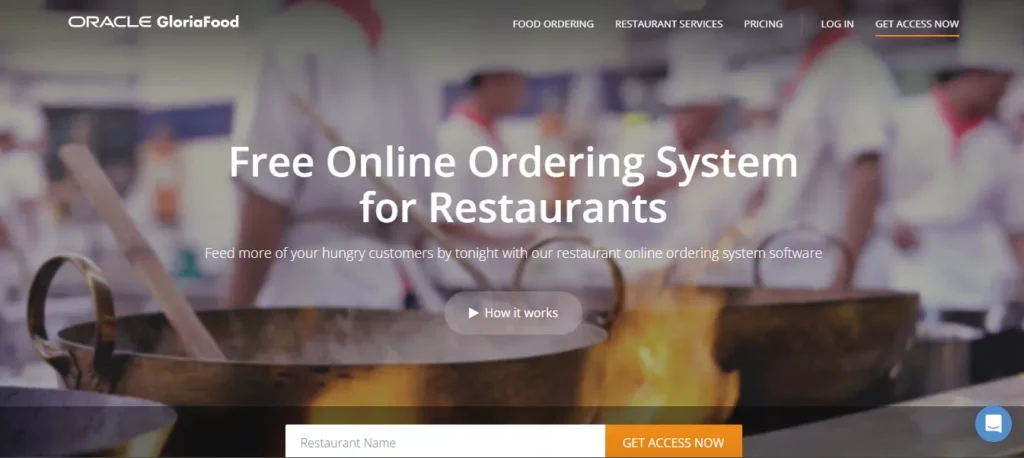
GloriaFood has gained popularity in food delivery services. It is a cloud-based online restaurant food ordering system that provides a variety of online ordering options to customers.
This online food ordering system provides various features, which include:
- Order tracking
- Ordering statistics with heatmaps and client database exports
- Online payment processing
- Automated printing of kitchen tickets
- Multiple payment options
- User-friendly admin dashboard
Features
- Powerful analytics
- Reservation management
- Multi-location management
- POS integration
Pros
- Quick setup
- Promotions and coupons support
- Available for Android & iOS smartphones or tablets
- Customization
Cons
- Offer limited marketing and promotional opportunities
- Minor technical issues in the app
- Limited features and customization
GloriaFood Pricing for Restaurants
GloriaFood offers a free online ordering system for restaurants, enabling unlimited orders and locations without commissions or monthly fees. Optional premium features are available at the following rates:
- Sales Optimized Website: $9 per month
- Promotional Marketing: $19 per month
- Online Payment Processing: $29 per month
- Branded Mobile Apps: $59 per month
7. MenuDrive
Best for
- Restaurants focused on branding and customer loyalty
- Family-run or themed restaurants
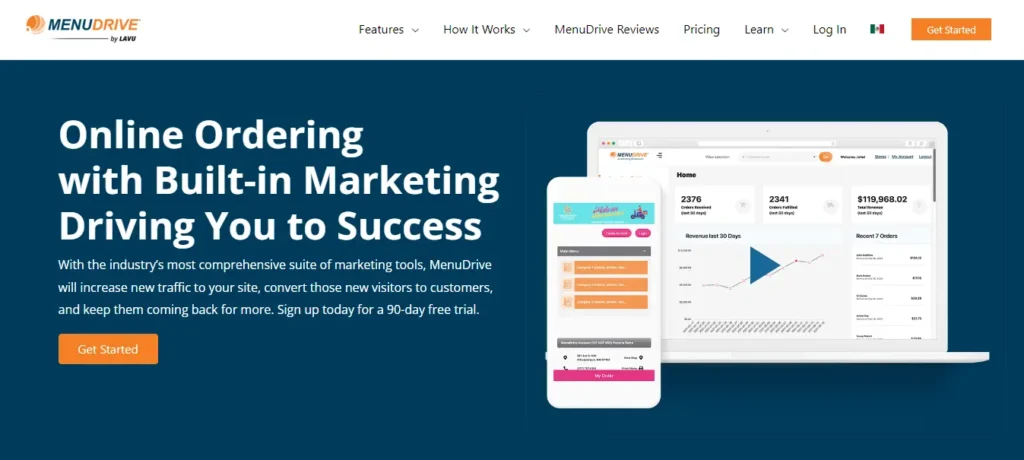
MenuDrive is a customizable online food delivery management system for restaurants. This platform allows restaurants to convert their menus into interactive websites, add featured food photos for more visual appeal, etc.
MenuDrive also provides retention features like promotions, loyalty, and coupons. Therefore, you can attract customers to revisit your store.
Features
- Multi-location management
- Customizable branding
- Marketing tools
- POS integration
Pros
- 100+ customizable restaurant website templates
- Set up online payments in minutes
- Marketing tools
- Automation emails
Cons
- The tips management feature is not included.
- Multi-location is not added.
- The table management feature is missing.
MenuDrive Pricing for Restaurants
Here is the pricing structure of MenuDrive.
| Plan | Monthly Cost | Setup Fee | Features |
| Restaurant Plan | $149 | $149 | Unlimited online orders, menu management, branding, and marketing tools. |
| Basic Plan | $89 | None | Basic online ordering features. |
| Premium Plan | $149 | None | Advanced features, including marketing and branding tools. |
| Annual Subscription | $891 (one-time) | None | Special deal for a one-year plan, averaging $74 per month. |
8. Flipdish

Best for
- Modern, tech-forward restaurants
- Chains and franchises building custom apps/websites
Flipdish is a famous online food ordering and delivery platform that helps restaurants create their food delivery app or website. With Flipdish, customers can order food online and pay for pickup or delivery from the restaurant.
Moreover, Flipdish helps to track and improve business performance with insights and reporting. This added convenience and helped restaurant owners build long-term, profitable customer relationships.
Features
- Restaurant marketing
- Kitchen display system
- Labor cost reporting
- Promotions management
- Sales tax management
- Stock management
- Table management
Pros
- Customer database management
- Retention campaigns
- Managed marketing
- Real-time analytics
- Customization branding
Cons
- Delayed software updates
- Errors not explained at checkout make it hard for customers to understand where they went wrong
Flipdish Pricing for Restaurants
Look at the table below and understand the Flipdish pricing plans.
| Plan | Monthly Price (Billed Annually) | Monthly Price (Billed Monthly) |
| Website | $119 | $149 |
| Website and Mobile App | $199 | $249 |
| Self-Service Kiosk | $79 | $99 |
Flipdish charges a fee of 7% of order fees (scaled depending on volume) plus a 2.5% card processing fee.
Why Do Restaurants Need Online Food Ordering Systems?
Nowadays, restaurant owners want to stay competitive by using technology. With the increased demand for food delivery services and convenience, restaurateurs prefer online food ordering systems.
If you’re on the fence about establishing an online food ordering system for your restaurant like a Foodpanda clone, consider these benefits:

Easy Online Order Management
A restaurant food ordering system helps to accept incoming orders easily without any mistakes. It simplifies the order-taking process and minimizes errors that can occur with traditional methods of taking orders. Plus, it also improves customer satisfaction and order accuracy.
Save Money
Online food ordering platforms can reduce labor costs and eliminate the need for third-party delivery services. This cost-saving can significantly impact your profit margins, and you can easily reinvest in other business areas.
Own Your Customer Data
With a food ordering system online, restaurateurs can easily maintain all their clients’ information in a single place. This information can help them create marketing campaigns and promotions, assist in making smarter business decisions, offer deals and discounts to customers, and more.
Increase Revenue
Food ordering systems for restaurants can help increase revenue and make it easier for customers to order and pay quickly. With the best online ordering platforms, you can reach many customers and drive revenue growth.
Order Tracking
Restaurants can easily track orders with an online food ordering system. With order tracking, restaurants can provide customers with a seamless dining experience and ensure that all orders are fulfilled on time. It helps restaurants to make informed inventory, monitor customer preferences, and make staffing decisions.
Easier Menu Management
With a food ordering platform, restaurants can manage their menu. They can easily add new items and modify the existing ones. Web-based food ordering systems make complex interactive menus easier. Restaurants can add photos, descriptions, ingredients, nutritional information, and special offers.
Advantages and Disadvantages of an Online Food Ordering System
Online food ordering systems offer numerous advantages that greatly benefit your business, but also have some disadvantages. Let’s discuss both so you know them before using them for your business.
| Advantages of an Online Food Ordering System | |
| Advantages | Description |
| Efficiency | It is one of the main advantages of online food ordering systems for restaurants. It streamlines the ordering process and saves customers and restaurant staff time. |
| Provide Personalized Experience | Allow restaurants to provide a better experience by offering personalized recommendations, promotions, and more. |
| Stay Ahead of the Competition | Online food ordering platforms can help you stay ahead of the competition. With a user-friendly and efficient mobile ordering app, you can attract more customers and place your restaurant at the top. |
| 27/7 Available | With the food ordering system online, restaurants are available round the clock to allow customers to place orders at any time from anywhere. |
| Reduce Human Errors | The online ordering platform minimizes human errors and eliminates the need for manual entry. |
| Disadvantages of an Online Food Ordering System | |
| Disadvantages | Description |
| Revenue Conflicts | Sometimes, a conflict occurs between restaurant owners and delivery providers regarding payments. |
| Security Concern | The customer’s sensitive information, such as payment details, raises cybersecurity concerns. Therefore, restaurants can invest in security measures to protect customer data. |
| Training of Staff | When new technology is used, you should train your staff. Therefore, the chances of errors are less. |
| Depending on Ratings and Reviews | Ratings and reviews of customers can influence online ordering platforms. These are subjective and do not reflect the correct quality of the food or service. |
What Are the Components of the Food Ordering System?
Below are some features that you should look at in the food ordering system.
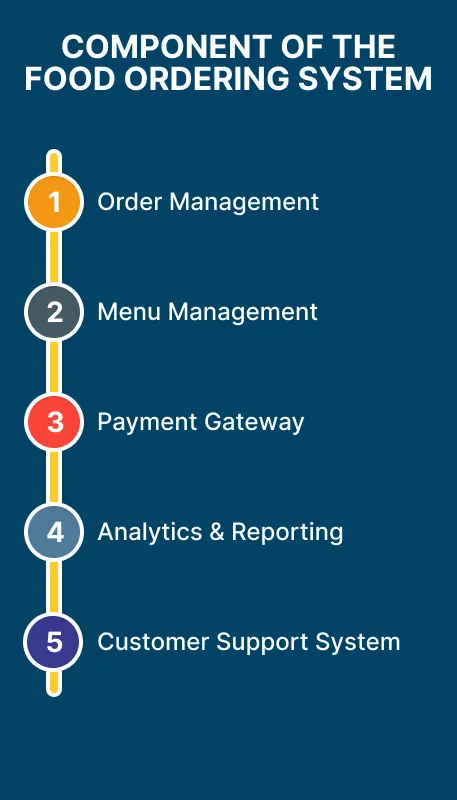
Order Management
The order management system (OMS) is the backbone of any food ordering system. It handles the receipt, processing, and fulfillment of orders. The OMS integrates with the restaurant’s kitchen display and point-of-sale (POS) systems, ensuring orders are efficiently managed when they are placed until they are delivered to the customer.
Menu Management
Menu management allows restaurants to update their offerings in real time. This component enables the addition, removal, or modification of menu items, descriptions, and prices. It also supports the creation of special deals and promotions, making it easier to manage seasonal or time-limited menus.
Payment Gateway
This component facilitates secure financial transactions, accepting various forms of payment like credit/debit cards, digital wallets, and other payment methods. It ensures that all transactions are encrypted and processed securely to protect customer data.
Analytics and Reporting
The analytics and reporting tool provides valuable insights into the restaurant’s performance. This component generates reports on metrics such as sales trends, popular menu items, and customer feedback. These insights help in making informed business decisions and strategies.
Customer Support System
The customer support system includes multiple channels such as live chat, email, and phone support. This component ensures that any customer inquiries or issues are addressed promptly.
How to Choose an Online Ordering Platform for Restaurants?
When choosing the best restaurant online ordering system, follow these tips and tricks.
- Look for features and functionality that meet your needs.
- Always look for the best restaurant online ordering system with marketing tools and analytics.
- Check food ordering management system allows you to integrate the chosen system with your existing POS system.
- Choose a restaurant food ordering system that has a user-friendly interface.
- The design of online food ordering software should be mobile-responsive.
- Select the best online ordering for restaurants with transparent pricing.
- Opt for ordering systems that provide a trial version.
FAQs
1. What is a restaurant ordering system?
A restaurant ordering system is a system that enables restaurants to receive online orders from customers. These systems simplify the ordering process, from menu management to payment.
2. What is a fast food ordering system?
A fast food ordering system is a platform that lets customers place online orders quickly, with features like digital menus, payment processing, and delivery tracking.
3. How does the ordering system work?
Below are some steps that show how the online food ordering system works.
- Customers access the ordering system through the app or the web
- Create an account
- Browse menus
- Place an order
- Make the payment using online payment methods
- Order placement
- The restaurant receives the order and starts working on it
- The rider receives the order from the restaurant and delivers it to the customer
- Customers provide feedback and reviews
4. What is the function of the ordering system?
The function of an ordering system is to facilitate seamless and efficient transactions between customers and restaurants. By offering an intuitive interface, the system ensures users can easily browse menus, customize their orders, and make payments.
5. What are the four types of ordering systems?
The four main types of ordering systems are:
- Phone ordering system
- Manual ordering system
- Point-of-sale ordering system
- Online ordering system
6. Which platform is best for ordering food?
Below is a list of platforms that are best for ordering food online.
- Zomato
- Swiggy
- UberEats
- Grubhub
- DoorDash
7. What is the ordering system in a restaurant called?
In a restaurant, the ordering system is typically called the point-of-sale (POS) system. This system allows servers to input customer orders, manage payments, and track sales data.
8. What is the most popular food ordering service?
DoorDash is one of the most popular food ordering services in the U.S., followed closely by UberEats and Grubhub.
9. What is the order management system for restaurants?
An order management system for restaurants streamlines the process of taking, processing, and tracking customer orders, integrating front-of-house and back-of-house operations to improve efficiency and customer service.
10. What food delivery system is the best?
The best food delivery systems include DoorDash, Uber Eats, and Grubhub for their extensive restaurant partnerships, user-friendly apps, and reliable delivery services.
11. What do restaurants use for online ordering?
Restaurants use their own branded websites and mobile apps, or third-party apps like Uber Eats and DoorDash, to take online orders.
12. What is the table ordering system for restaurants?
A table ordering system for restaurants is a digital solution (via tablets, QR codes, or mobile apps). It allows customers to browse the menu, place orders, and even pay directly from their table without waiting for staff.
13. What is the most popular food ordered online?
The most popular food ordered online worldwide is pizza, followed closely by burgers, sushi, and Chinese food, depending on the region.
14. How to take food orders online?
You can take food orders online by setting up a restaurant website, mobile app, or partnering with food delivery platforms that let customers browse your menu, place orders, and pay digitally.
Supercharge your deliveries with Enatega.
Register NowConclusion
Food ordering systems for restaurants play a vital role in succeeding in the food delivery market. They are a beneficial tool for restaurants to optimize their operations and provide convenience for customers.
So, if you are running a cafe, cloud kitchen, or any other food business, you can consult food app development company to create food delivery software to manage your operations.
About the author

Hudaibia Khalid is the creative force behind the blog—a maestro of words and ideas. Her distinctive style not only imparts wisdom but also leaves an indelible mark, transforming each post into a captivating journey through her unique perspective on the world.
SHARE










 IOS
IOS Android
 Web
Web