


The food delivery market is growing, and launching your app could be your golden chance to take your steps into this ever-growing industry. But one question often stops entrepreneurs in their tracks: “How long does it take to develop a food delivery app?”
The short answer? Depending on your goals, features, and development approach, it can take anywhere from 2 months for a basic MVP to 12 months or more for a fully customized, enterprise-level solution.
In this blog, we’ll break down exactly why the timeline varies, what key phases are involved, and how you can speed up the process without sacrificing quality. If you’re building from scratch or using a ready-made solution, this blog will help you plan your app launch with confidence.
Supercharge your deliveries with Enatega.
Register NowFood Delivery App Development Timeline – Phases and Their Duration
Developing the food delivery app requires proper planning and the right development approach. If you want to build an online food ordering software, understanding the timeline helps you set goals and manage expectations.
Here are the key phases involved and how long each takes.
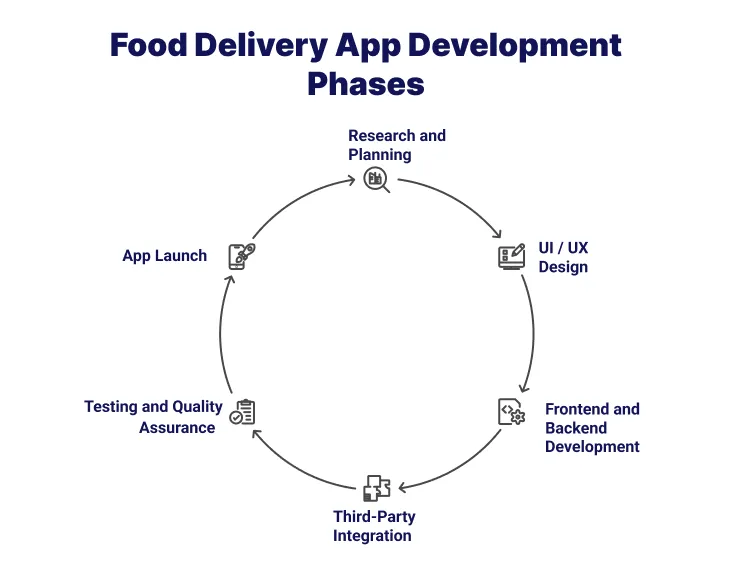
1. Research and Planning – 1 to 2 weeks
This stage involves conducting market research, analyzing competitors, defining the app’s goals, and finalizing the feature list. A well-structured plan saves time later in development.
2. UI/UX Design – 2 to 4 weeks
Designers create wireframes, prototypes, and visual designs that ensure the app is user-friendly and aligns with your brand identity.
3. Frontend and Backend Development – 6 to 12 weeks
This phase covers both the client-facing interface (frontend) and the server-side infrastructure (backend), including database management and API development.
4. Third-Party Integration – 1 to 2 weeks
Essential integrations like payment gateways, map services, push notifications, and analytics tools are added to improve functionality.
5. Testing and Quality Assurance – 2 to 4 weeks
Developers and QA testers identify and fix bugs, test app performance, and ensure the platform meets quality and security standards.
6. App Launch – 1 week
The app is deployed to the App Store and Google Play, marketing campaigns begin, and the team monitors initial feedback for quick adjustments.
Average Timeframes for Food Delivery App Development
Below is the average timeframe for developing a food delivery app.
| Type of App | Timeline | Description |
| MVP (Minimum Viable Product) | 4 – 8 weeks | A basic version with essential features like user registration, restaurant listing, menu display, order placement, and payment integration. Ideal for testing the market quickly. |
| Full-Featured App | 3 – 6 months | Includes advanced features such as real-time tracking, multiple payment options, loyalty programs, in-app chat, and personalized recommendations. Suitable for scaling operations. |
| Custom Enterprise-Level Solution | 6 – 12+ months | A fully customized solution with unique branding, advanced analytics, AI integration, and complex backend systems. Designed for large-scale operations or niche business models. |
Food Delivery App Development Timeline: Based on Popular Food Delivery Apps
The time to build a food delivery app like Uber Eats, DoorDash, or Grubhub can vary based on several factors, including features, complexity of the app, platform (iOS, Android, or both), location of the development team, etc.
Here is the estimated timeline of these apps.
Time to Build an App Like Uber Eats
Estimated Timeline: 6 – 12+ months
Key Features
- Real-time GPS tracking
- Multiple payment options
- Personalized recommendations
- Advanced search filters
- In-app chat
- Ratings and reviews
- Restaurant dashboard
- Delivery partner app
Time to Build an App Like DoorDash
Estimated Timeline: 5 – 10 months
Key Features
- Scheduled deliveries
- Contactless delivery options
- Promotions and discounts
- Rider tracking
- Order history
- Restaurant onboarding system
- Multi-language support
Time to Build an App Like Grubhub
Estimated Timeline: 4 – 8 months
Key Features
- Menu customization
- In-app ordering
- Live order tracking
- Loyalty programs
- Push notifications
- Secure payments
- Restaurant management panel
Factors Affecting the Development Time of Food Apps
Look at the table below and understand the factors that affect the online ordering platform development timeline.
| Factor | Impact on Development Time | Details |
| Features and Functionality | High | More complex and advanced features (e.g., AI-based recommendations, loyalty programs) require more development time compared to basic features. |
| App Design (UI/UX) | Medium to High | Custom, brand-focused designs and interactive elements take longer to create than using simple, standard templates. |
| Platform Choice | Medium | Building for both iOS and Android separately (native) takes longer than cross-platform development. |
| Technology Stack | Medium | The choice of backend, frontend, and database technologies can influence speed and efficiency. |
| Third-Party Integrations | Medium | Integrating payment gateways, maps, analytics, and notifications can add time, especially if APIs are complex. |
| Team Size and Expertise | High | Experienced, well-coordinated teams can work faster. Smaller or less experienced teams may extend the timeline. |
| Testing and QA | Medium to High | Thorough testing (manual and automated) is essential to ensure a bug-free experience, which can extend timelines. |
| Regulatory Compliance | Low to Medium | Meeting data privacy, payment security, and local regulations may require extra development time. |
Tips to Reduce Food Delivery App Development Time
Reducing the development time for a food delivery app involves strategic planning and efficient practices. Here are some key tips to help you reduce the time of food delivery app development.
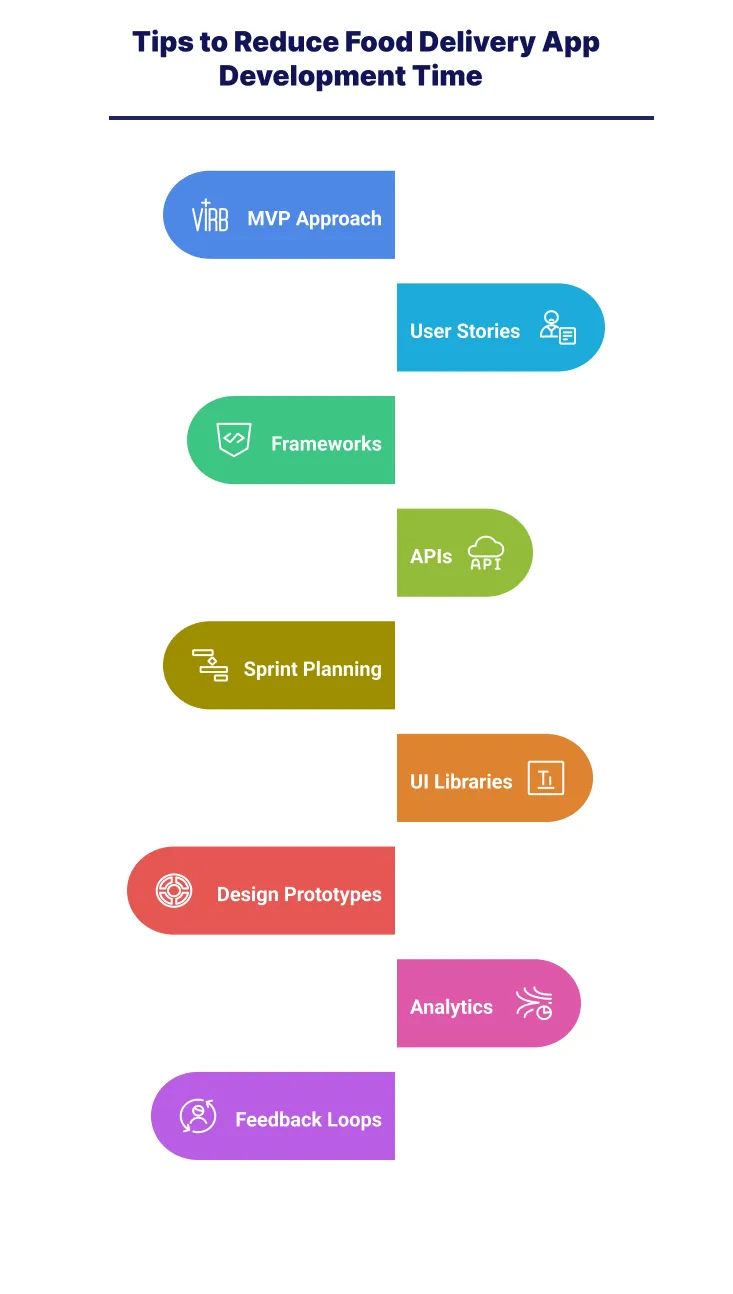
MVP Approach: Start with an MVP that includes essential features to launch quickly.
User Stories: Create detailed user stories to clarify functionality and user experience.
Frameworks: Use frameworks that speed up development, such as React Native for cross-platform apps.
APIs: Use existing APIs for payment processing, location services, and notifications.
Sprint Planning: Break development into sprints with specific goals to maintain focus and flexibility.
UI Libraries: Use libraries like Material-UI or Bootstrap for a consistent user interface design.
Design Prototypes: Create wireframes and prototypes using tools like Figma or Adobe XD to visualize the app before coding.
Analytics: Use analytics to monitor user behavior and app performance post-launch for continuous improvement.
Feedback Loops: Establish feedback mechanisms to gather user input for future updates.
FAQs
1. How much would it cost to build a food delivery app?
Building a food delivery app can cost between $30,000 and $150,000+, depending on features, complexity, and the development team’s location.
2. Is food delivery still profitable?
Yes, food delivery can still be profitable, especially with growing demand and the expansion of online ordering. However, profitability varies by market, competition, and operational efficiency.
3. How to quickly develop an app?
Below are some steps to help you quickly develop an app.
- Define Core Features: Focus on essential functionalities to launch a minimum viable product.
- Choose the Right Tools: Use low-code or no-code platforms for faster development.
- Agile Methodology: Implement agile practices for iterative development and quick feedback.
- Use Existing Solutions: Use APIs and existing services to reduce development time.
- Outsource: Consider hiring freelancers or a development team to speed up the process.
4. Who uses food delivery apps the most?
Food delivery apps are most commonly used by:
- Young Adults: Millennials and Gen Z, who prefer convenience and quick access to a variety of dining options.
- Busy Professionals: People with tight schedules who look for quick meal solutions.
- Families: Parents looking for convenient meal options without the hassle of cooking.
- Urban Residents: People living in cities with a higher density of restaurants and delivery services.
Supercharge your deliveries with Enatega.
Register NowConclusion
Understanding the development timeline before building your food delivery app is essential. It not only helps you plan resources effectively but also ensures a smooth, on-time launch without unnecessary delays.
Now that you have a clear idea of the phases, timeframes, and factors involved, it’s time to turn your vision into reality. At Enatega, we specialize in building reliable and scalable food delivery apps that help businesses succeed in a competitive market.
Partner with our industry experts and take the first step toward launching your app. Book a free demo today and see how quickly we can bring your idea to life.
About the author

Hudaibia Khalid is the creative force behind the blog—a maestro of words and ideas. Her distinctive style not only imparts wisdom but also leaves an indelible mark, transforming each post into a captivating journey through her unique perspective on the world.
SHARE










 IOS
IOS Android
 Web
Web