

The medicine delivery app development cost ranges from $20,000 to $120,000+, depending on the app’s complexity, features, platforms, integrations, and development team location. A basic app can cost around $20,000–$35,000, a mid-level app may cost $35,000–$60,000, and an advanced app with features such as e-prescriptions, real-time tracking, and multi-vendor support can cost $60,000–$100,000+.
Maintaining good physical health is important, and timely access to essential medicines plays a major role in that. In today’s world, on-demand medicine delivery apps are a convenient solution, ensuring people can get the medications and healthcare products they need, right at their doorstep.
These apps are not just about convenience; they’re changing the healthcare industry by improving accessibility.
According to Statista, the online pharmacy market is projected to reach US$97.18bn in 2025.
But one question sticks in the mind of everyone who wants to build a medical app: What does it take to build a medicine delivery app?
The cost can range from 20,000 to $120,000 or even more, depending on a range of factors such as app complexity, core features, and target platforms (iOS, Android, or web).
So, let’s explore the exact cost that gives you a clear picture of what it takes financially and strategically to develop a successful medicine delivery app.
Supercharge your deliveries with Enatega.
Launch NowHow Much Does it Cost to Develop a Medicine Delivery App?
The development cost of an online medicine delivery app can vary widely based on several key factors, including:
- App’s complexity
- App features
- Target platforms (iOS, Android, or web)
- Location and expertise of your development team, and more
To help you better understand the financial scope, look at the table below that shows the estimated cost of building the app. This will give you a clearer picture of what to expect when budgeting for your medical app development project.
| App Type | What It Includes | Estimated Cost (USD) | Estimated Timeline |
| Basic / Single-Pharmacy MVP | User registration Medicine catalog Search Checkout Basic order management | $20,000–$40,000 | 2–4 months |
| Standard Medicine Delivery App | Advanced search Payments Order Tracking Notifications Pharmacy management Admin dashboard | $40,000–$80,000 | 4–6 months |
| Advanced Multi-Vendor Platform | Multiple pharmacies Prescription workflows Real-time tracking Delivery management Chat Advanced admin features | $80,000–$120,000+ | 6–9+ months |
| Enterprise Healthcare Platform | Multiple apps Custom integrations Advanced workflows Analytics Security and compliance requirements | $120,000+ | 9–12+ months |
How to Estimate Medicine Delivery App Development Cost
The cost of developing a medicine delivery app depends on the amount of development work required, not just the number of features. The estimates consider:
- The scope of the customer app
- Pharmacy or vendor panel
- Delivery management
- Admin dashboard
- Backend development
- UI/UX design
- Testing
- Third-party integrations
- Deployment
A simple way to estimate the total development cost is:
Development Cost = Estimated Development Hours × Hourly Development Rate + Third-Party and Infrastructure Costs
For example, a basic medicine delivery MVP requires fewer development hours than a multi-vendor platform with prescription management, pharmacy integrations, real-time delivery tracking, payment processing, and multiple user apps.
The final cost can also change based on:
- Number of platforms
- Development team location
- Level of customization
- Healthcare compliance requirements
- Integrations
- Ongoing maintenance needs
Medicine Delivery App Development Cost by Location
The location of your development team can significantly affect the cost of building a medicine delivery app. Development rates vary based on factors such as:
- Developer experience
- Agency size
- Technical expertise
- Project complexity
- The services included in the development package
The table below provides general hourly rate ranges and estimated project costs for different regions. These figures are estimates and can vary depending on the scope of your app.
| Region | Hourly Rate (USD) | Estimated Total Cost |
| United States | $100 – $180/hour | $100,000 – $200,000+ |
| United Kingdom | $80 – $150/hour | $90,000 – $180,000+ |
| Western Europe | $70 – $130/hour | $80,000 – $150,000+ |
| Eastern Europe | $40 – $80/hour | $40,000 – $90,000 |
| India | $20 – $50/hour | $20,000 – $60,000 |
| Pakistan/Bangladesh | $15 – $40/hour | $15,000 – $50,000 |
| Southeast Asia | $25 – $45/hour | $20,000 – $55,000 |
Choosing a development team based only on the lowest hourly rate can be risky. Before making a decision, consider these factors:
- Team’s experience with similar applications
- Technical expertise
- Communication process
- Project management
- QA capabilities
- Security practices
- Experience with healthcare-related requirements
A lower hourly rate does not always mean a lower overall project cost. An experienced team may complete the project faster and require less rework, which can reduce total development cost.
Medicine Delivery App Development Cost by Component
The total cost of a medicine delivery app depends on more than just the customer-facing mobile app. A complete platform may include:
- Customer app
- Pharmacy or vendor panel
- Delivery partner app
- Admin dashboard
- Backend
- Third-party integrations
- Testing
Below are estimated costs for the major development components.
| Development Component | Estimated Cost (USD) |
| UI/UX Design | $3,000–$10,000 |
| Customer App | $8,000–$20,000 |
| Pharmacy/Vendor Panel | $5,000–$12,000 |
| Delivery Partner App | $5,000–$12,000 |
| Admin Dashboard | $5,000–$15,000 |
| Backend & APIs | $8,000–$20,000 |
| Payment & Map Integrations | $1,000–$5,000 |
| QA & Testing | $3,000–$8,000 |
| Deployment & App Store Setup | $1,000–$3,000 |
Medicine Delivery App Development Cost by Feature
The features you include can have a major impact on the medicine delivery app development cost. Basic features such as registration, medicine search, cart, and order placement require less development work.
Moreover, prescription management, real-time tracking, telemedicine, and pharmacy integrations require more time and technical resources.
The table below provides indicative estimates for adding common features to a medicine delivery platform.
| Feature | Estimated Cost (USD) |
| User Registration and Login | $500–$1,500 |
| Medicine Search and Filters | $1,000–$3,000 |
| Medicine Catalog | $1,000–$3,000 |
| Shopping Cart and Checkout | $1,000–$3,000 |
| Prescription Upload | $1,500–$4,000 |
| Prescription Verification Workflow | $2,000–$6,000 |
| Prescription OCR | $3,000–$8,000 |
| Real-Time Order Tracking | $1,500–$4,000 |
| Payment Gateway Integration | $1,000–$3,000 |
| Pharmacy/Inventory Integration | $3,000–$10,000+ |
| Delivery Management | $2,000–$6,000 |
| Push Notifications | $500–$2,000 |
| Refill & Subscription Features | $1,000–$3,000 |
| Telemedicine/Doctor Consultation | $5,000–$15,000+ |
| Multi-Vendor Functionality | $5,000–$15,000+ |
| AI-Powered Recommendations | $3,000–$10,000+ |
| Advanced Analytics & Reporting | $2,000–$7,000 |
How Long Does It Take to Build a Medicine Delivery App?
The time to build a medicine delivery app ranges from 2-3 months for a basic version to 10+ months for a more advanced application with complex features.
A basic MVP with essential features can be developed faster. More advanced platforms and features require more development and testing time.
| App Complexity | Typical Development Timeline |
| Basic MVP | 2–4 months |
| Standard Medicine Delivery App | 4–6 months |
| Advanced Multi-Vendor Platform | 6–9+ months |
| Enterprise Healthcare Platform | 9–12+ months |
Several factors can affect the development timeline, including:
- Number of platforms, such as iOS, Android, and web
- Number and complexity of features
- Custom UI/UX requirements
- Pharmacy and inventory integrations
- Prescription and healthcare workflows
- Payment, maps, SMS, and other third-party integrations
- Testing, security, and compliance requirements
- Size and experience of the development team
These timelines are estimates and can change based on the project scope and development approach. Using a ready-made or white-label solution may reduce the time required to launch compared with building the entire platform from scratch.
Medicine Delivery App Development Cost: Based on Popular Medicine Delivery Apps
If you want to build a medicine delivery app similar to an established platform such as Tata 1mg, PharmEasy, NetMeds, or CVS, the development cost depends on the features and workflows you want to replicate.
The table below shows the estimated development costs of these apps and provides a general idea of what it may cost to build a similar platform.
| App Name | Type | Main Features | Estimated Development Cost (USD) | Development Time |
| 1mg / Tata 1mg | Full-scale medicine app | ePharmacy eConsultation Lab tests eWallet | $80,000 – $150,000+ | 6 – 8 months |
| NetMeds | ePharmacy + Lab services | User profile Prescription upload Order tracking Payment gateway | $70,000 – $130,000+ | 5 – 7 months |
| PharmEasy | Medicine + Healthcare | Doctor consultation Tests booking Offers Smart reminders Refill option | $80,000 – $140,000+ | 6 – 8 months |
| Zeno Health | Generic medicine app | Discounted pricing Search Order management Notifications | $50,000 – $90,000 | 3 – 5 months |
| CVS | US-based hybrid apps | Online pharmacy Vaccine booking Insurance Chat with pharmacists | $100,000 – $200,000+ | 6 – 10 months |
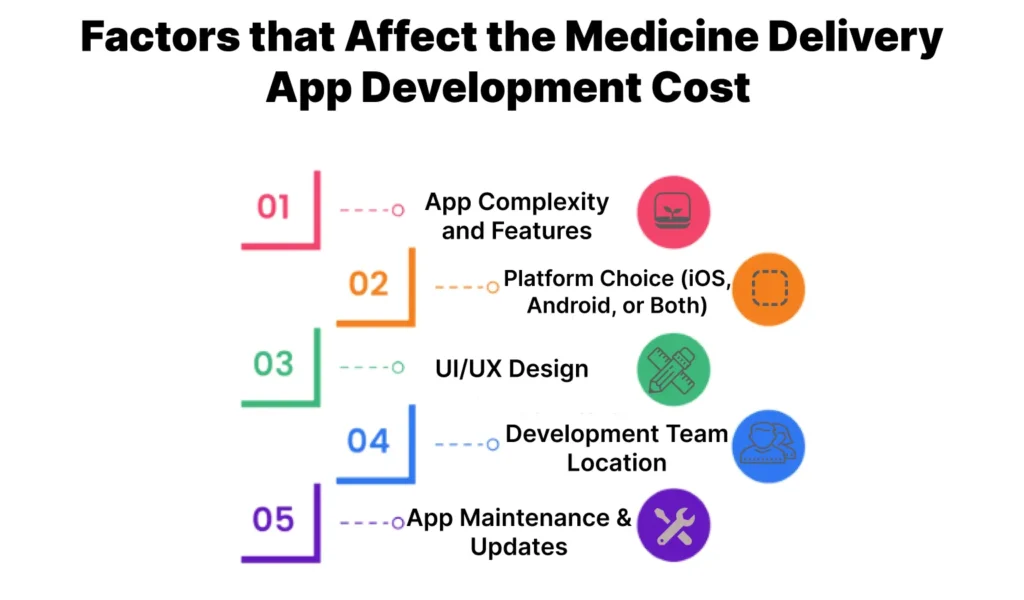
Factors that Affect the Medicine Delivery App Development Cost
Before starting the development process, it’s essential to understand the major factors that impact the overall cost of building a medicine delivery app.
Let’s explore the main factors that can influence your budget, timeline, and the outcome of your app.
1. App Complexity and Features
The scope and functionality of your app are the biggest cost factors. A basic app with features like user registration, medicine search, and order placement will cost less than an advanced app with features such as real-time order tracking, AI-powered recommendations, teleconsultation, and multi-vendor support.
2. Platform Choice (iOS, Android, or Both)
Choosing the right platform or opting for both has a direct impact on development costs. Building for a single platform is more affordable, while developing a cross-platform or native app for both iOS and Android increases the workload, time, and cost. Always base your decision on your target audience’s preferred devices.
3. UI/UX Design
User experience plays an important role in user retention and satisfaction. A clean, user-friendly design with standard layouts is cost-effective, but if you’re aiming for a highly customized interface with advanced animations, micro-interactions, or 3D elements, the design cost will rise accordingly.
4. Development Team Location
Development rates vary by region. For example:
- North America and Western Europe: $100–$180/hour
- Eastern Europe: $40–$80/hour
- South Asia (India, Pakistan): $20–$50/hour
5. App Maintenance and Updates
Development doesn’t end at launch. Continuous maintenance, bug fixes, performance optimization, and regular updates are essential to ensure the app remains secure, up-to-date, and competitive. These recurring costs should be factored into your long-term budget.
Tips to Reduce the Medicine Delivery App Development Cost
If you’re looking to build a medicine delivery app without exceeding your budget, smart planning and strategic choices can make a big difference.
Below are proven tips to help you reduce development costs without compromising on quality.
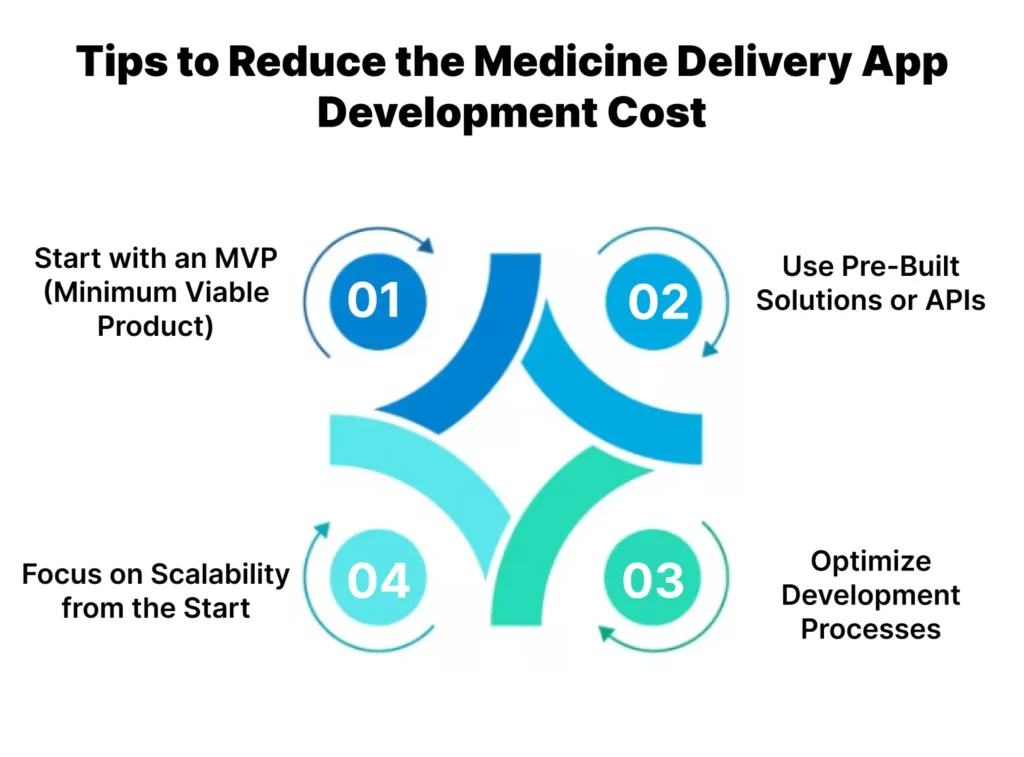
1. Start with an MVP (Minimum Viable Product)
Instead of building a full-scale app from day one, begin with a basic version that includes only the core features. This allows you to launch faster, gather user feedback, and validate your idea while saving time and money. You can always expand functionality later based on your user needs.
2. Use Pre-Built Solutions or APIs
Rather than developing every feature from scratch, use pre-built modules, third-party APIs, or white-label solutions for functions like payment gateways, authentication, and maps. This will help you reduce development time and cost.
3. Optimize Development Processes
Adopt agile methodologies, maintain clear communication with your development team, and ensure proper planning and documentation. These practices minimize rework, improve efficiency, and help avoid unnecessary expenses during development.
4. Focus on Scalability from the Start
Design your app architecture to support future growth. Investing in scalable infrastructure early on can prevent costly overhauls later when user demand increases.
Ready-Made Solution vs. Custom App Development
Businesses generally have two options when launching a medicine delivery platform: use a ready-made or white-label solution, or develop the platform from scratch.
A ready-made solution can reduce the initial development time because core features are already available. Custom development takes longer and usually costs more upfront, but it provides greater control over the platform’s functionality, architecture, and user experience.
| Factor | Ready-Made / White-Label Solution | Custom App Development |
| Time to Market | Usually faster because core features are already developed | Usually takes longer because the platform is built from the ground up |
| Initial Investment | Often lower, depending on the product, license, customization, and setup fees | Usually higher because design, development, testing, and deployment are handled specifically for your business |
| Customization | Depends on the solution and its available customization options | High; features and workflows can be designed around specific business requirements |
| Scalability | Depends on the underlying architecture and the vendor’s capabilities | Can be designed around your expected users, transactions, and future requirements |
| Source Code and Ownership | Depends on the vendor’s licensing and ownership terms | Depends on the development contract and intellectual-property agreement |
| Maintenance | May be handled by the vendor, your team, or both | Usually handled by your internal team or development partner |
| Integrations | Limited to supported integrations unless customization is available | Can be developed specifically for required pharmacy, payment, inventory, and delivery systems |
Why Build a Medicine Delivery App?
A medicine delivery app can help pharmacies and healthcare businesses make ordering more convenient. Let’s look at them and understand why investing in this is the best decision.
| For Customers | For Businesses |
| Convenient Ordering: Customers can search for medicines, check availability, upload prescriptions where applicable, and place orders from their phones. | Wider Customer Reach: An online platform can help pharmacies serve customers beyond their physical store location, subject to local delivery and pharmacy regulations. |
| Order Tracking: Customers can receive order updates and track deliveries when real-time tracking is supported. | Centralized Order Management: Businesses can manage orders, customer information, and other operations from a centralized dashboard. |
| Multiple Payment Options: Integrating trusted payment providers can give customers more ways to pay for their orders. | Better Inventory Visibility: Integration with inventory systems can help businesses monitor medicine availability and reduce manual stock management. |
| Easy Prescription Submission: Where legally permitted, customers can upload prescriptions digitally instead of visiting a pharmacy to submit them in person. | Pharmacy and Vendor Management: Multi-vendor platforms can allow businesses to manage multiple pharmacies, catalogs, orders, commissions, and delivery operations from one system. |
| Delivery Convenience: Customers can order eligible medicines and healthcare products for delivery instead of traveling to a pharmacy. | Operational Efficiency: Automated notifications, order workflows, and reporting can reduce repetitive manual tasks. |
| Order History: Customers can access previous orders and relevant information, making it easier to manage repeat purchases where permitted. | Data and Reporting: Analytics can provide insights into orders, sales, inventory, and customer activity. |
FAQs
Below are some steps to help you create a medicine delivery app.
Research and planning
Select the business model
Choose the app features
Select the tech stack
Start the app development
Testing and launching
Yes, medical delivery is a profitable business. It has potential for strong revenue and growth, especially with the increasing demand for specialized delivery services in healthcare.
Starting a medication delivery service involves some steps, such as:
Do research
Choose a legal structure for your business
Secure funding through loans, investors, or personal savings
Build a partnership with local pharmacies
Determine your delivery system
Create the website or app
Follow all the relevant laws and regulations
Yes, online medicine apps can be legal, but with important considerations. They must follow relevant laws and regulations, including those related to prescribing, data privacy, and the practice of medicine.
Supercharge your deliveries with Enatega.
Launch NowConclusion
Buying medicine online has become a common practice globally. According to GlobeNewswire, the turnover of online pharmacies is projected to reach $178.1 billion by 2026. This highlights the rapid shift toward digital health solutions.
If you're aware of the costs associated with developing a medication delivery app but need expert assistance in creating a high-quality application, consider consulting Enatega. Our experienced team has successfully developed apps that drive business growth.
Register with us today and benefit from the expertise of industry professionals.
About the author

Hudaibia Khalid is a senior content writer with several years of experience in creating clear and easy-to-understand content. Over the years, she has worked closely with startups, restaurants, and entrepreneurs, helping them simplify complex digital and technical topics into actionable insights.
Her expertise lies in writing about on-demand platforms, food delivery solutions, and business growth strategies in a way that is accessible even to non-technical readers. With her experience in the industry, she focuses on guiding businesses step by step, from understanding ideas to turning them into fully working solutions.
SHARE






 IOS
IOS Android
 Web
Web