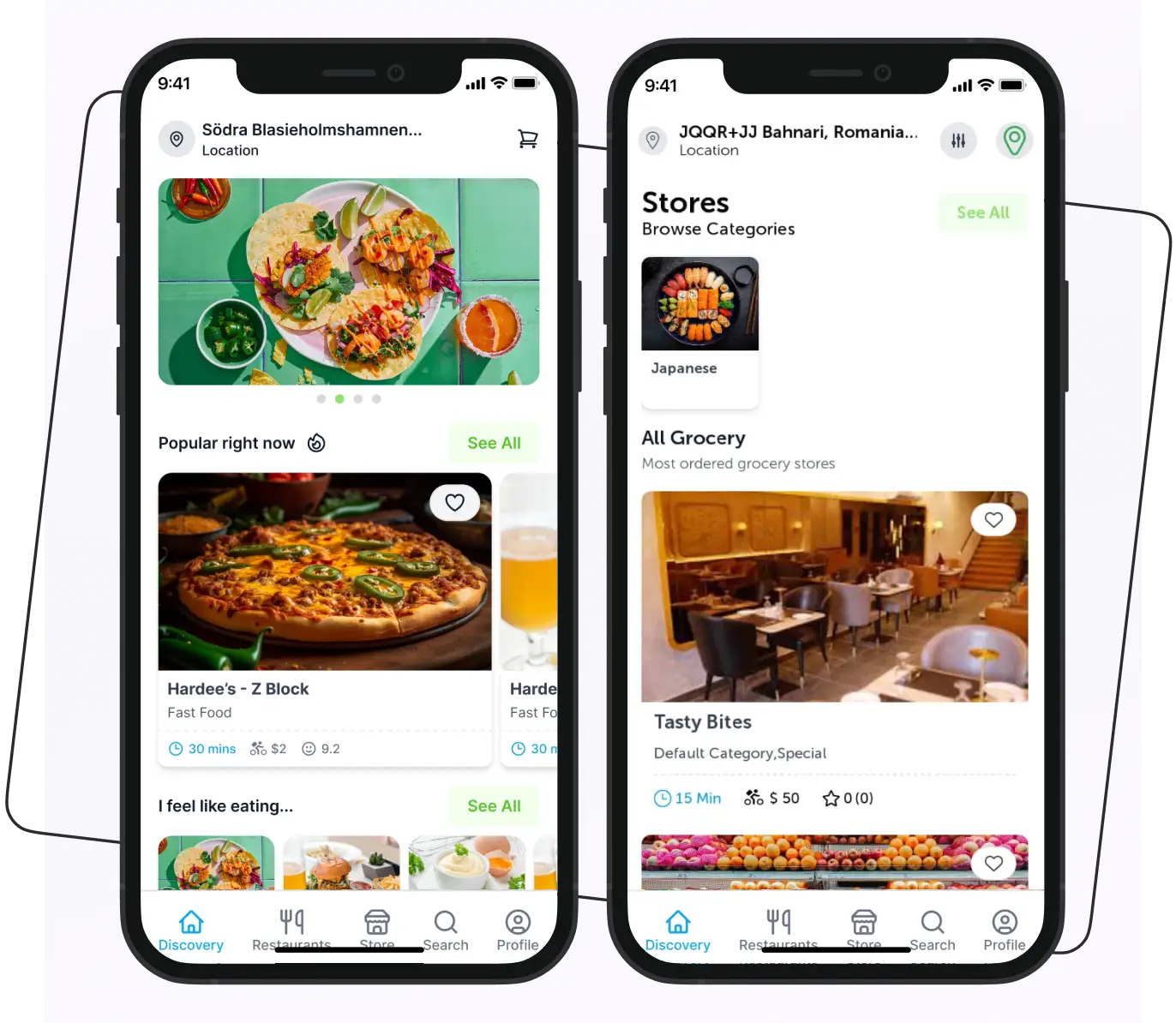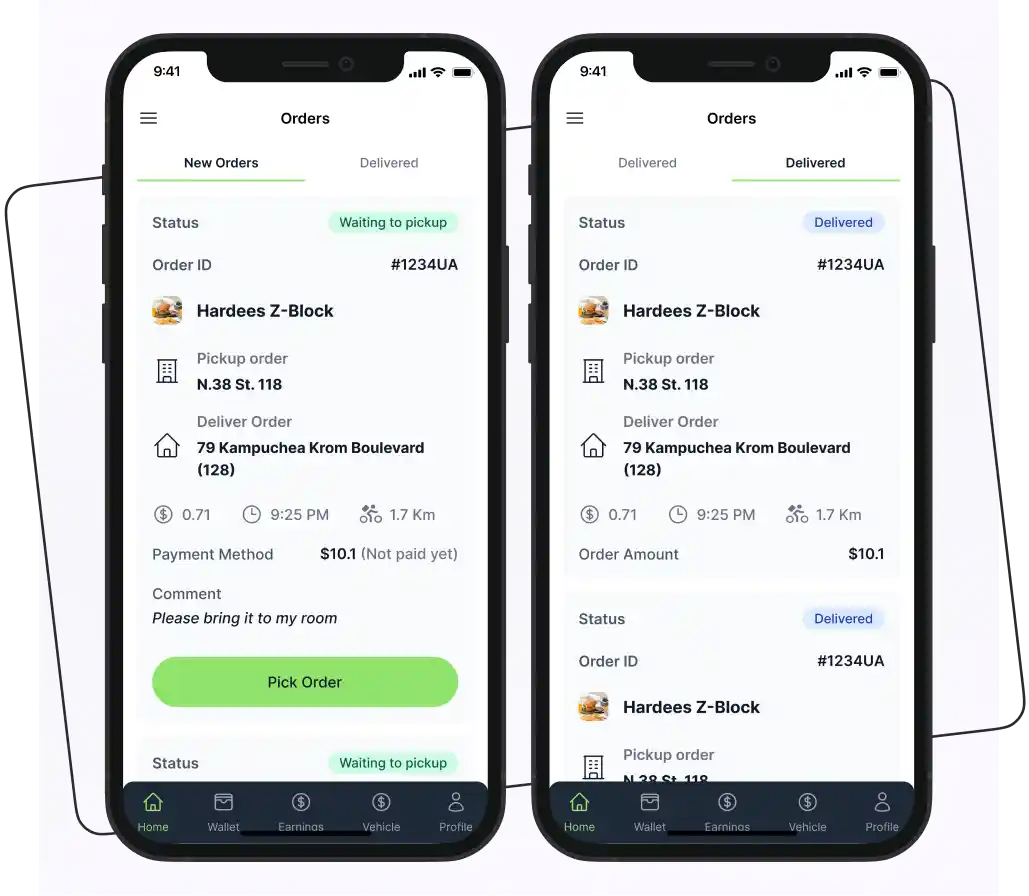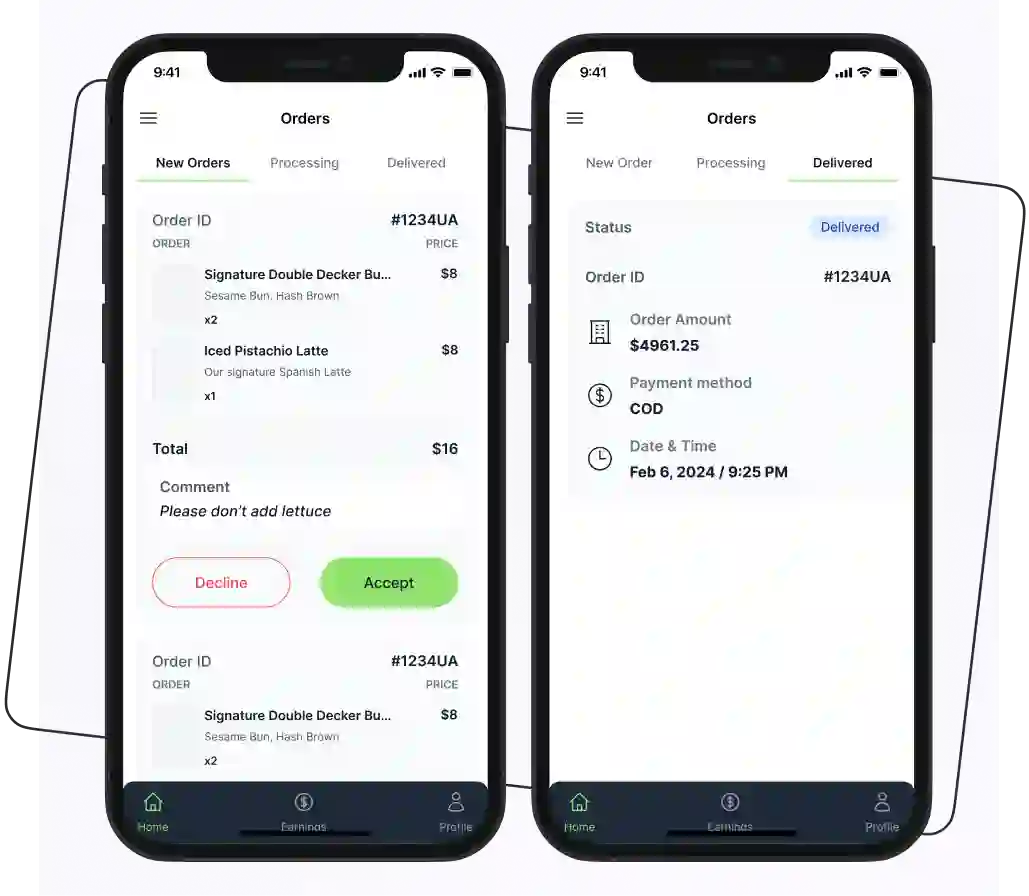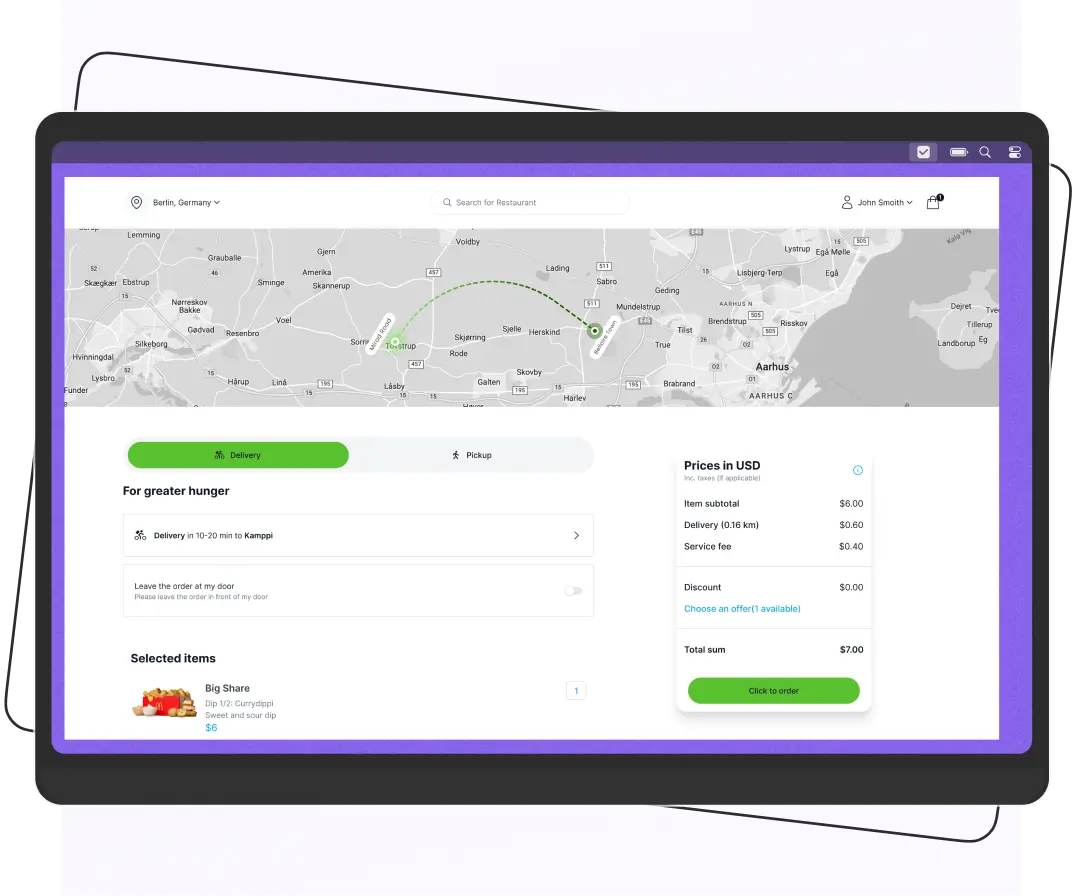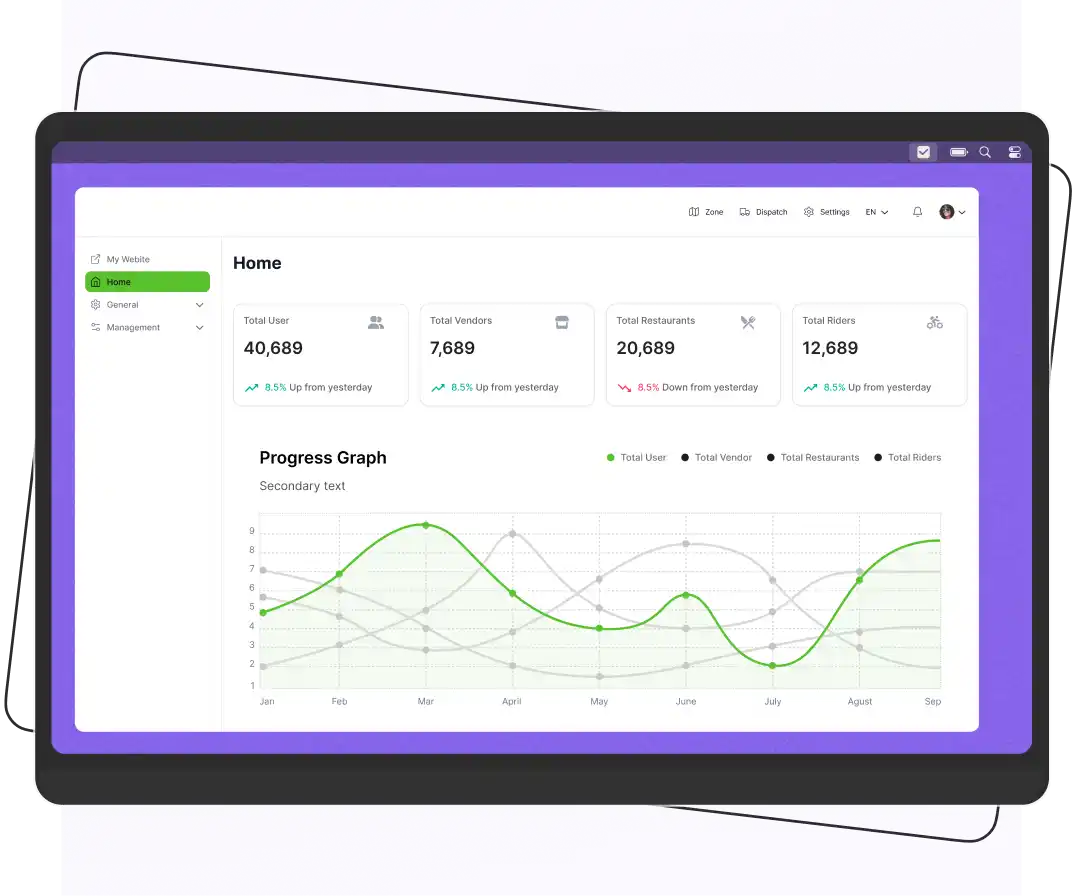


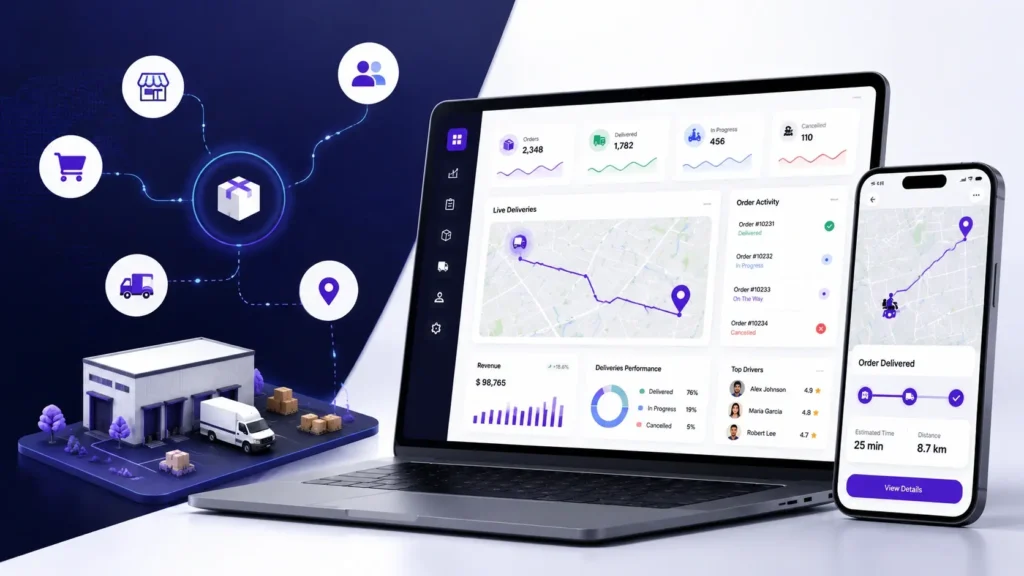
White-label delivery software for marketplaces is a customizable platform that enables businesses to launch their own multi-vendor delivery marketplace without building the software from scratch. It includes customer, vendor, rider, and admin apps with features like order management, payment integration, commission management, and analytics, helping businesses launch faster.
What if you could launch your own Uber Eats or DoorDash-style marketplace without spending months building the technology from scratch? As customers increasingly prefer ordering directly from brands, businesses need more than just an online store; they need a fast and reliable delivery experience.
That’s where white label delivery software for marketplaces comes in. It gives you everything you need to launch your own marketplace, including customer, vendor, driver, and admin apps, while keeping full control of your brand, customer data, and profits.
So, let’s explore what white label delivery software for marketplaces is, how it works, its benefits, and how to choose the best solution for your business.
What is White Label Delivery Software for Marketplaces?
White label delivery software for marketplaces is a ready-built, fully rebrandable delivery and ordering platform that businesses license from a third-party provider and launch under their own brand name instead of building the technology from scratch.
Why businesses use it:
- Launch in weeks instead of the 6-18 months a custom build takes
- Lower upfront cost than hiring a dev team
- The vendor handles hosting, security, and updates
- The business keeps full control of its brand, customers, and (usually) its data
Who Uses White Label Marketplace Software
White label delivery platforms aren’t limited to food. It is commonly used for:
- Food delivery marketplaces
- Grocery and quick commerce
- Pharmacy delivery
- Courier and parcel delivery
- Liquor, flowers, and specialty retail delivery
- Subscription businesses
- POS providers and agencies
Main Components of the Platform
Most white label delivery marketplace solutions bundle four to five connected applications:
- Customer app/website: Browsing, ordering, payments, live order tracking
- Vendor/merchant panel: Menu or catalog management, order acceptance, inventory
- Delivery agent (rider) app: Order assignment, navigation, proof of delivery
- Admin dashboard: Commission control, analytics, dispute resolution, marketing tools
- APIs/integrations: Payment gateways, maps, SMS/push notifications, POS systems, and sometimes third-party fleet networks
Supercharge your deliveries with Enatega.
Register NowHow White Label Delivery Software Works
A white label delivery platform provider builds and maintains the core technology once, then licenses it to many businesses that each rebrand it as their own. When you sign up, the process looks like this:
- Select a plan or package based on your marketplace type (food, grocery, pharmacy, courier, multi-category, etc.)
- Apply your branding logo, app icons, color scheme, and domain name
- Onboard vendors or merchants onto the platform’s vendor panel
- Configure delivery zones, pricing, and commission rules
- Publish the customer app and delivery agent app to the App Store and Google Play under your own developer account
- Go live, usually within 2-6 weeks, instead of the 6-12+ months a custom build would take
The vendor hosts and maintains the backend infrastructure (servers, updates, security patches), while you own the customer relationship, the brand, and the data.
White-Label vs Building In-House
Choosing between white-label delivery software and building an in-house platform is one of the biggest decisions for any marketplace.
Custom development offers complete flexibility; it requires significant time, budget, and technical expertise. White-label solutions, on the other hand, provide a faster, more cost-effective way to launch a marketplace with proven features already in place.
Look at the table below to understand it better.
| Factor | White-Label Software | Custom In-House Build |
| Ideal For | Startups, SMBs, fast market entry | Large enterprises with unique, complex workflows |
| Time to launch | Weeks | 6-18 months |
| Upfront cost | Low–moderate (license/subscription fee) | High (dev team, infra, QA) |
| Ownership of code | Usually licensed, not owned outright | Fully owned |
| Customization depth | Configurable within the platform’s framework | Unlimited |
| Ongoing maintenance | Handled by the vendor | Handled by your own team |
Features to Look for in White Label Marketplace Delivery Software
Not all white label delivery solutions offer the same capabilities. Choosing the right platform can make a huge difference in how efficiently your marketplace operates and scales.
When evaluating providers, prioritize these features:
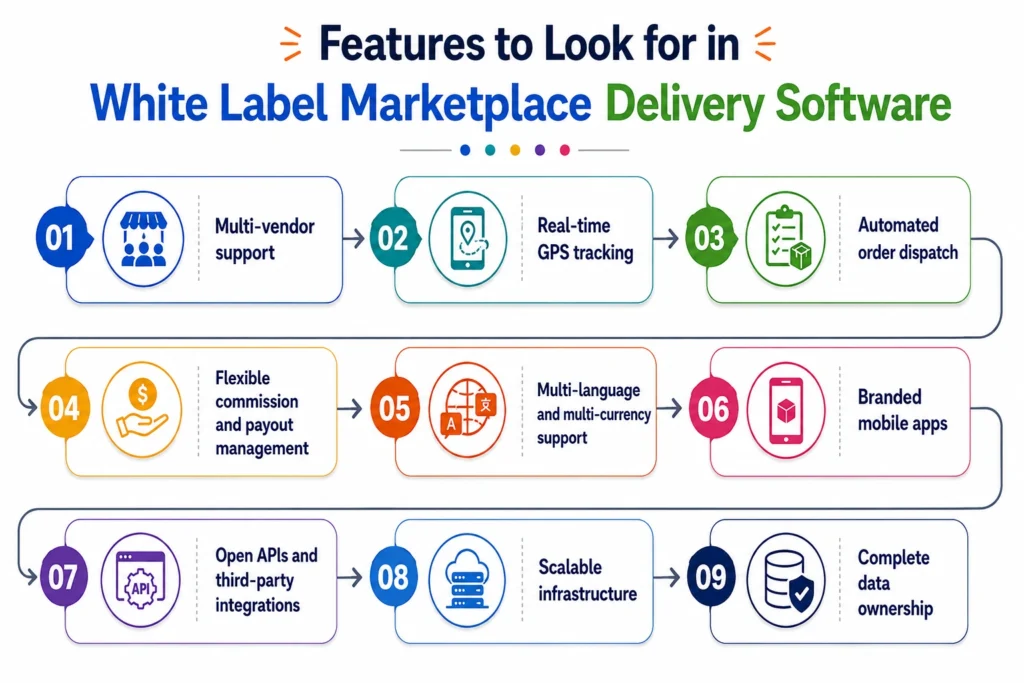
- Multi-vendor support
Easily onboard and manage multiple restaurants, stores, or merchants from a single marketplace dashboard.
- Real-time GPS tracking
Allow customers to track orders live while giving dispatchers complete visibility into driver locations.
- Automated order dispatch
Assign deliveries to the nearest available driver automatically to reduce delivery times and improve efficiency.
- Flexible commission and payout management
Customize commission rates, vendor settlements, and driver payouts to match your business model.
- Multi-language and multi-currency support
Expand into new regions and provide a localized experience for customers and merchants.
- Branded mobile apps
Ensure the customer, merchant, and driver apps are published under your own brand and developer accounts for complete ownership.
- Open APIs and third-party integrations
Connect easily with POS systems, payment gateways, CRM tools, and external delivery fleets.
- Scalable infrastructure
Choose software that can grow with your business, from serving a single city to managing multiple locations or franchise networks.
- Complete data ownership
Retain full control of your customer, order, and business data with the ability to export it whenever needed.
Benefits of White Label Delivery Software for Marketplace Owners
It gives marketplace owners everything they need to launch, manage, and scale a delivery platform without the time, cost, and complexity of building one from scratch.
Below are the biggest advantages.
| Advantages | Description |
| Faster time to market | Launch your marketplace in weeks instead of spending months or even years developing a custom solution. |
| Lower development costs | Save on hiring developers, designers, and infrastructure teams by using a ready-made platform. |
| Reduced technical complexity | Your software provider handles: Maintenance Security updates Bug fixes Performance improvements It allows you to focus on growing your business. |
| Complete brand ownership | Build customer loyalty with fully branded web and mobile apps that showcase your logo, colors, and identity, not a third-party marketplace’s. |
| Revenue control | Keep more of your earnings by controlling your own commission structure, delivery fees, subscriptions, and other revenue streams instead of paying ongoing marketplace commissions. |
| Proven and reliable technology | Benefit from a platform that has already been tested, optimized, and refined across multiple businesses, reducing the risks associated with launching new software. |
| Easy scalability | Expand from a single city to multiple regions or franchise locations without rebuilding your technology stack. |
| Full control over customer data | Own your customer, merchant, and order data, giving you valuable insights for marketing, personalization, and long-term business growth. |
How Much Does White Label Marketplace Delivery Software Cost?
White-label marketplace delivery software costs between $100 to $1,500 per month for subscription-based SaaS models, or a one-time fee of $1,500 to $25,000 for a lifetime self-hosted license.
Most providers use one or more of the following pricing models:
- One-time setup or licensing fee for branding, app publishing, or initial deployment.
- Monthly or annual subscription for hosting, maintenance, updates, and customer support.
- Per-order commission, either alongside or instead of a subscription fee.
- Commission-free subscription plans, which have become increasingly popular among marketplace owners who prefer predictable operating costs and want to keep 100% of their order revenue.
Before choosing a provider, compare what’s included in the price, such as:
- Mobile apps
- Source code ownership
- Customization
- Integrations
- Hosting
- Maintenance
- Ongoing support to avoid unexpected costs later
Common Challenges of White Label Delivery Software (and How to Avoid Them)
Choosing the wrong provider can lead to unexpected challenges. Understanding these pitfalls upfront will help you make a smarter investment and avoid costly surprises.
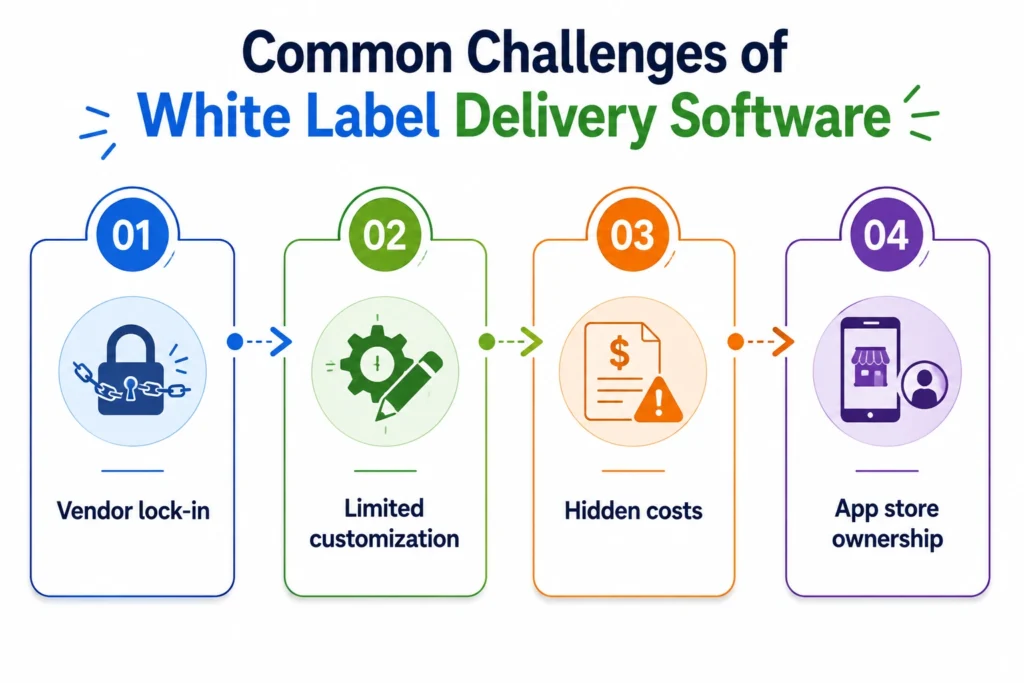
- Vendor lock-in
Some providers make it difficult to migrate your business later. Before signing a contract, confirm that you own your data and can export customer, merchant, and order information whenever needed.
- Limited customization
Not every platform offers the flexibility your business may require. If you need unique workflows or advanced features, choose a solution with open APIs or customization options that can grow with your business.
- Hidden costs
A low upfront price doesn’t always mean lower overall costs. Ask whether pricing includes setup, customization, support, maintenance, and future updates, or if there are additional charges for these services.
- App store ownership
To build long-term brand credibility, your mobile apps should be published under your own Apple App Store and Google Play developer accounts. Verify that the provider supports this instead of listing the apps under their own account.
By asking the right questions before choosing a white-label delivery solution, you can avoid these common challenges and invest in a platform that supports your marketplace’s long-term success.
How to Choose a White Label Delivery Provider?
Ask each vendor these questions before signing:
- Do you own the source code, or only a license to use it?
- Is pricing subscription-based, commission-based, or hybrid?
- Can the platform scale from one city to a multi-city or franchise model?
- What integrations (payment gateways, maps, POS) are included vs. paid add-ons?
- Who owns customer and merchant data if we switch providers later?
- What is the average time from signing to go-live?
- Is ongoing support included, and what are response-time guarantees?
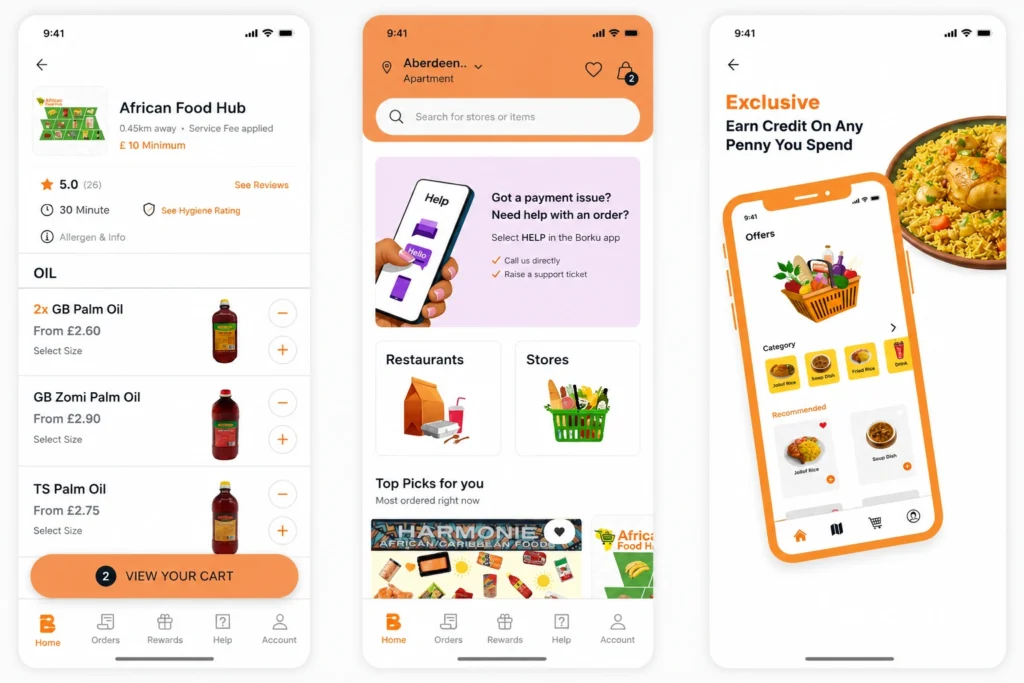
Borku: African Cuisine Delivery, Built on White Label Software (UK)
Borku is a food delivery app focused entirely on African cuisine, built on Enatega’s white-label delivery platform. Rather than building a delivery marketplace from scratch, Borku’s team used a white-label foundation and layered on the customization needed to serve a specific, underrepresented niche: the diverse world of African food for customers across the UK.
What the white-label foundation enabled them to customize:
- Cuisine-specific menu structuring
Rather than a generic restaurant menu template, the platform was adapted to reflect regional African cuisines, letting restaurants highlight dishes like West African Jollof rice and North African tagines that don’t fit neatly into typical food delivery categories.
- Culturally-driven UI/UX
The interface received a full redesign incorporating African-themed visual elements, rather than shipping with the platform’s default look.
- Simplified onboarding flows
Separate, streamlined signup forms were built for riders and restaurants to make it easier for both groups to join the network.
- Payment infrastructure
Stripe was integrated for secure, reliable transaction handling, so Borku didn’t have to build payment processing from the ground up.
FAQs
No. A franchise involves a shared business model and brand identity dictated by the franchisor. White label software is purely a technology license; your business model, pricing, and brand identity are entirely your own.
Yes, within the boundaries the vendor allows branding, workflows, commission rules, and available features. Big structural changes usually require API access or a custom development add-on.
Most providers quote 2-6 weeks from onboarding to go-live, compared to 6-18 months for a fully custom-built platform.
You own the branding, the customer relationships, and (in some cases) the data. However, the underlying source code usually remains licensed from the vendor unless your contract states otherwise. Always confirm ownership terms before signing.
White label software is a complete, ready-to-brand application (apps + dashboards). A delivery API is just the backend logic (e.g., dispatch or tracking) that you integrate into your own, separately built front end. Some providers offer both.
Supercharge your deliveries with Enatega.
Register NowConclusion
In 2026, the biggest advantage in delivery isn’t just having an app; it’s getting to market before the opportunity passes. White label delivery software gives businesses a head start by turning months of development into weeks of execution, while still allowing them to build a brand customers recognize and trust.
The winning businesses are not the ones writing every line of code from scratch. They’re the ones using a proven foundation and focusing their energy on what truly creates value.
So the real question is no longer “Should I build everything myself?” It’s “How quickly can I launch, learn, and grow?”
For most startups, SMBs, and franchise operators, white label delivery software is not a shortcut; it’s a strategic advantage. The technology may be shared, but the brand, the customers, and the growth story are entirely yours.
About the author

Hudaibia Khalid is a senior content writer with several years of experience in creating clear and easy-to-understand content. Over the years, she has worked closely with startups, restaurants, and entrepreneurs, helping them simplify complex digital and technical topics into actionable insights.
Her expertise lies in writing about on-demand platforms, food delivery solutions, and business growth strategies in a way that is accessible even to non-technical readers. With her experience in the industry, she focuses on guiding businesses step by step, from understanding ideas to turning them into fully working solutions.
SHARE






 IOS
IOS Android
 Web
Web