

Key Takeaways
- Growing Demand: On-demand food delivery apps are projected to have 185 million users by 2025, highlighting their immense growth potential.
- Importance of Architecture: A well-structured app architecture ensures smooth performance, scalability, and user satisfaction.
- Core Components: The architecture involves a user interface, backend services, database, APIs, and third-party integrations to streamline operations and enhance user experience.
- Design Principles: Performance, scalability, security, reliability, and user-friendliness are critical for building an effective app.
- Steps to Build: The process includes market research, feature selection, UI/UX design, development, testing, and deployment.
- Cost Estimate: Developing a food delivery app can range from $5,000 for basic features to $100,000 or more for advanced functionalities.
Ever wondered how apps like Uber Eats or DoorDash handle several orders every second without crashing?
Behind every successful food delivery app is a great architecture. The better your food delivery app architecture is, the better your app performs, and you can achieve your goal.
Good architecture helps the app perform smoothly and facilitates seamless communication between users and restaurants. The architecture of a food delivery service requires a careful understanding of the project’s infrastructure and the responsibilities of each component.
To learn more about the food delivery apps process and grow your business with the latest market trends, you’re at the right place. This blog will explore the architecture, features, cost, and steps related to developing food delivery apps.
What is a Food Delivery App Architecture?
The food delivery app architecture involves various elements. Using the interface, customers can place orders and check the delivery progress. The main objective of the architecture is to provide a seamless experience to customers and restaurants.
The user interface connects with the backend server, which manages all processes, such as online orders, order fulfillment, payment processing, and more.
In addition, the server integrates with outside services, which include mapping and geolocation. All the customer and restaurant information is stored on the app database.
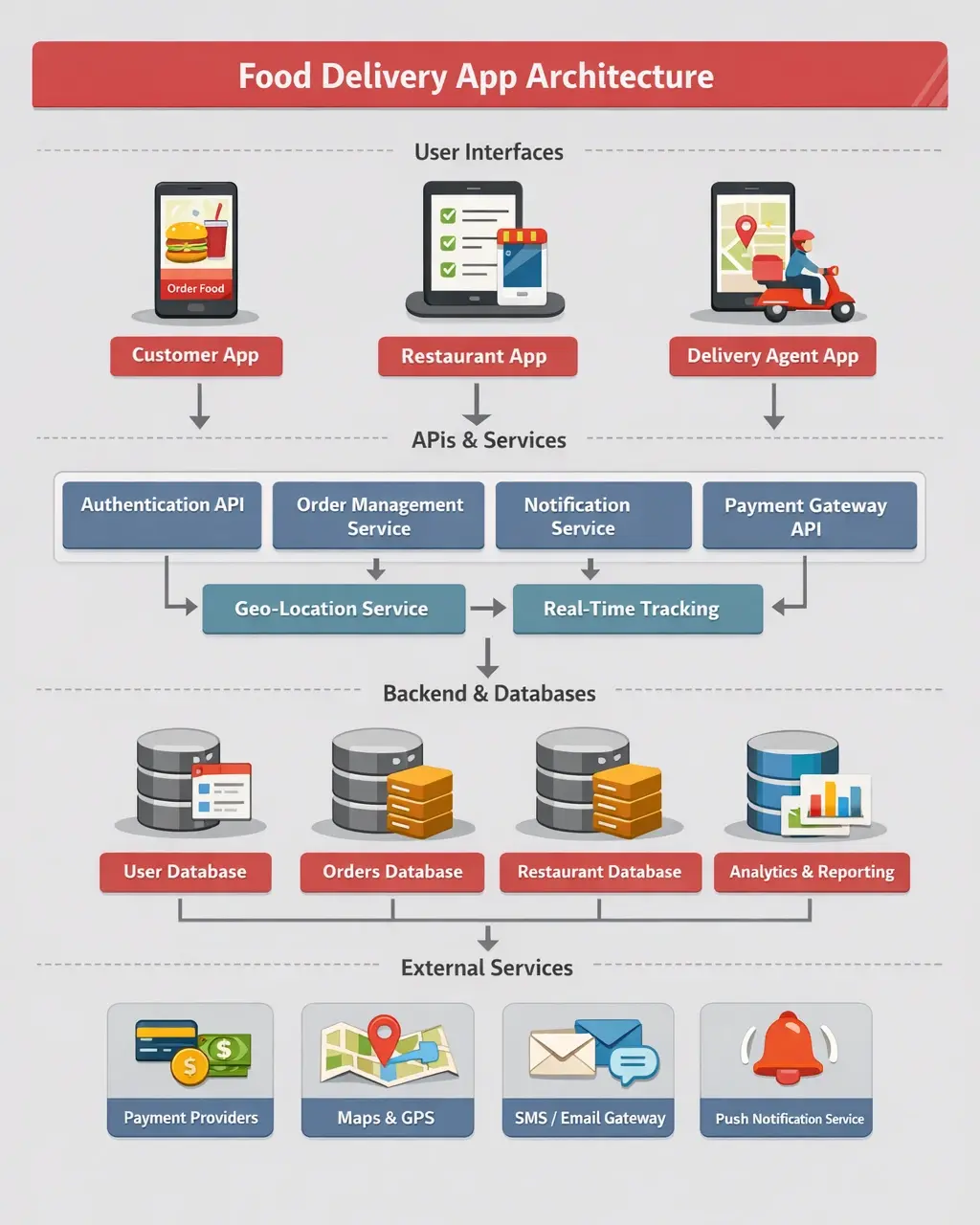
Food Delivery App Architecture Diagram
Components of Food Delivery App Architecture
Let’s discuss these components in detail.
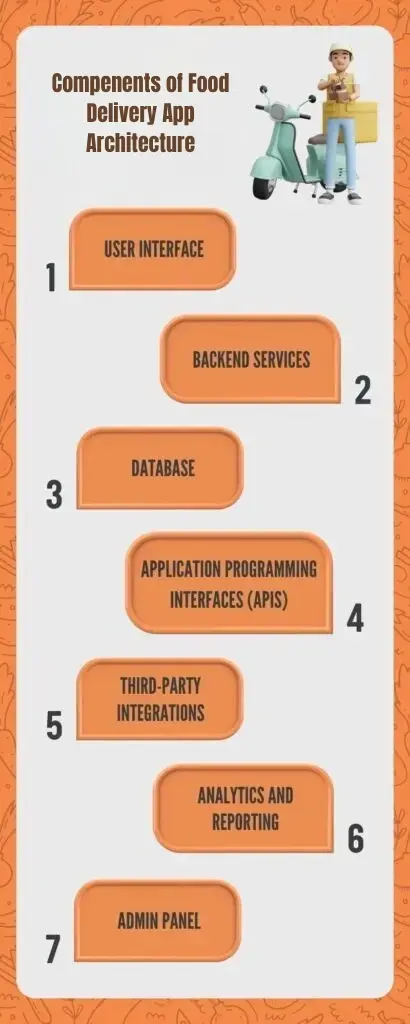
User Interface
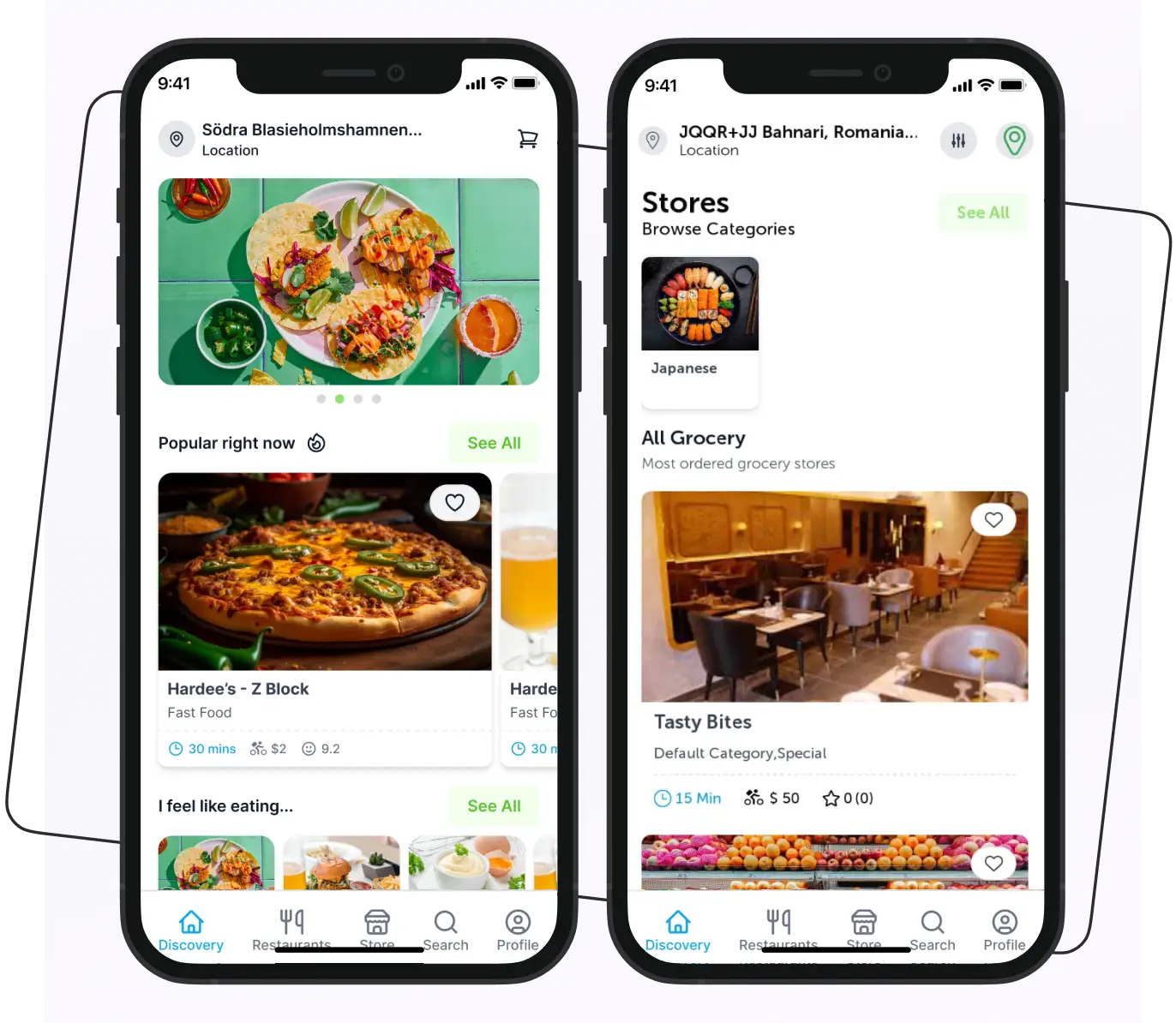
The user interface is the foremost thing that users interact with. It includes various features, such as order tracking, browsing restaurants, placing orders, and making payments.
Also, UI includes:
Customer App: The app allows users to browse menus, place orders, and track deliveries.
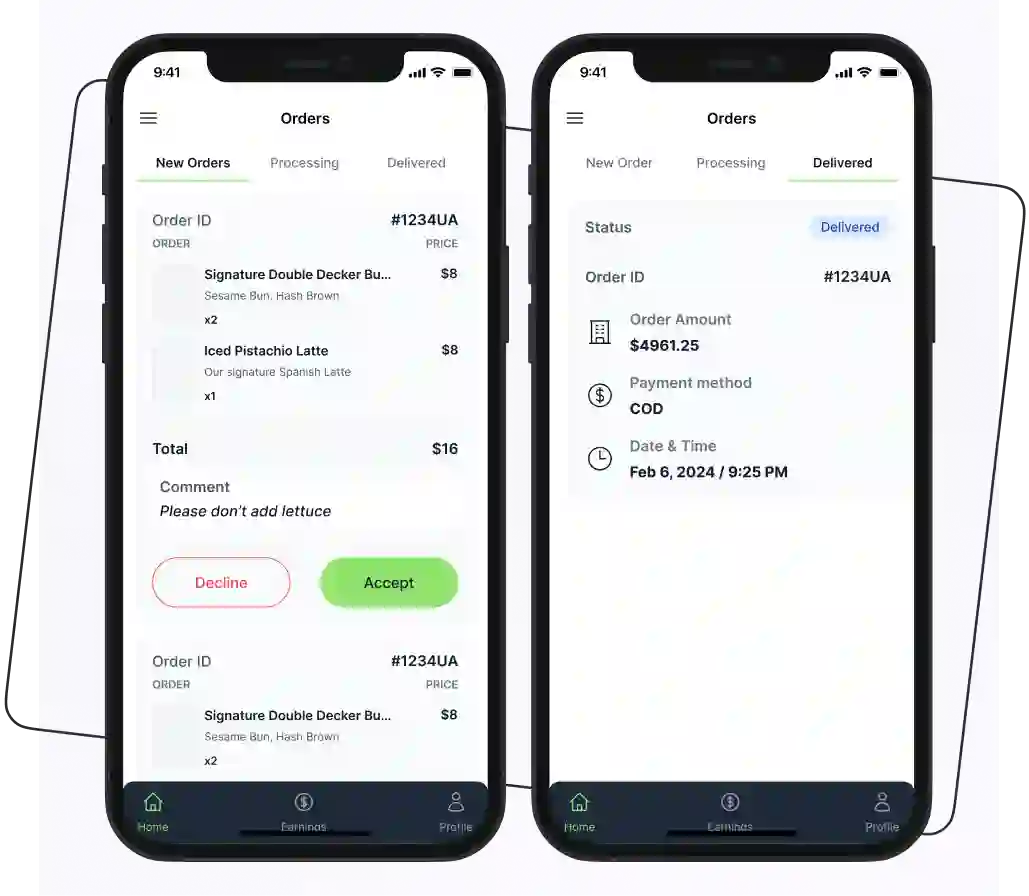
Restaurant App: From the restaurant app, the restaurants manage orders, view orders, track deliveries, update their availability, and more.
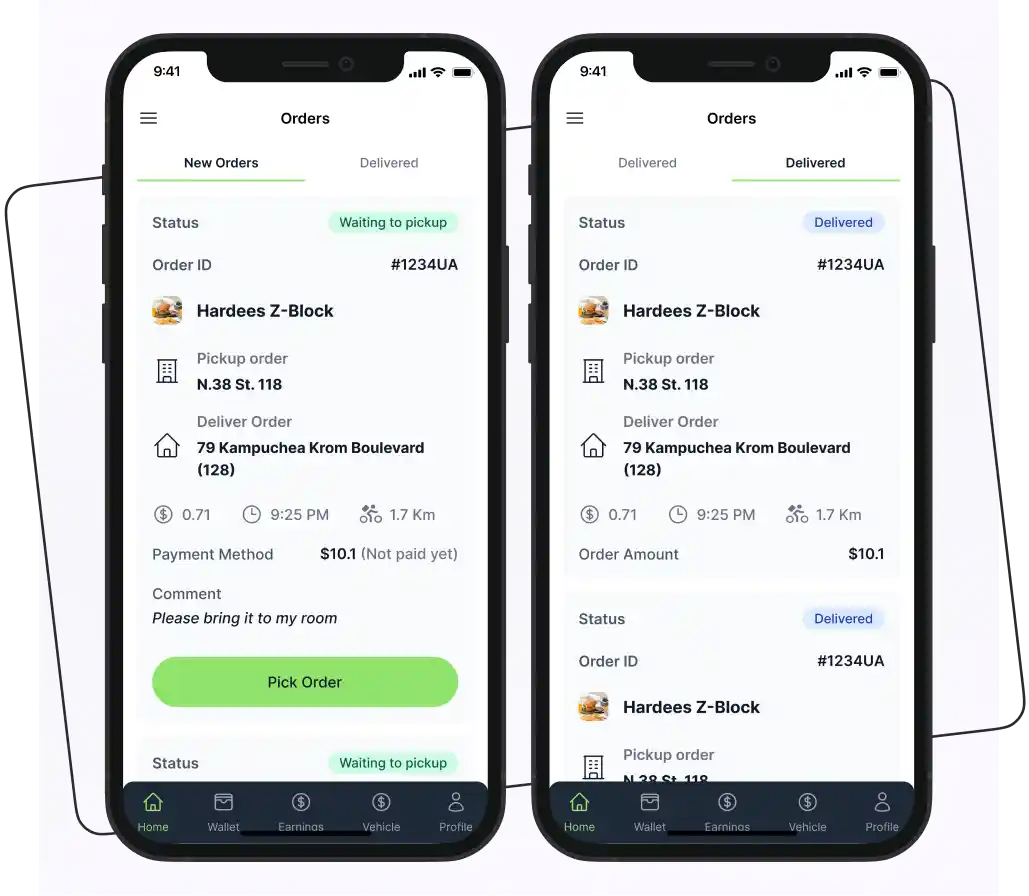
Rider App: With a rider app, the riders can accept or reject orders, navigate routes, and update order status.
Backend Services
The backend services are responsible for managing various app operations. They handle the data and logic behind the app. The backend services include:
- Authorization
- Authentication
- Menu management
- Payment gateway
- Order management
- Notifications
- User profiles and more
Database
The database is an integral part of the food delivery app architecture. It helps store and manage customer, restaurant, and rider data. The database acts as a central hub.
For the customer app, the customer’s personal information, such as name, phone number, delivery address, and other information, is stored in the database.
The database for the food delivery app stores the restaurant information, including location, operation hours, and menu items. In addition, the order-related data, which includes delivery instructions, payment status, timestamps, and order details, is also in the database.
All this information makes it possible to handle orders quickly and correctly, and helps us keep track of their progress as they are delivered.
Application Programming Interfaces (APIs)
The food delivery app can communicate with other services and systems through APIs. They make it easy for the app to connect to many third-party systems and services, increasing its usefulness and giving users a better experience.
The APIs are used to connect geolocation and mapping services. With this, the app can collect positive information and provide real-time tracking of goods.
Third-Party Integrations
The third-party integrations are associated with adding external services to improve the app functionality. These integrations improve user experience and streamline operations for restaurants and riders.
With mapping and geolocation integration, the riders can reach their destination on time by providing optimized routes. Also, the app can track orders in real-time and enhance user experience with live tracking.
Restaurants can partner with renowned payment gateways like Stripe, PayPal, or more. It helps them facilitate secure and smooth online transactions.
Analytics and Reporting
The reporting and analytics provide information about order trends, user activity, and app performance. With this data, the restaurants can make informed decisions for their business. Additionally, it increases operational efficiency and streamlines all operations.
Admin Panel
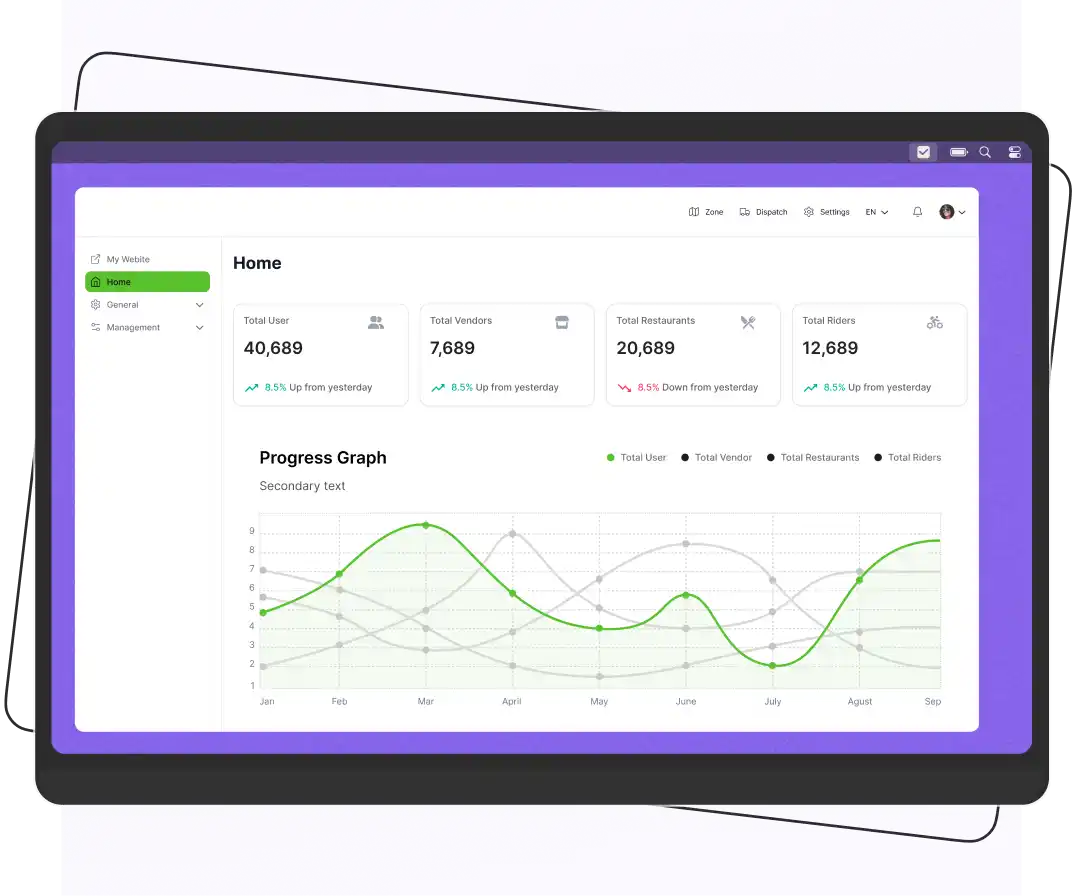
The admin panel helps administrators manage orders, restaurants, riders, and user support effectively. The administrators can make data-driven decisions from the admin panel to improve the user experience.
Food Delivery App Architecture vs. Grocery Delivery App Architecture
| Aspect | Food Delivery App | Grocery Delivery App |
| Order Frequency | High (daily or weekly meals) | Medium (weekly or bi-weekly shopping) |
| Logistics | Often time-sensitive (hot food) | Focused on inventory and batch delivery |
| Architecture Focus | Real-time routing, restaurant menus, and delivery time windows | Warehouse inventory, product availability, and delivery slots |
| User Features | Menu customization, real-time ETA, reviews | Cart saving, bulk orders, substitutions |
Design Principles of an Online Food Delivery App
Below is a list of the food delivery system design principles that should be considered while architecting any system.
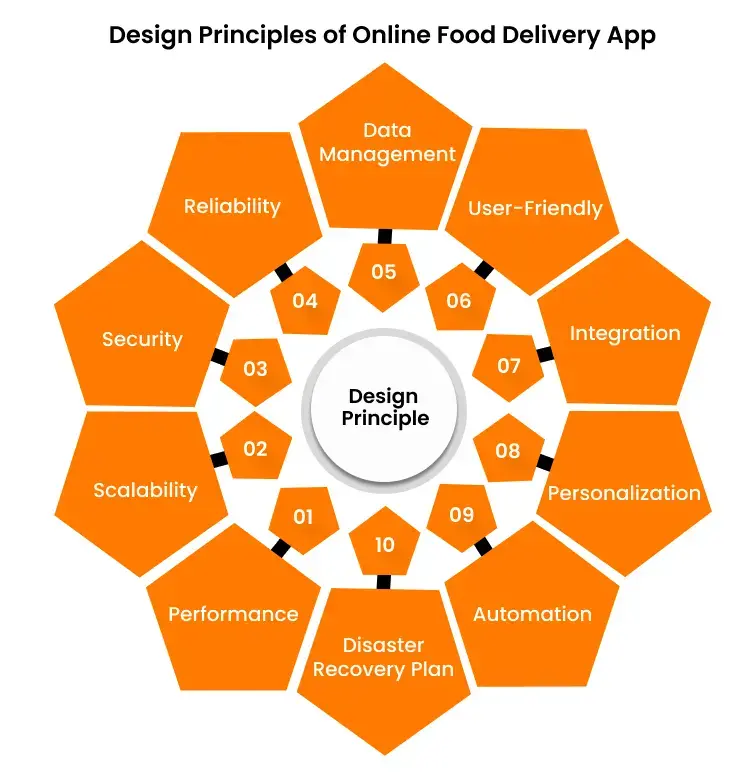
Performance: The system should be designed to provide a fast response time for handling high throughput and low latency.
Scalability: The large number of users and orders should be easily handled.
Security: All sensitive information should be protected.
Reliability: The system should be able to handle failures without disrupting the service.
Data Management: The system should handle large amounts of data.
User-Friendly: The user interface should be easy to navigate, and all customers of all ages can use it easily.
Integration: The system should easily integrate location tracking, payment gateways, and map services.
Personalization: The system should be personalized by offering customized offers and recommendations.
Automation: To minimize manual intervention, design a food delivery system with automation and improve efficiency.
Disaster Recovery Plan: A disaster recovery plan should be included in the system so businesses can keep running even if something goes wrong.
Choosing the Right Architecture: Monolith vs Modular Monolith vs Microservices
When building a food delivery app, one of the most important decisions is how you structure your system architecture. The three most common approaches are Monolith, Modular Monolith, and Microservices. Each is suited for different stages of growth.
Monolithic Architecture (Best for Beginners)
In monolith architecture, your entire application is built as a single system. All features (orders, users, payments, and delivery) are tightly connected in one codebase.
Why choose it?
- Simple to build and launch quickly
- Lower development cost
- Easier to manage for small teams
Limitation
- Hard to scale as your app grows
- Changes in one feature can affect the whole system
Modular Monolith (Best for Growing Apps)
A modular monolith is still one system, but it’s divided into separate modules (like orders, payments, and delivery), making it more organized and flexible.
Why choose it?
- Cleaner structure than a basic monolith
- Easier to scale and maintain
- Allows a gradual transition to microservices later
Limitation
- Still not as flexible as microservices for very large systems
Microservices Architecture (Best for Large-Scale Platforms)
In a microservices architecture, your app is split into independent services, where each feature (orders, payments, users, notifications) runs separately.
Why choose it?
- Highly scalable and flexible
- Teams can work on different services independently
- Faster updates and deployments
Limitation
- More complex and expensive to build
- Requires experienced development teams
How Does The Food Delivery App Work?
The online food delivery process includes four apps: customer, restaurant, rider, and admin. Each app contains features for smooth functioning.
Take a look below and learn what the food delivery app provides.
Customer App
The customer app connects users with their favorite restaurants so they can easily place an order through the app. Its main features are:
- Menu viewing
- Restaurant browsing
- Customization of the menu
- Secure payments
- Order tracking
- Reviews and ratings
- Promo codes and discounts
- View order history
- Notifications
- Search functionality
- User profile
Restaurant App
The restaurant app helps them to manage their food delivery operations through a single platform. It allows them to promote their services and stand out from the crowd. Its features include:
- Order management
- Menu update
- Order acceptance/rejection
- Order tracking
- Profile management
- Customer feedback
- Customer support
Rider App
With the rider delivery app, the restaurants ensure that orders are delivered on time. Using the food delivery rider app ensures the order is given to the right person. The main highlights of the rider app are:
- Order acceptance/rejection
- Order details
- Navigation assistance
- Notifications
- Customer feedback
- Order history
Admin Dashboard
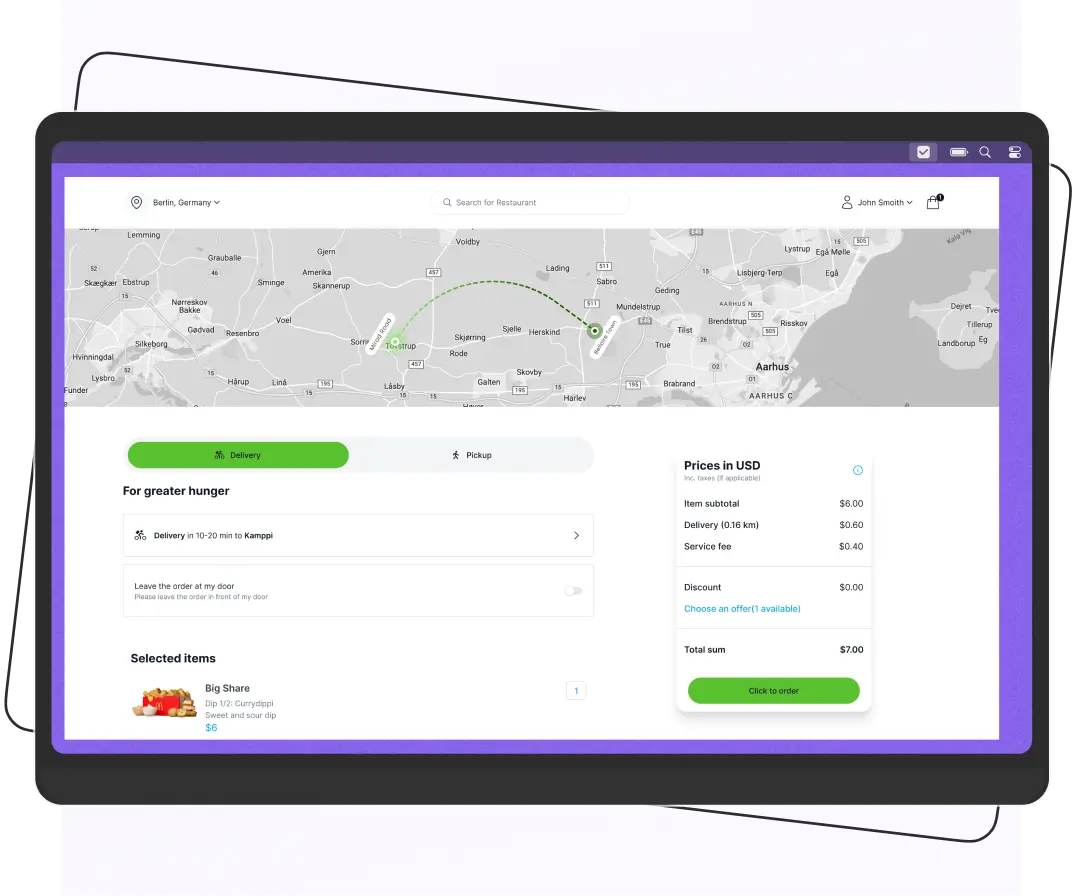
The admin dashboard is the place where all the operations are managed. The admin has complete control from restaurant management to rider management. The main features of the admin dashboard are:
- User management
- Restaurant management
- Riders management
- Content management
- Analytics and reporting
How to Create a Food Delivery App?
You must follow the process that helps you with food delivery app development. Before solid planning, you cannot create a great food delivery app.
Below are some steps to help you in your food delivery app process.
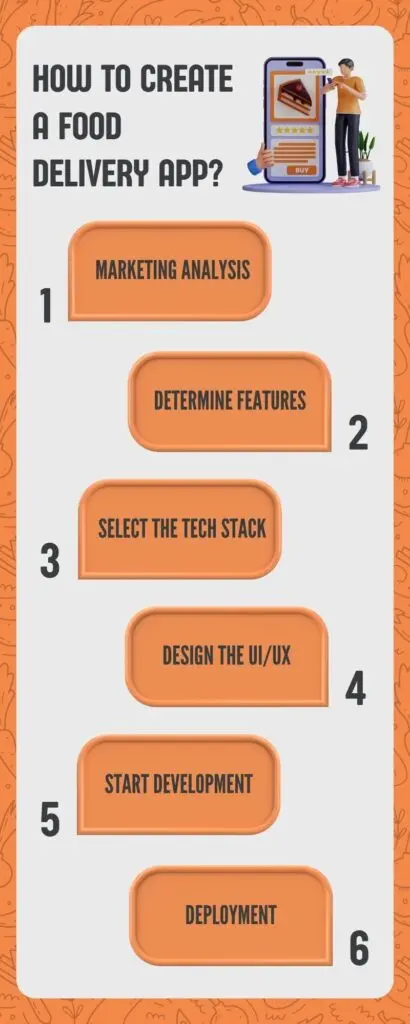
1. Marketing Analysis
Do research and know the latest market trends and competitors. Determine the app requirements, features, ordering technology, target audience, and business model to help in designing a food delivery system.
2. Determine Features
Identify the app features that make your app engaging for the users. Ensure the features you add can be implemented easily and take little time. In the food delivery app, you should include these features:
- Order tracking
- Payment integration
- Menu management
- Rider management
- Reviews and ratings
3. Select the Tech Stack
Select the technology stack according to the functionality of the app. Make sure you select it before working on it; otherwise, it will become a huge problem.
4. Design the UI/UX
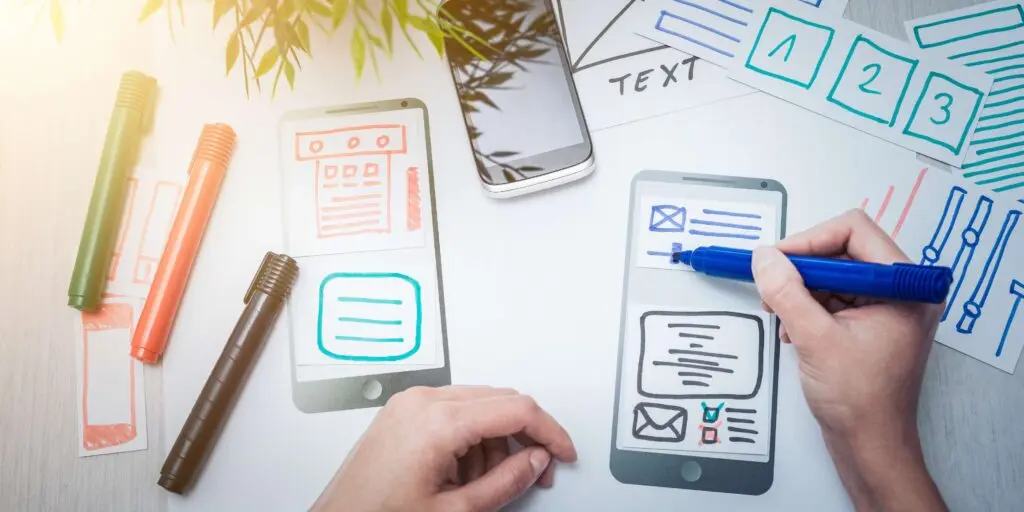
Create a UI/UX design that is visually appealing and attracts users. Make the system design for the food delivery app simple and easy for the users so that they can use it without hassle.
5. Start Development
After designing the food delivery app system design, start working on its development and implement each feature. When the development phase is complete, start testing and make the app error-free.
6. Deployment
Now, it’s time to deploy the app on the App Store and Google Play Store. Follow all their guidelines and deploy them successfully. After deployment, promote your app on social media platforms so people know about your food app.
Supercharge your deliveries with Enatega.
Register NowCost of Building a Food Delivery App
How much would it cost to build a food delivery app?
The cost of building the food delivery app depends on the app’s features, app type, platforms, complexity, development process, tech stack, and scope.
However, with limited features, it costs between $10,000 – $30,000. The app costs between $50,000 – $100,000 or even more for multiple and advanced features.
Common Mistakes to Avoid in Food Delivery App Architecture
Below are some mistakes to avoid in food delivery app architecture.
Choosing the Wrong Architecture
Many businesses start with the wrong architecture without planning for growth. Choosing microservices too early can make the system complex and expensive. Sticking with a monolith for too long limits scalability. This creates problems as your app grows. Always choose an architecture based on your current stage and future needs.
Ignoring Scalability
Some apps work perfectly in the beginning but fail when user demand increases. Without proper scalability planning, your app may slow down or crash during peak hours. This leads to poor user experience and lost customers. Designing for growth from day one is essential.
Poor Real-Time Tracking
Real-time tracking is a core feature, but it’s often poorly implemented. Users may see delayed updates or incorrect delivery locations, which reduces trust in the app. This usually happens due to weak backend systems or slow APIs. Using reliable real-time technologies helps ensure accuracy.
Weak Database Design
A poorly structured database can slow down your entire app. It may lead to slow queries, data duplication, and errors in order processing. Over time, this affects performance and user satisfaction. A well-optimized database is essential for smooth operations.
Over-Reliance on Third-Party Services
Food delivery apps depend on services like payment gateways and maps. If these services fail and you don’t have backups, your app can stop working. This creates a bad user experience and potential revenue loss. Always plan for fallback options and proper error handling.
Ignoring Security Measures
Security is often overlooked in the early stages of development. Weak authentication or unprotected data can lead to serious issues like data breaches and fraud. This damages your brand’s trust and credibility. Implementing strong security practices is essential from the start.
Not Handling Peak-Time Traffic
Food delivery apps experience heavy traffic during lunch and dinner hours. If your system isn’t prepared, servers may crash or slow down. This leads to delayed orders and frustrated users. Proper load handling and scaling strategies are important.
Not Separating Different User Apps
Customer, rider, and restaurant apps have different functions, but some systems treat them the same. This creates confusion and delays in operations. It also makes the system harder to manage and scale. Separating these components improves efficiency and performance.
Skipping Testing and Monitoring
Launching an app without proper testing can lead to bugs and crashes. Without monitoring tools, it becomes difficult to detect and fix issues quickly. This negatively affects user experience and app reliability. Continuous testing and monitoring are key to success.
Build Your Food Delivery App with Enatega
It would be best if you had a robust app architecture to build a top-notch food delivery app that benefits you. With the help of the Enatega team’s years of experience and knowledge, you will get the app that best meets your business needs.
Get the best solution for your brand from us that meets all customers’ demands. Contact us now, and let’s get started.
FAQs
Developing a food delivery app takes 3 to 6 months, depending on features, complexity, and the development team’s expertise.
The stages of an online order include:
Order Placement: The customer selects items and completes the checkout process.
Order Confirmation: The system confirms the order and provides a summary to the customer.
Payment Processing: Payment is processed and verified.
Order Preparation: The restaurant or vendor prepares the order.
Order Dispatch: The order is handed over to a delivery service or rider.
Delivery: The order is delivered to the customer.
Order Completion: The customer receives the order and may provide feedback or review.
The most successful food delivery apps vary by region, but globally, Uber Eats and DoorDash are among the leaders in market share and user popularity. Other notable apps include Grubhub, Deliveroo, and Just Eat.
The food delivery app’s algorithm matches users with nearby restaurants based on preferences, order history, and real-time availability, while optimizing delivery routes and times for efficiency. It often incorporates machine learning for personalized recommendations.
An AI-based food delivery app uses smart technology to recommend meals, optimize delivery routes, and improve order accuracy. It is making the whole process faster and more personalized for users.
The most important factor is reliability, making sure the app delivers your food on time and gets your order right. Other things to consider are ease of use, restaurant choices, and good customer support.
The busiest food delivery app often varies by location, but globally, apps like Uber Eats, DoorDash, and Grubhub tend to lead in popularity and order volume. In some regions, local apps may also be the busiest.
Supercharge your deliveries with Enatega.
Register NowConclusion
The robust online food ordering system architecture is necessary to build a great app that delivers results. All the success of the app depends on the app architecture.
With the help of Enatega, you can easily build scalable apps that meet your needs and help you stay in the competitive market.
About the author

Hudaibia Khalid is a senior content writer with several years of experience in creating clear and easy-to-understand content. Over the years, she has worked closely with startups, restaurants, and entrepreneurs, helping them simplify complex digital and technical topics into actionable insights.
Her expertise lies in writing about on-demand platforms, food delivery solutions, and business growth strategies in a way that is accessible even to non-technical readers. With her experience in the industry, she focuses on guiding businesses step by step, from understanding ideas to turning them into fully working solutions.
SHARE






 IOS
IOS Android
 Web
Web