

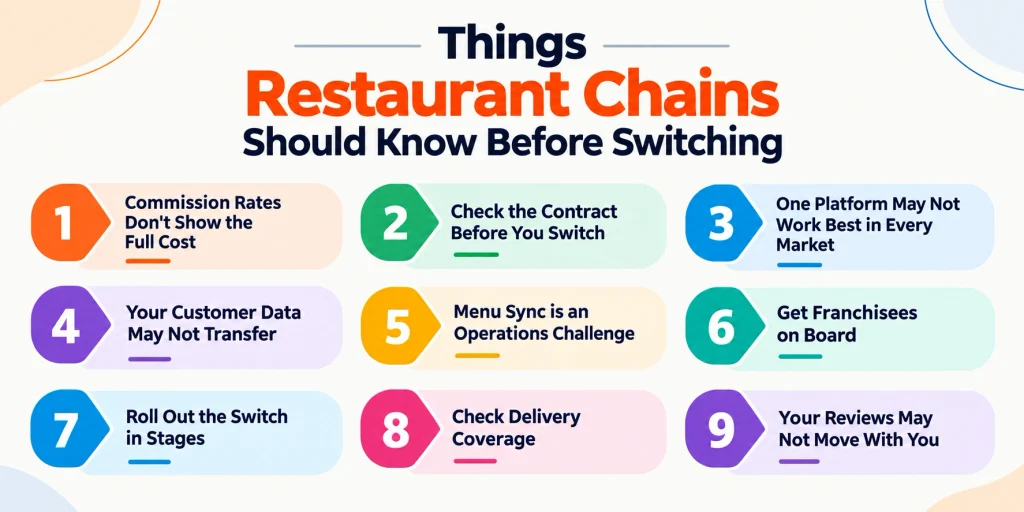
Before switching delivery platforms, restaurant chains should:
- Evaluate total costs
- Existing contracts
- Platform performance by market
- Customer data ownership
- Menu management
- Franchisee adoption
- Rollout requirements
- Delivery coverage
- Transfer of reviews and ratings
A successful switch requires checking these factors in advance. Test the new platform with a small group of locations, and use a phased rollout to reduce operational risks.
For a single restaurant, switching delivery platforms can be a simple software upgrade. For a chain with 20, 200, or 2,000 locations, it’s a business-wide transformation. One platform change can affect orders, customer data, POS integrations, delivery operations, and revenue across hundreds of locations.
And it’s not just about finding lower commissions or a better dashboard. The real questions are:
- Who owns your customer data?
- How smoothly can you migrate?
- Will the platform handle peak demand?
- Can it integrate with your existing systems?
- Will it still work when your chain doubles in size?
Before making the switch, here are 9 things restaurant chains should know to avoid costly problems and choose a platform that can grow with their business.
Supercharge your deliveries with Enatega.
Launch NowThings Restaurant Chains Should Know Before Switching
Switching platforms is a big decision for any restaurant chain. Before making the move, consider these 9 factors to make the transition easier and avoid costly issues.
1. Commission Rates Don’t Show the Full Cost
Most delivery platform comparisons focus on the commission rate, but that number doesn’t always show what you will actually pay. Along with the basic commission, you may also have to pay:
- Marketing fees
- Premium placement charges
- Payment processing fees
- Delivery or logistics costs
Once these extra charges are added, a platform with a lower commission rate may end up costing you more.
Before you switch: Ask the platform for the total cost per order, including all additional fees. Use your actual order volume from the past 90 days to make a more accurate comparison instead of relying on estimated sales figures.
2. Check the Contract Before You Switch
The commission rate is important, but the contract can have an even bigger impact on your ability to switch platforms. Restaurant chains may have multi-year contracts, automatic renewals, or exclusivity clauses that prevent them from working with other delivery platforms in certain areas.
For chains, this can become more complicated because different franchisees or regional locations may have separate contracts. The corporate team may think it is free to switch; some locations could still be tied to older agreements.
Before you switch: Review all existing contracts carefully. Look for exclusivity terms, renewal dates, and termination fees. Knowing these details early can help you plan the switch properly and avoid unexpected costs or legal issues.
3. One Platform May Not Work Best in Every Market
One of the most important things for restaurant chains to understand is that delivery platform performance can vary by location. A platform that is popular in one city may not have the same customer base or order volume in another.
Customers also tend to keep only one or two delivery apps on their phones. So the leading platform in one market could be much less popular somewhere else.
This makes a nationwide platform decision risky. A platform may perform well across most of your locations but still be the third-best option in a few important markets.
Before you switch: Don’t evaluate platforms only at the national level. Check market share and order volume by region or even by individual store.
This can help you avoid losing visibility and orders in markets where another delivery platform already has a strong customer base.
4. Your Customer Data May Not Transfer
When switching delivery platforms, restaurant chains often focus on features, pricing, and integrations but overlook one important issue: customer data.
On third-party marketplaces, the customer may be considered the platform’s customer rather than yours. This can mean that important information such as order history, contact details, and purchasing habits remains with the delivery platform.
This matters because customer and loyalty data can help restaurant chains understand buying behavior and create targeted offers. If you leave a platform, you may not automatically get all of this information back.
Before you switch: Find out exactly which customer data you own and which data is controlled by the platform. Ask what data can be transferred when you leave. If little or no data can be moved, create a plan to reconnect with your existing delivery customers before making the switch.
5. Menu Sync is an Operations Challenge
For a single restaurant, setting up a menu is usually a one-time task. For a large restaurant chain, it is an ongoing process. Prices, promotions, and food images need to stay updated across hundreds of locations and multiple delivery platforms. If menus are not updated correctly, customers may see the wrong prices or order unavailable items, leading to order mistakes and poor ratings.
This becomes even more important when switching platforms because every location needs to stay consistent during the transition.
Before you switch: Make sure the new platform offers proper menu management tools, such as:
- Bulk updates
- POS-linked item availability
- Centralized control of prices and images
Also ask how quickly menu changes are updated across all locations.
6. Get Franchisees on Board
For a franchised restaurant chain, switching delivery platforms is not as simple as making a decision at the corporate level. Franchisees may have their own contracts, preferred platforms, and concerns about revenue, so they may not immediately support the change.
Some locations may also be tied to different delivery agreements, making it difficult to move every store at the same time. If franchisees are not properly informed or given a reason to support the change, the rollout can become slow, incomplete, or even reversed.
Before you switch: Create a clear communication and incentive plan for franchisees before choosing the new platform. Identify which locations can switch immediately and which are still tied to existing contracts.
7. Roll Out the Switch in Stages
For a single restaurant, switching platforms can happen all at once. For a large chain, moving every location at the same time can create major problems. If there is an issue with onboarding, order processing, or driver dispatch, it could affect every location and lead to problems during busy hours.
A staged rollout gives you time to find and fix problems before they affect the entire chain. It also helps your teams and franchisees adjust to the new system.
Before you switch: Start with a small group of locations in different markets. Test the platform in areas where customer demand and platform performance vary.
Set a clear rollout timeline and decide in advance when to pause or reverse the switch if the new platform does not perform as expected.
8. Check Delivery Coverage
Delivery service can vary from one location to another. A platform may have plenty of drivers in a busy city but fewer drivers in suburban or rural areas. This can lead to longer delivery times and more cancelled orders.
For restaurant chains operating in different types of markets, one delivery platform may not work equally well everywhere. Some locations may need marketplace delivery, and others may benefit from in-house or white-label delivery.
Before you switch: Check delivery times and fulfillment rates for each type of location, rather than relying on national averages. Make sure the platform can provide reliable delivery coverage across your entire chain.
9. Your Reviews May Not Move With You
When you switch to a new delivery platform, your ratings, reviews, and search ranking may not transfer. If your restaurant has built a strong reputation on the old platform, starting again on a new one can mean lower visibility and fewer orders at first.
This can be especially challenging for large chains because customers may not find their favorite locations as easily on the new platform. Order volume may drop for a few weeks or even months when the new listings build visibility.
Before you switch: Plan for a temporary drop in visibility. Use promotions, in-store signs, email, and SMS campaigns to let customers know about the change and encourage them to order through the new platform.
Why Restaurant Chains Are Considering White-Label Platforms
Several points discussed above, such as commission costs and data ownership, come from relying on someone else’s marketplace. This is why more restaurant chains are looking at white-label ordering platforms along with or instead of third-party delivery apps.
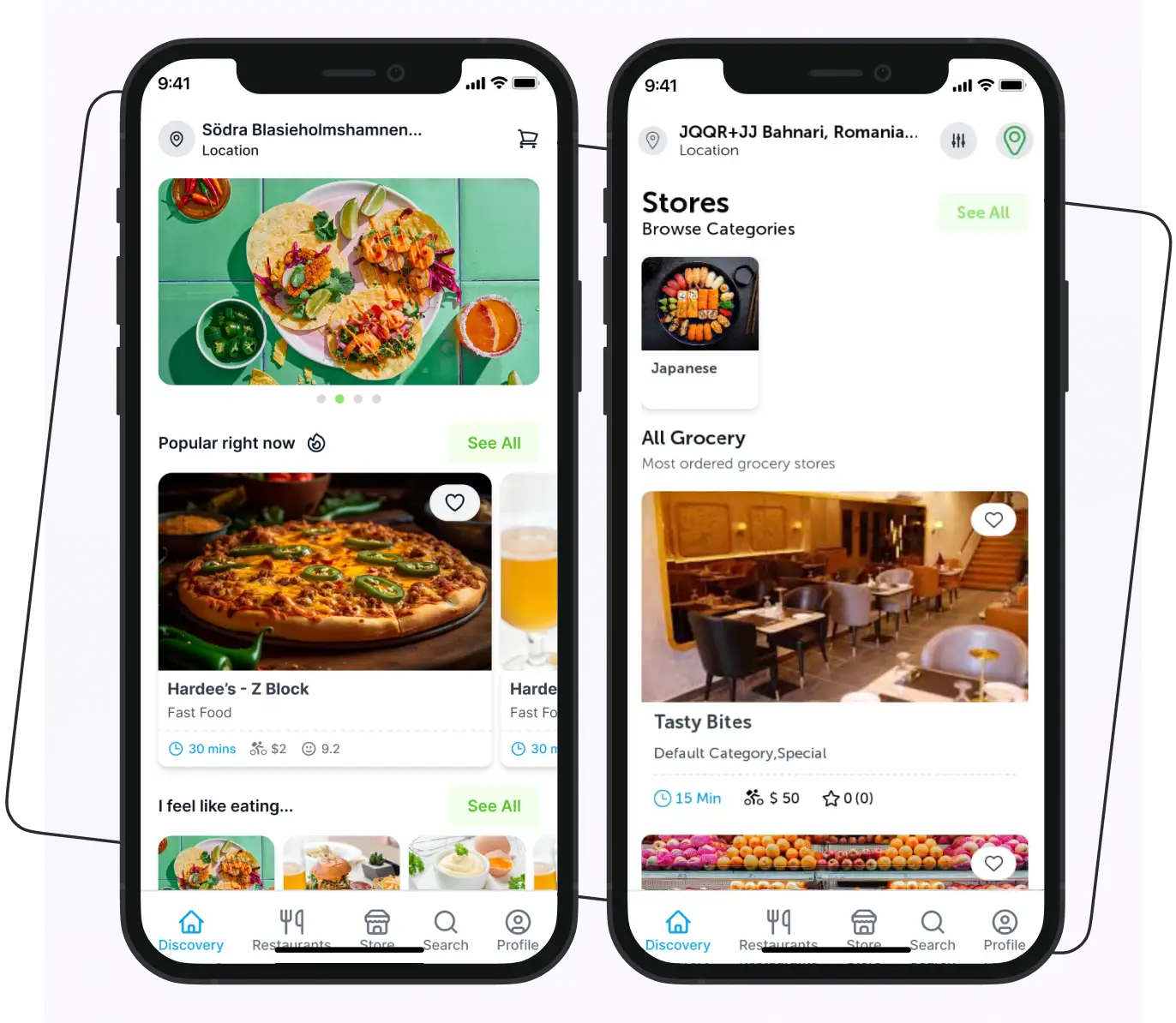
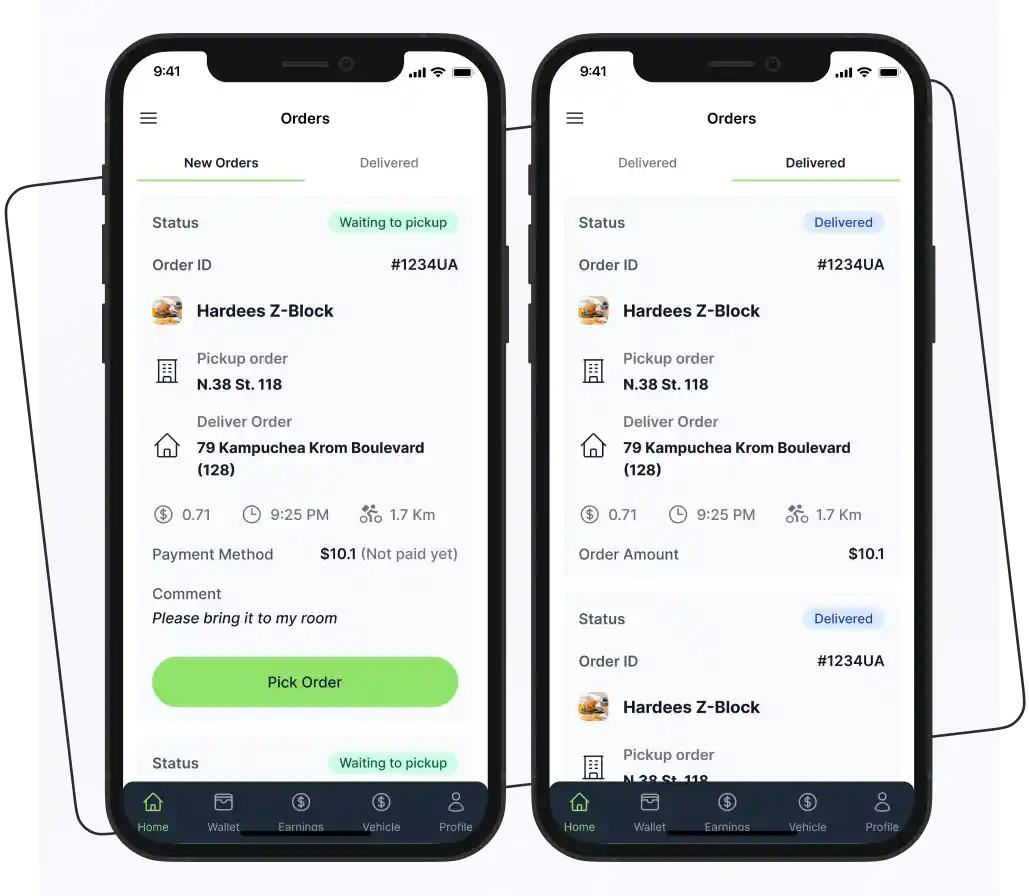
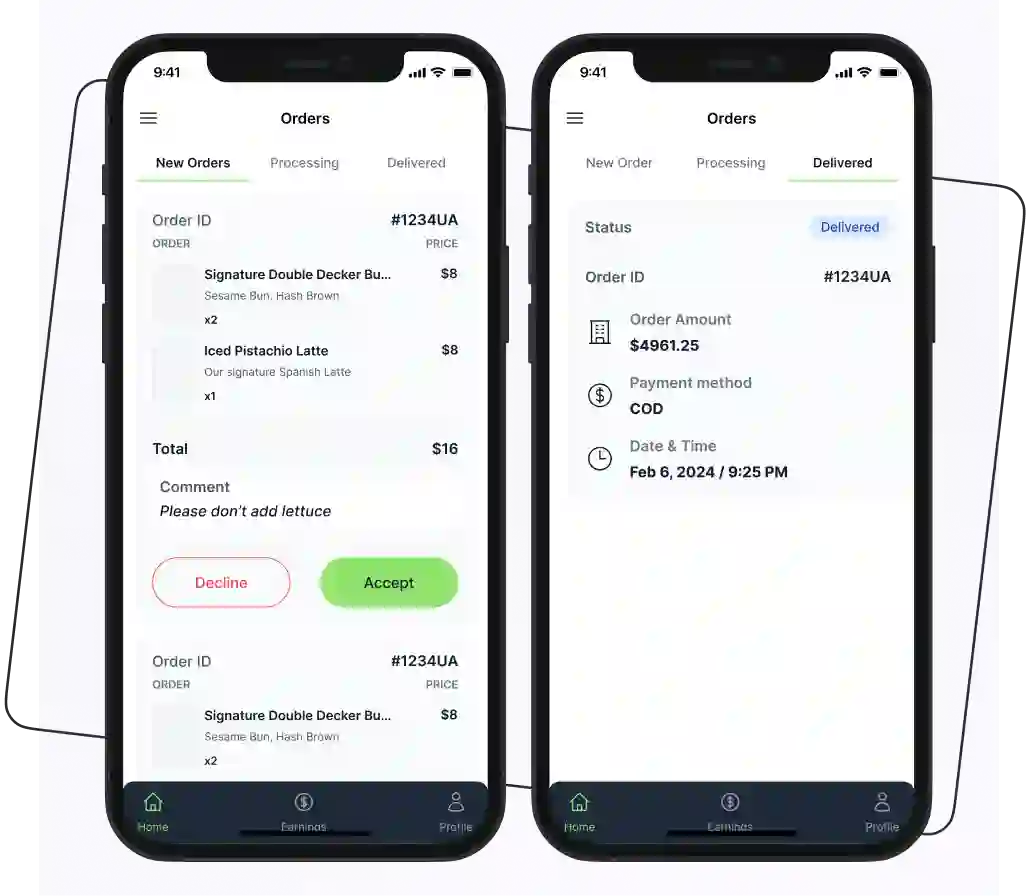
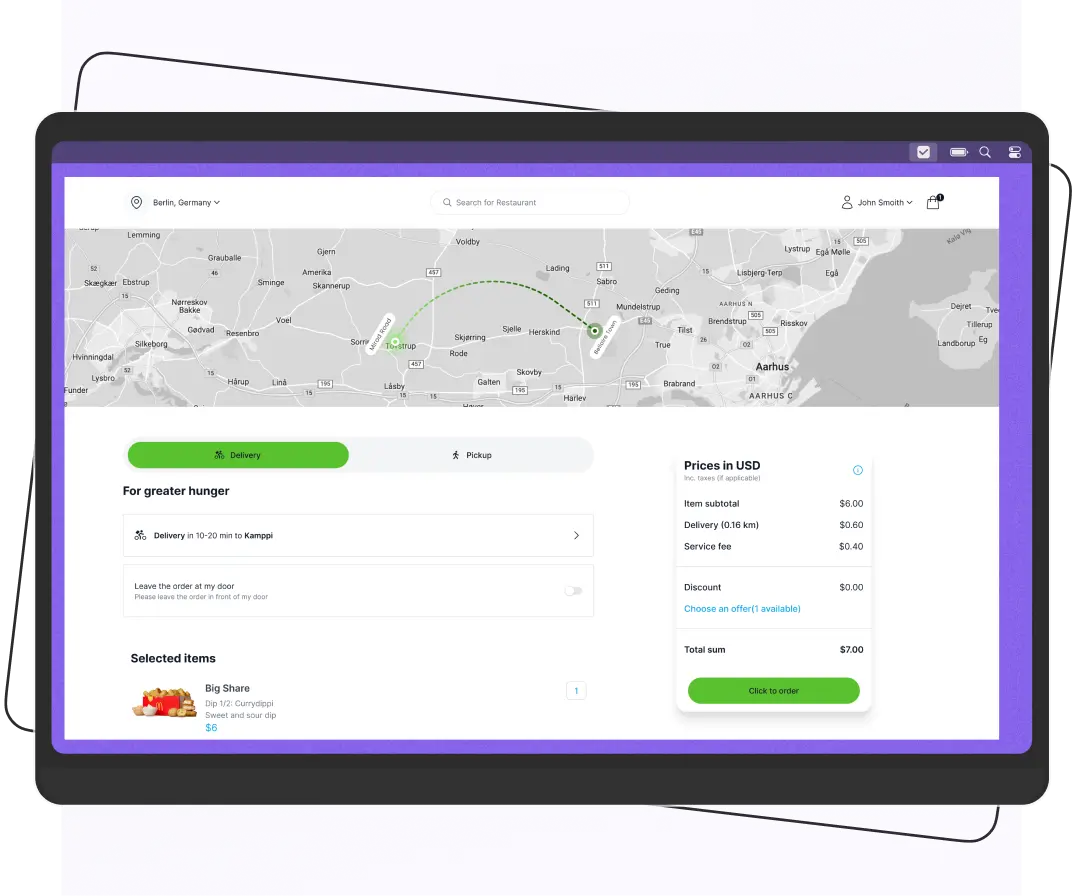
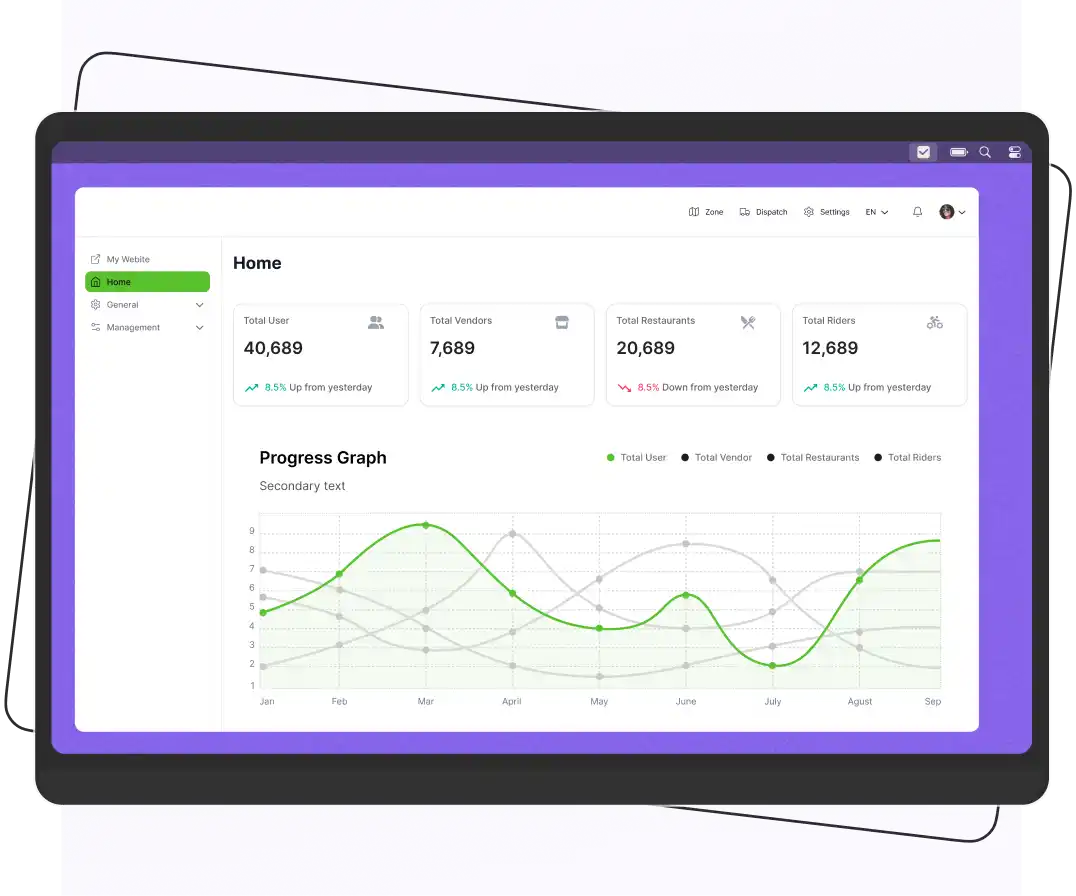
Enatega is one example. It is an open-source, white-label food delivery solution that gives restaurants their own branded customer, rider, and restaurant apps instead of placing them inside a shared marketplace.
Here are a few ways it can address some of the concerns discussed earlier.
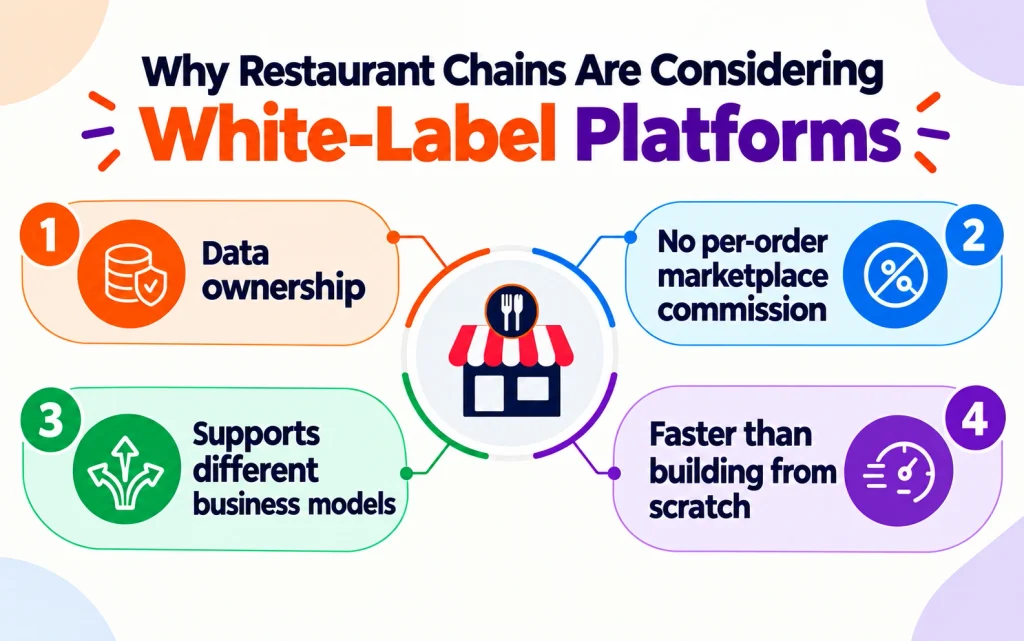
- Data ownership
The ordering system operates under the restaurant’s own brand; customer and order data stays with the business.
- No per-order marketplace commission
Enatega uses a license and ownership model instead of charging marketplace commissions on every order. This can change the overall cost, although there are still upfront setup and ongoing maintenance costs.
- Supports different business models
Enatega can support single-brand restaurants, multi-vendor marketplaces, and regional chain or franchise setups. It can help with multi-location management and franchisee needs.
- Faster than building from scratch
Since Enatega is based on an existing open-source codebase, it can provide a faster way to launch a delivery app compared with developing one completely from the beginning.
A white-label platform does not remove the need for proper planning. It still requires licensing, setup, customization, and rollout planning.
However, for chains deciding between a third-party marketplace and an owned delivery channel, it can be another option worth considering.
FAQs
Switching restaurant delivery software can cost around $0 to $1,500 in setup fees, with monthly subscriptions ranging from $49 to $500+. For larger chains, the total cost can be higher due to customization, integrations, data migration, and additional locations.
A restaurant chain takes 4 to 12 weeks to switch delivery platforms, depending on the number of locations and the complexity of the setup. Larger chains with multiple integrations, franchisee agreements, and data migration may take 2 to 6 months for a full rollout.
A simple single-location setup may go live in 48 hours to 1 week. A large multi-location chain usually needs more time for testing, training, and a phased rollout.
Yes. Large chains may get lower rates because of their order volume, but the final cost can also include marketing, delivery, logistics, and payment processing fees. Compare all these costs, not just the base commission.
Yes. Many restaurant chains use multiple platforms because platform popularity can vary by region. They may use marketplace apps for reach, their own website or app for customer loyalty, and in-house delivery in selected markets.
Customer contact details and order history on third-party platforms often stay with the platform and may not move to the new one. Restaurant chains should use email, SMS, or loyalty programs to reconnect with customers after switching.
Supercharge your deliveries with Enatega.
Launch NowConclusion
Switching delivery platforms is a big decision for a restaurant chain, and it’s not something you want to rush. A lower commission or a few extra features may look attractive, but they won’t matter much if the new platform creates problems with your data, franchisees, or delivery operations.
Take the time to check the contracts, costs, integrations, delivery coverage, and rollout plan before making the move.
Test the platform with a few locations first, listen to your teams and franchisees, and make sure the new system can handle your future growth.
The best switch is not simply about leaving one platform for another. It’s about choosing a system that gives your restaurant chain more control and makes delivery easier to manage as you grow.
About the author

Hudaibia Khalid is a senior content writer with several years of experience in creating clear and easy-to-understand content. Over the years, she has worked closely with startups, restaurants, and entrepreneurs, helping them simplify complex digital and technical topics into actionable insights.
Her expertise lies in writing about on-demand platforms, food delivery solutions, and business growth strategies in a way that is accessible even to non-technical readers. With her experience in the industry, she focuses on guiding businesses step by step, from understanding ideas to turning them into fully working solutions.
SHARE






 IOS
 Android
 Web