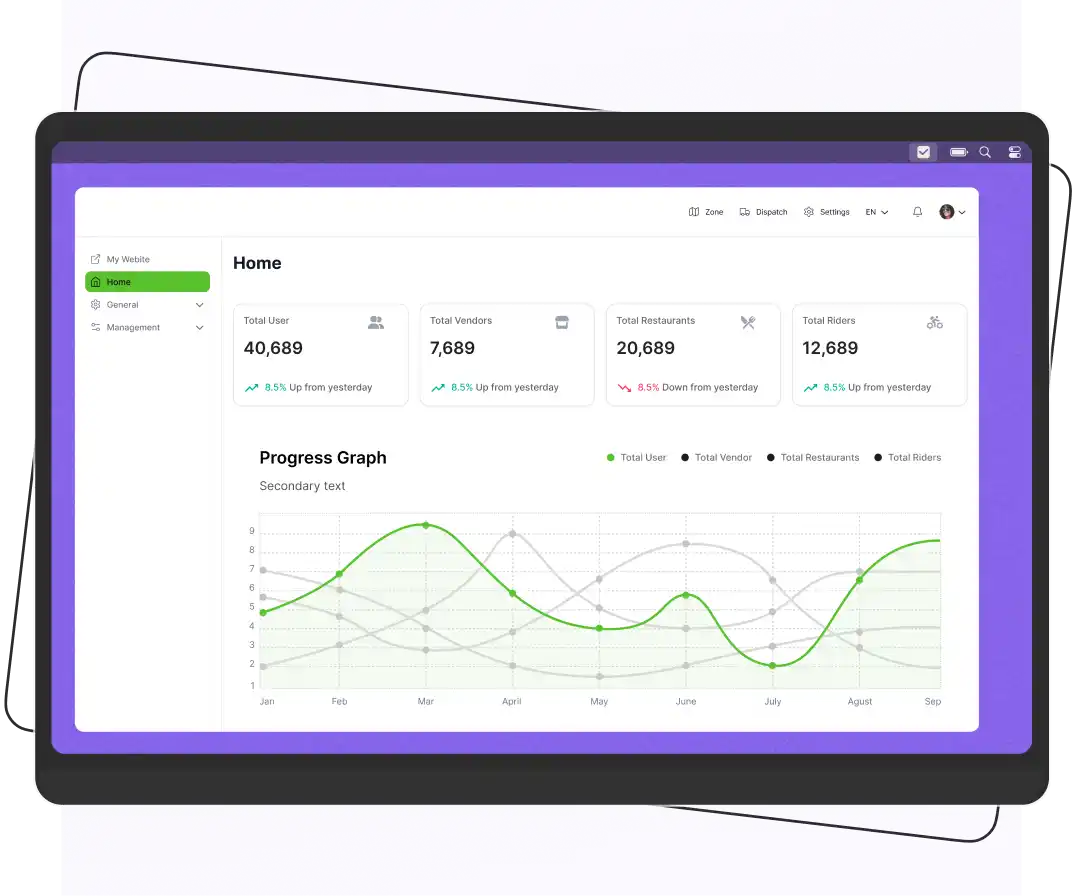


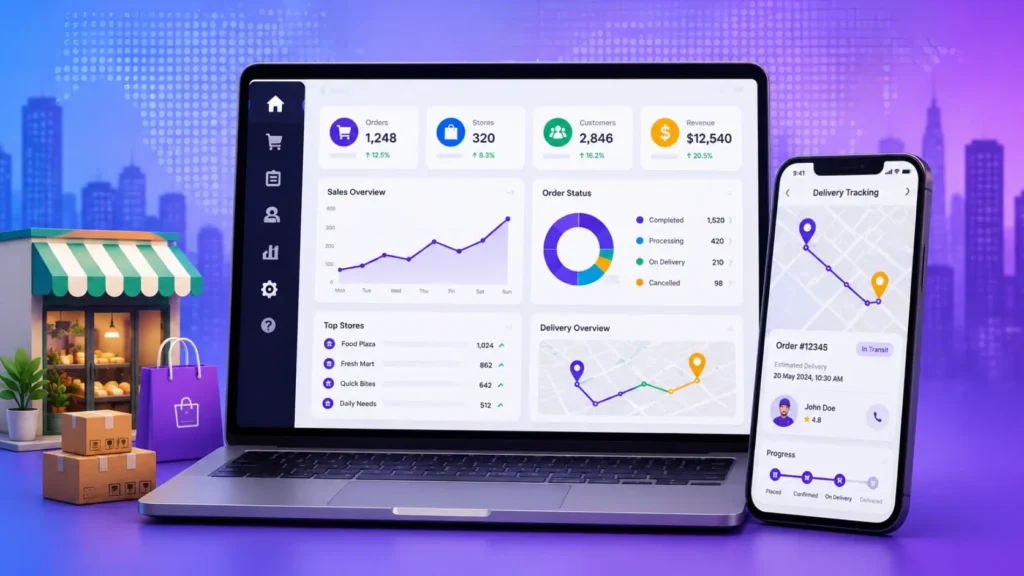
8 main factors in choosing multivendor delivery software are:
- Total cost of ownership
- Data ownership and exit strategy
- Compliance and regulatory fit
- Scalability
- Vendor and driver usability
- Fraud and dispute management
- Integration depth
- Real customer evidence
Choosing multivendor delivery software can look easy at first. Compare features, check the price, pick the platform that seems to offer the most. But that approach can quickly become expensive when real orders start coming in.
A delivery platform has to work for everyone involved, not just the customer. Vendors need simple tools to manage orders, drivers need reliable delivery workflows, and your team needs control over data. At the same time, the software should handle sudden order spikes without slowing down or creating costly congestion.
That’s why the main factors in choosing multivendor delivery software go well beyond a feature checklist. You need to look at:
- The true cost of running the platform
- Who owns your data and source code
- How well it scales
- How payouts and compliance are handled
- Vendors and drivers can actually use it without difficulty
This blog explores what really matters when comparing platforms and the important details that typical “top delivery software” lists often leave out.
So, let’s start.
Supercharge your deliveries with Enatega.
Launch NowWhat is Multi-Vendor Delivery Software?
Multi-vendor delivery software is a platform that lets multiple independent sellers restaurants, grocery stores, pharmacies, retailers, or couriers list products and fulfill orders through one app or website.
It differs from single-vendor delivery software (built for one restaurant chain or one store). It has to coordinate four separate parties at once: the platform operator, vendors/sellers, delivery drivers, and customers.
Because four sides have to work in sync, the software’s job isn’t just “take an order”. It’s order splitting across vendors, real-time driver dispatch, and dispute handling, all at once. That’s why choosing the wrong platform is expensive to reverse.
8 Factors in Choosing Multivendor Delivery Software
Below are some factors that help you choose the right multi-vendor delivery software for your business.
1. Total Cost of Ownership, Not Sticker Price

The price you see on a software website is not always the amount you will actually pay. Many platforms advertise a low starting monthly fee, often around $15–$500/month for route and dispatch tools, or charge a percentage-based SaaS fee for full marketplace platforms. But these starting prices often leave out several additional costs.
Before choosing a platform, look at the total cost of ownership, including:
- Extra charges per task or order: Some plans include a fixed number of tasks or orders and charge an additional $0.13-$0.15 per task once you go over the limit.
- Per-seat or per-driver fees: Some platforms charge based on the number of users or drivers rather than your order volume. As your team grows, these costs can quickly add up.
- One-time setup costs: Branded apps, white-label solutions, and customer tracking portals may come with separate setup or implementation fees.
- Payment and payout fees: Payment gateway and payout processing charges can add to the platform’s own commission, increasing your overall costs.
- Ongoing development costs: Open-source or self-hosted software may appear free, but you still need a development team to manage hosting, security updates, maintenance, and future feature development.
Don’t judge a platform by its entry-level price. Ask the vendor for a 12-month cost projection based on your expected order volume. This will give you a much clearer picture of what the software will actually cost your business.
2. Data Ownership and Exit Strategy

Most people focus on features and pricing but rarely ask an important question: What happens if you decide to leave the platform?
Before committing to any multivendor delivery software, make sure you understand what happens to your data, source code, and payment setup if you switch providers.
Check these points:
- Can you export your data? Make sure you can easily export your complete order history, customer data, and vendor data in a usable format.
- Who owns the software code? Find out whether the platform is self-hosted or source-available, where you retain access to the code, or it is a fully managed SaaS platform where you may lose access when you cancel.
- Can you change payment providers? Check whether you are tied to the platform’s payment processor or can switch to another payment gateway without rebuilding your entire checkout system.
A platform may be inexpensive and easy to start with, but if leaving it is difficult, costly, or impossible, that low entry price can become a hidden liability for your business.
3. Compliance and Regulatory Fit for Your Market

Delivery platforms handle payments, customer data, vendor information, and driver payouts. All of these areas are subject to different rules depending on where your business operates.
Therefore, compliance should be a main part of your software selection, not something you think about after launch.
Before choosing a platform, check that it supports:
- Data privacy requirements
Make sure the platform meets the privacy regulations that apply to your market, such as GDPR in the EU and UK, or equivalent local regulations.
- PCI-DSS requirements
Check how the platform handles card information. This is especially important if it stores payment details instead of using tokenization through a certified payment processor.
- Gig-worker and labor rules
Driver classification, payout schedules, and benefit requirements can vary by region and are changing in several markets. Your platform should allow these rules to be adjusted instead of having them hardcoded into the system.
- Tax handling
Find out whether the software can automatically calculate and handle sales tax or VAT for different vendors and regions. Your team will have to manage these calculations manually.
Choosing software that fits your market’s regulatory requirements can help you avoid compliance problems. Also, reduce the amount of manual work your team has to handle.
4. Scalability

Almost every delivery software platform claims to be “scalable.” But a marketing claim does not tell you how the system will actually perform when your order volume suddenly increases.
Instead of simply trusting the word “scalable,” look for real evidence:
- Ask for relevant customer references
Look for businesses handling a similar order volume to yours, rather than being impressed by large enterprise logos alone.
- Test performance during demand spikes
Find out how the platform performs during busy periods such as lunch rushes, weekends, and holidays. Does routing or dispatch remain fast, or does performance slow down?
- Check real-time routing and dispatch
Make sure route optimization and automatic order assignment work in real time rather than relying on batch processing or delayed updates. This becomes especially important when dozens of orders and drivers are active at the same time.
- Review uptime guarantees and SLAs
Check that the provider offers a clear uptime guarantee and Service Level Agreement (SLA). If there is no published SLA, you may have limited accountability when the platform goes down during your busiest hours.
Don’t choose software because it says it can scale. Choose it because you have evidence that it can handle your real-world order volume and peak demand.
5. Vendor-Side and Driver-Side Usability (Not Just the Customer App)
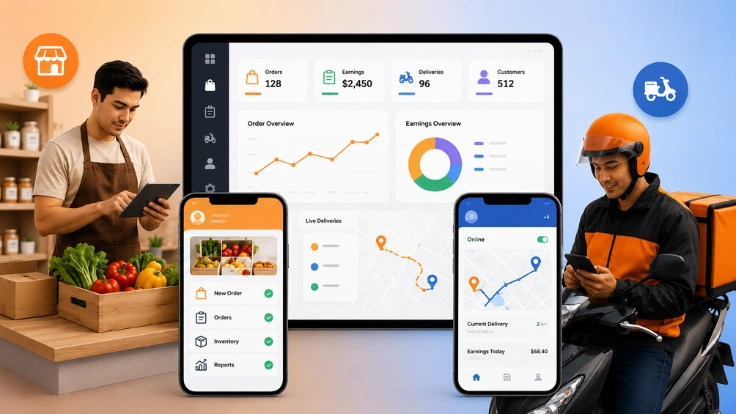
Some pay attention to the customer app and overlook the other two-thirds of the platform: the vendor and driver experience. But even the best customer app cannot succeed if vendors and drivers find the platform difficult to use.
Before choosing a multivendor delivery platform, look closely at these areas:
- Easy vendor onboarding
Can a non-technical vendor sign up, set up their profile, and update their menu or catalog without needing to contact support for every change?
- Reliable driver app
Can drivers continue using the app when they have poor or no internet connectivity? Ideally, the app should queue status updates and sync them when the connection is restored. This is especially important in suburban areas.
- Clear and flexible payouts
How and when do vendors and drivers receive their payments daily, weekly, or on demand? Delayed or unclear payouts can increase vendor and driver churn, which can ultimately affect the reliability of your delivery network.
- Real-time communication
Is there a built-in chat or dispute channel connecting customers, vendors, drivers, and support? Or does every issue have to go through a slow ticketing system? Faster communication can make it much easier to resolve delivery problems.
Don’t evaluate delivery software only from the customer’s perspective. Vendors and drivers use the platform every day, so their experience can directly affect adoption.
6. Fraud, Disputes, and Trust Mechanics
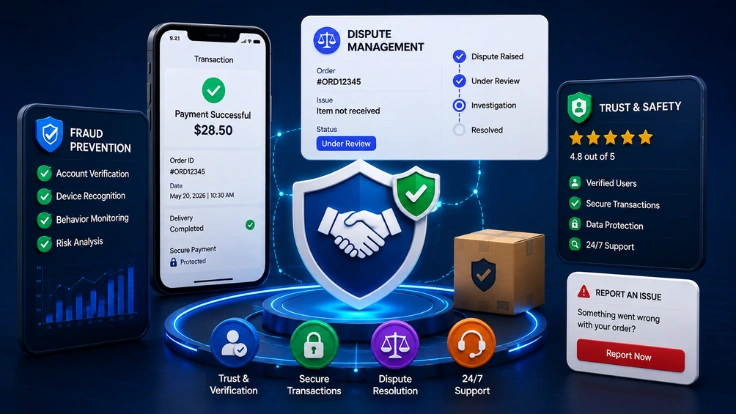
A platform may look great on paper, but if it cannot help you manage refunds, suspicious activity, and vendor quality issues, your team could end up handling everything manually.
Before choosing a platform, check how it handles:
- Refunds and delivery disputes
Can the system automatically handle common issues such as missing items, incorrect orders, or delivery disputes? Or will your support team have to manually review and resolve every claim?
- Fraud detection
What tools are available to detect fake accounts, suspicious orders, or driver GPS spoofing? Strong fraud controls can help protect your revenue and platform reputation.
- Vendor ratings and suspension
Does the platform provide a system for rating, monitoring, and suspending vendors when quality issues arise? More importantly, can you customize these rules according to your own policies, rather than being limited to fixed default settings?
Trust and fraud controls are not optional extras. They can help protect your customers, vendors, drivers, and revenue as your marketplace grows.
7. Integration Depth, Not Just Integration Existence

Many delivery platforms advertise integrations as a main feature, but simply saying “integrates with X” does not tell you how useful or reliable that integration is.
What matters is how deeply the software connects with the tools your business already uses. Also, those integrations will continue to work as your platform grows.
Before choosing a solution, consider these points:
- Native and maintained integrations
Is the integration built into the platform and regularly maintained, or does it rely on a third-party connector that could break after an update?
- Stable and documented APIs
Does the platform provide a well-documented and reliable API? This gives your development team more flexibility to build custom features and integrations without having to wait for the vendor to add them to its roadmap.
- Connection with existing systems
Can the platform connect with your current POS, inventory, and accounting systems? Good integration should reduce manual work rather than forcing vendors to enter the same information into multiple systems.
Don’t choose software simply because it has a long list of integrations. Look at how reliable and deeply those integrations work with your existing business systems.
8. Real Evidence Over Marketing Claims

Claims such as “40% cost reduction” or “launch in 60 days” may sound convincing, but they don’t tell you much without real evidence behind them.
Before trusting a platform’s marketing claims, look for proof:
- Ask for named and verifiable references
Don’t rely on percentages or anonymous success stories. Ask the vendor to provide real customer references you can verify.
- Check recent user reviews
Look at recent, dated reviews on platforms such as G2 and Capterra instead of relying only on testimonials published on the vendor’s website.
- Verify claims through documentation
Compare what the sales team promises with the vendor’s official product documentation, release notes, and changelog. This can help you see whether the advertised features are actually available and actively maintained.
A Practical Decision Framework
Once you know what to look for, comparing multi-vendor delivery platforms becomes much easier. Instead of getting distracted by long feature lists, use the questions below to identify potential problems early.
The order matters: start with the questions that could disqualify a vendor fastest.
| Priority | Question | Red Flag Answer |
| 1 | Can I export my data if I leave? | “No” or “unclear” |
| 2 | What’s the true 12-month cost at my volume? | Vendor won’t project beyond the entry tier |
| 3 | What’s the published uptime SLA? | No SLA offered |
| 4 | Can vendors and drivers self-onboard without support? | Requires manual setup every time |
| 5 | Does it handle my region’s tax and compliance needs natively? | “You’ll need a workaround” |
| 6 | How are disputes and refunds resolved? | Fully manual, with no workflow |
| 7 | Is there a real, documented API? | Integrations are “coming soon” |
| 8 | Can I see recent, verifiable customer references at my scale? | Only logos, with no contacts |
Use this framework before signing a contract or committing to a platform. A vendor that cannot give clear answers to these questions may create operational or financial problems later. Even if its feature list looks impressive today.
Build vs. SaaS vs. Self-Hosted
When choosing delivery software, the decision isn’t simply about finding the platform with the most features. You also need to decide how much control and responsibility you want to take on.
There are three common approaches, and each comes with its own trade-offs:
- Custom-built from scratch
This gives you complete control over the platform, but you also become responsible for every future feature, security update, and bug fix.
It is rarely worth the investment unless your delivery model is significantly different from what existing platforms can support.
- Self-hosted or source-available (open-source core)
This can be a practical middle ground. You get more freedom to customize the platform and aren’t tied to a vendor’s release schedule. However, you or your development team still need to handle hosting, scaling, security, updates, and ongoing maintenance.
- Pure SaaS
SaaS platforms are usually the quickest to launch and require less technical work upfront. However, you depend on the provider for its roadmap, pricing, infrastructure, and continued operation. This makes data portability especially important if you ever need to move to another platform.
There is no single “best” option for every business. The right choice depends on your technical resources, growth plans, and launch timeline. Not simply on which platform has the longest feature list.
Enatega: More Control Without Building From Scratch
Enatega sits between a custom-built platform and a SaaS solution. It gives businesses more control and customization without the time and cost of building a delivery platform from scratch.
With Enatega, you get:
- Full source code for customer, vendor, and rider apps
- White-label branding
- Support for multiple industries such as food, grocery, pharmacy, and retail
- Guided setup and support to help businesses get started
This makes Enatega a great option for startups and agencies that want to avoid building everything from zero.
If you’re comparing delivery software based on cost, ownership, customization, and ease of setup, you can explore Enatega and see how it fits your business needs.
FAQs
There is no single factor that matters most. However, total cost of ownership and data/exit portability are often overlooked by buyers and can become two of the most expensive things to get wrong after launch.
No. Affordable entry-level and mid-market platforms can work well for startups. The real risk is not a low price but an unclear pricing model.
Choose SaaS if you want to launch quickly and don’t have an in-house engineering team. Consider self-hosted or source-available software if you need deeper customization or want greater control and less long-term vendor lock-in.
Ask the vendor for customer references with a similar order volume to your target. Also ask how dispatch and routing perform during demand spikes and request the platform’s uptime SLA in writing.
Supercharge your deliveries with Enatega.
Launch NowConclusion
Choosing multivendor delivery software is about more than ticking off features. Look at the real cost, data ownership, and day-to-day experience for vendors and drivers before making a decision.
Ask the questions that matter: Can you take your data with you? What happens when your orders increase? Can the platform handle busy periods? And will your vendors and drivers actually find it easy to use?
The right platform should fit your business today while giving you enough flexibility to grow tomorrow.
About the author

Hudaibia Khalid is a senior content writer with several years of experience in creating clear and easy-to-understand content. Over the years, she has worked closely with startups, restaurants, and entrepreneurs, helping them simplify complex digital and technical topics into actionable insights.
Her expertise lies in writing about on-demand platforms, food delivery solutions, and business growth strategies in a way that is accessible even to non-technical readers. With her experience in the industry, she focuses on guiding businesses step by step, from understanding ideas to turning them into fully working solutions.
SHARE






 IOS
IOS Android
 Web
Web