

8 things to know about one-time fee delivery platforms are:
- One-time payment instead of recurring software fees
- Ongoing costs may still apply
- Maintenance and updates may become your responsibility
- Source-code ownership provides greater control
- You must generate your own customer demand
- A complete platform should support customers, restaurants, and drivers
- Always calculate the total long-term cost
- A hybrid approach combining direct ordering with marketplaces can work best
Every time a customer places an order, paying a percentage of that sale to a delivery platform can quickly eat into your margins. What looks like a small fee on one order can become a huge expense when you’re processing hundreds or thousands of orders every month.
Now, more restaurants and delivery businesses are considering one-time fee delivery platforms. Instead of paying a monthly subscription or giving up a percentage of every order, you pay upfront for the software.
But a one-time payment doesn’t mean zero ongoing costs. Hosting, maintenance, updates, payment processing, third-party services, and technical support can still add to your expenses.
You may also have to build your own customer base rather than relying on marketplaces such as Uber Eats, DoorDash, or Grubhub to bring customers to you.
So, is a one-time fee delivery platform actually a better investment?
We’ll look at:
- How the model works
- What you really pay for
- The costs people often overlook
- When owning your delivery platform makes more sense than continuing to rent one
Let’s explore.
Supercharge your deliveries with Enatega.
Launch NowWhat is a One-Time Fee Delivery Platform?
A one-time fee delivery platform is a delivery service or software where you pay a single upfront charge instead of committing to a recurring monthly or yearly subscription or paying a fee on every order or transaction.
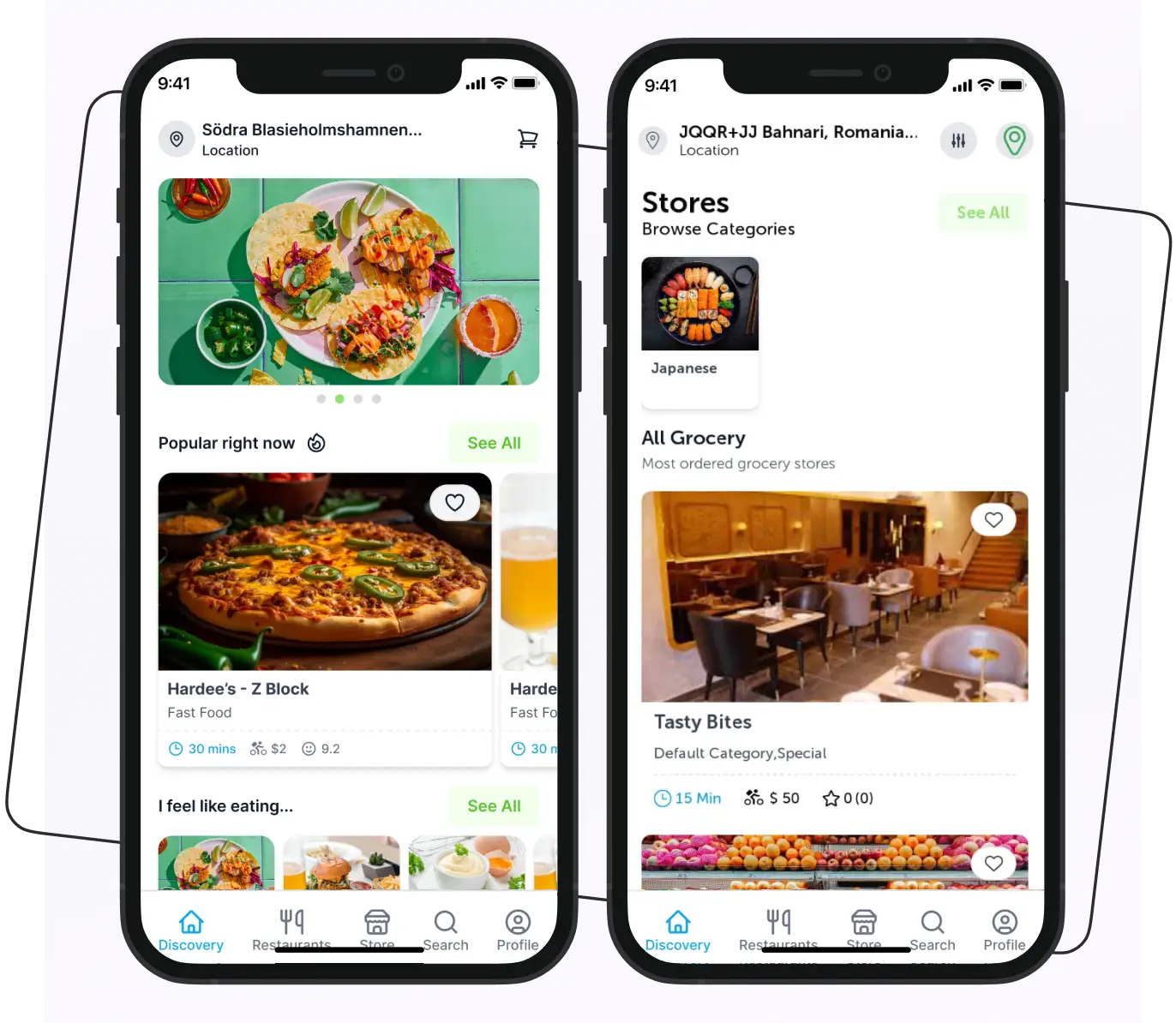
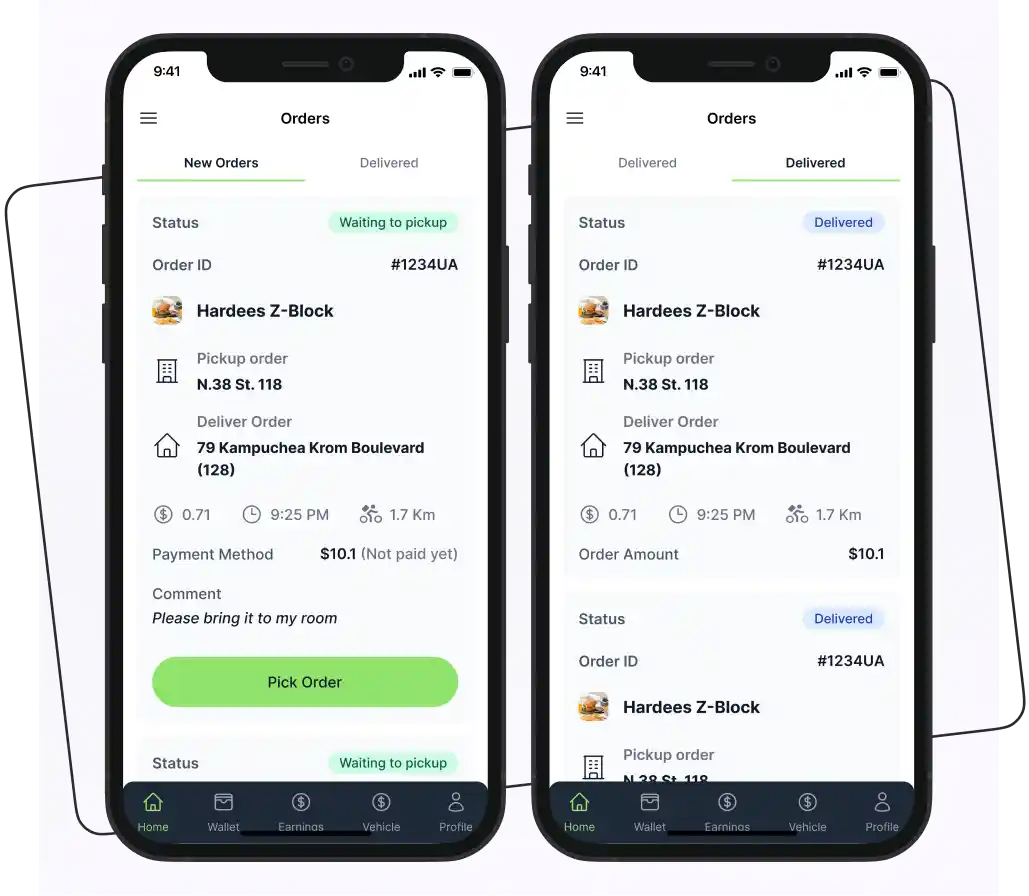
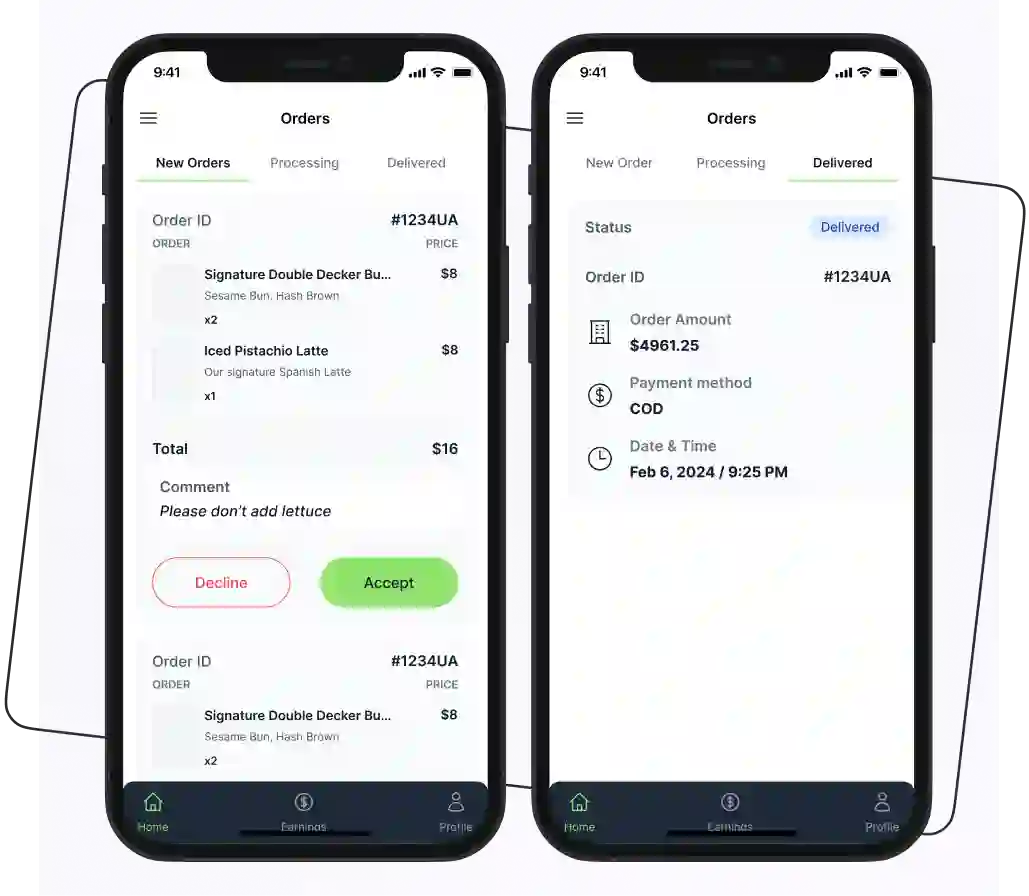
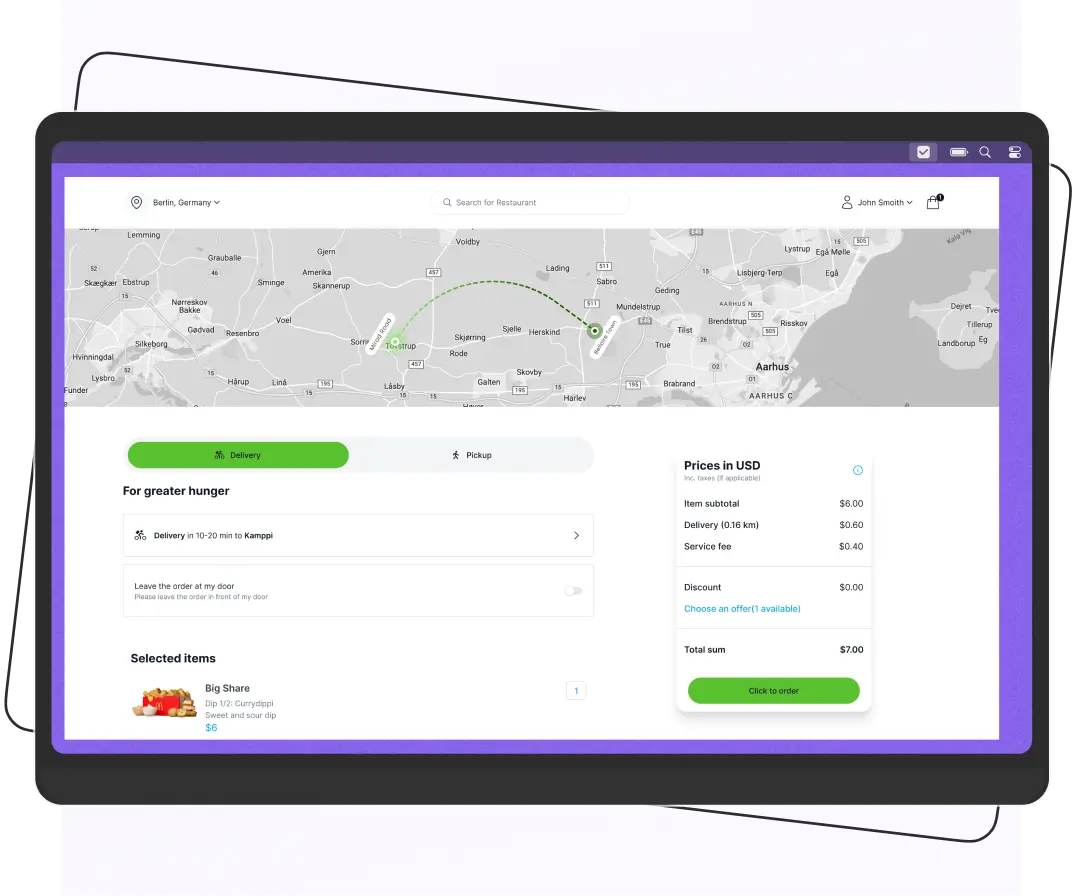
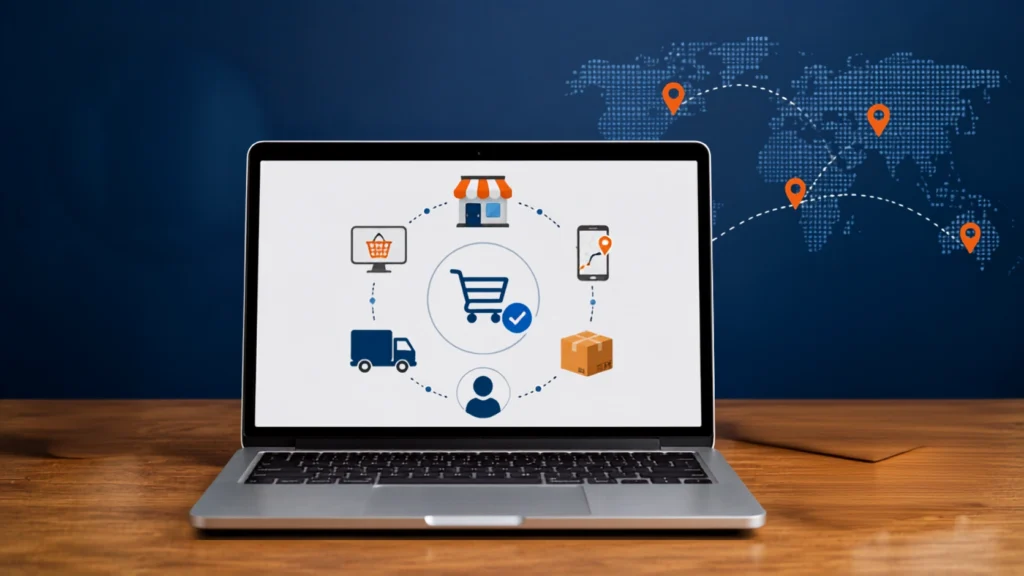
It is a white-label or licensed ordering system that includes a customer app or website, a restaurant dashboard, and, in some cases, a driver app.
You pay for the platform once rather than indefinitely. However, most providers may still charge separately for hosting, ongoing support, maintenance, or optional add-ons.
This model is fundamentally different from the two dominant pricing approaches used in food delivery:
| Model | How It Charges | Typical Cost | Who Owns the Customer Relationship? |
| Commission (Marketplace) | Percentage of every order | 15–30% per order | The platform (Uber Eats, DoorDash, Grubhub) |
| Subscription (SaaS) | Flat recurring fee | $50–$5,000/month | The restaurant, but access ends if you stop paying |
| One-Time Fee (Licensed/White-Label) | Single upfront payment | $1,500–$75,000+ once | The restaurant, permanently |
The one-time fee model appeals to two very different types of businesses:
- Restaurant owners: can use it to launch an ordering app without paying ongoing platform fees
- Delivery startup founders: can use it to launch a multi-restaurant marketplace without having to build the entire technology stack from the ground up.
Why This Model Exists: The Commission Problem
Third-party marketplaces have built their entire business model around commissions. For platforms like Uber Eats and DoorDash, restaurant-side commissions are one of the largest revenue drivers, often ranging from 15% to 30% of the order value.
For a delivery business generating $10,000 per month, a 25% commission adds up to roughly $30,000 a year paid to a third party before factoring in service fees, delivery fees, or advertising costs.
That calculation has pushed a growing number of restaurants toward off-premises ordering, which has increased significantly as a share of total restaurant traffic over the past several years.
Many are now moving toward direct ordering channels that they can control. One-time fee platforms represent the most extreme version of this shift: instead of renting a channel forever, you buy it once.
8 Things to Know Before You Choose a One-Time Fee Platform
Before investing in a one-time fee delivery platform, there are several important factors to consider beyond the upfront price.
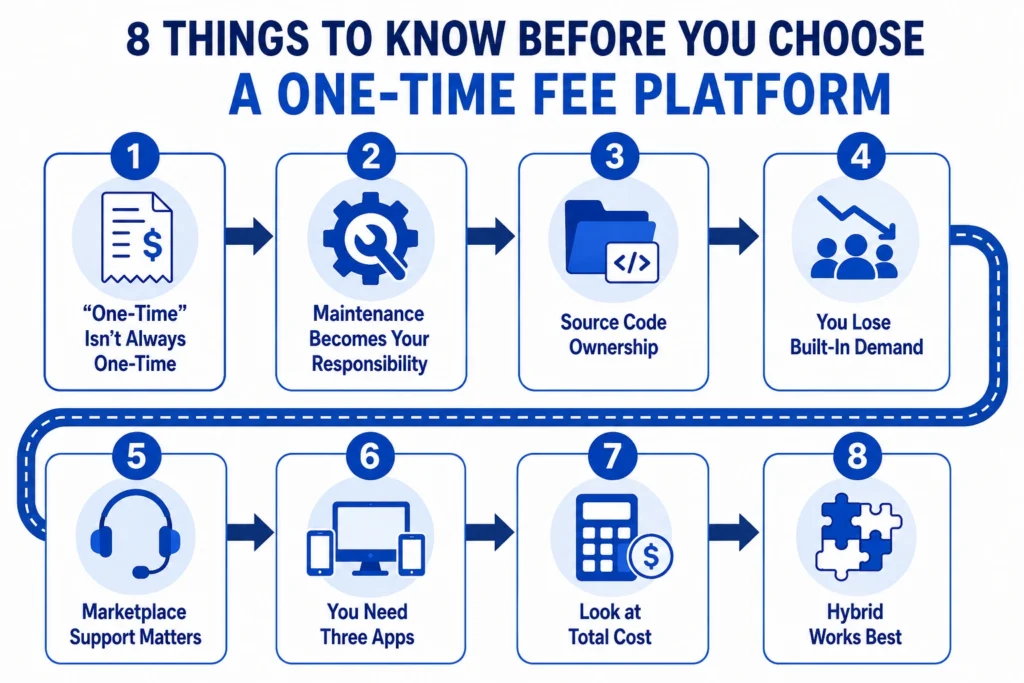
1. “One-Time” Isn’t Always One-Time
A one-time fee does not necessarily mean you’ll have zero ongoing costs. Almost every one-time fee provider still charges for something recurring, such as:
- Hosting
- SMS and notification credits
- Payment gateway fees (2–3%, which are unavoidable regardless of the pricing model)
- Paid support after an initial free year.
Before choosing a platform, read the fine print carefully to understand what is included in the upfront fee and which services or features require annual or recurring payments.
2. Maintenance Becomes Your Responsibility
With a marketplace app, the platform handles bug fixes, app store compliance, and OS updates. With a one-time license, that responsibility often shifts to you or a smaller vendor. Ask specifically: who handles iOS/Android updates when Apple or Google changes its requirements, and is that included in the price?
3. Source Code Ownership
The strongest one-time fee platforms include full, customizable source code ownership, rather than just a locked-down template. This matters if you plan to scale into a multi-vendor marketplace, add features later, or eventually sell the business. A licensed codebase is an asset; a rented SaaS account is not.
4. You Lose Built-In Demand
This is the trade-off founders underestimate most. DoorDash and Uber Eats bring millions of app users actively searching for food. A one-time fee app has zero built-in audience; you have to drive every install and every order yourself through your own marketing, QR codes, and loyalty programs.
5. Marketplace Support Matters
If you’re a founder building a delivery startup rather than a single restaurant buying an app, look specifically for platforms built for multi-vendor marketplaces (multiple restaurants, one customer app, one driver pool) rather than single-restaurant templates. The features, admin panels, and commission-configuration tools needed are very different.
6. You Need Three Apps
A complete delivery platform needs three interfaces: a customer ordering app, restaurant/admin dashboard, and delivery driver app. Some one-time fee vendors sell all three as a bundle; others sell only the customer app and expect you to add delivery logistics through services like Nash, Relay, or DoorDash Drive separately. Know exactly what you’re buying before comparing prices.
7. Look at Total Cost
A $1,500 one-time license may look cheaper than a $500/month subscription, but the real cost can change once you factor in support renewals, hosting, payment processing, app store fees ($99/year for Apple and a one-time $25 fee for Google), and eventual redevelopment costs as the platform ages. Instead of looking at month one, calculate the total cost over 3 years.
8. Hybrid Works Best
Very few restaurants go 100% one-time-fee and completely drop marketplaces. The more common approach in 2026 is to run a branded, low-cost direct ordering channel for repeat customers and loyalty while maintaining a presence on Uber Eats or DoorDash for new customer discovery.
Many owners also use a unified tablet or order-aggregation tool so staff doesn’t have to juggle five separate apps.
Pros and Cons of One-Time Fee Delivery Platforms
Like any technology investment, one-time fee delivery platforms come with both advantages and limitations. Understanding both can help you decide if the model fits your business and budget.
| Pros | Cons |
| No per-order commissions: Keep the full order value, minus standard payment processing fees. | No built-in customer demand: You are responsible for generating traffic, app installs, and orders through marketing. |
| Predictable costs: Pay an upfront amount rather than a percentage that increases as your sales grow. | Ongoing maintenance: Updates, bug fixes, and technical maintenance may become your responsibility or depend on the vendor. |
| Customer ownership: Retain control over customer data, order history, and contact information. | Higher upfront investment: The initial cost can be higher than commission-based, pay-as-you-go models. |
| Source code ownership: Access to the source code provides greater flexibility for customization, scaling, and potential resale. | Additional delivery costs: Drivers, routing, live tracking, and other delivery logistics may require separate services or expenses. |
| Greater independence: Reduce your reliance on third-party pricing changes, commissions, and policy updates. | Limited vendor support: Support and long-term assistance may be harder to secure when working with a smaller or niche provider. |
Who Should Choose This Model?
A one-time fee delivery platform isn’t the right choice for every business. So, let’s look at which businesses can benefit most from this model.
- Single-location restaurants
If you already have loyal customers who order regularly, a one-time fee platform can help you save on marketplace commissions and get a faster return on your investment.
- Multi-location and franchise businesses
A one-time platform can help keep your branding and customer data in one place. However, remember that managing and maintaining the platform becomes more complex as you add more locations.
- Delivery startups
Startups building a multi-restaurant marketplace can benefit from source-code ownership and avoid recurring SaaS fees. But you’ll still need to invest in drivers, delivery logistics, and marketing to attract customers.
- New restaurants
If you don’t have an established customer base yet, a one-time platform may not be the best choice. Marketplaces can help you reach customers first, and you can move them to your own platform as your loyal customer base grows.
Questions to Ask Before You Buy
Before choosing a one-time fee delivery platform, ask these questions to avoid unexpected costs and limitations:
- What does the one-time fee include? Does it cover the customer app, restaurant dashboard, driver app, or only one of them?
- Do I get the source code? Or is it a locked template that I cannot customize or move to another platform?
- What costs renew every year? Ask what you’ll need to pay after the first year and how much it will cost.
- Who handles updates? Find out who manages app store compliance and future iOS/Android updates.
- Does it support multiple restaurants? Check whether the platform supports multi-vendor operations or only a single restaurant.
- How does payment processing work? Ask about the payment processing fee and make sure there are no hidden markups.
- What will delivery logistics cost? Find out whether you need your own drivers or can connect the platform with a third-party delivery service.
- Can I see real examples? Ask for references from restaurants using the platform with a similar order volume to yours.
Build Your Own Delivery Platform With Enatega
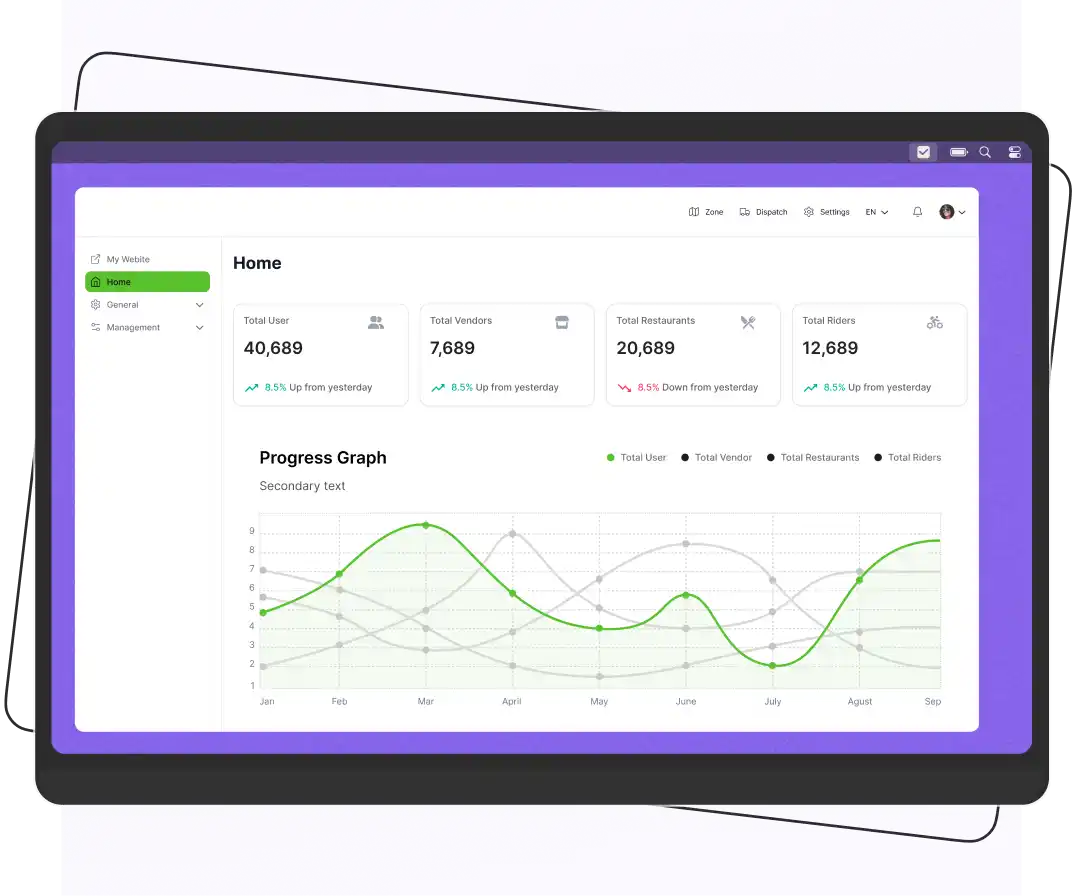
If you want more control over your delivery business, Enatega offers an open-source, white-label platform that lets you launch your own delivery solution. It supports customer, restaurant, rider, and admin applications, giving you the tools to manage orders, vendors, deliveries, and customers from one platform.
With one-time pricing options, you can avoid recurring software commissions while keeping greater control over your platform. You can also customize the system to match your brand and business requirements as you grow.
Ready to own your delivery platform instead of renting one? Explore Enatega and launch your delivery business.
FAQs
Usually, yes. You generally don’t pay a commission on each order, but that doesn’t mean there are no other costs. You’ll still have payment processing fees (2-3% per transaction) and may have recurring hosting or support fees after the initial period.
Basic white-label licenses can start at around $1,500-$5,000 for a single restaurant. More advanced multi-vendor platforms with full source-code ownership can cost roughly $15,000-$75,000+, depending on features and customization.
Yes, if the platform provides the source code and allows self-hosting. This gives you greater control over your data, hosting environment, and future customization. However, you’ll still need to manage hosting and maintenance.
Below are some tips to help you choose the right one-time fee delivery platform.
Compare the platform’s features
source-code ownership
customization options
support, scalability
Total cost
Also check what ongoing fees apply after the initial purchase
Supercharge your deliveries with Enatega.
Launch NowConclusion
A one-time fee delivery platform can be a smart choice for businesses that want more control and fewer recurring software costs. Instead of paying commissions on every order, you make an upfront investment and can build a direct relationship with your customers.
However, the upfront price isn’t the only factor to consider. Hosting, maintenance, updates, marketing, and delivery operations can all add to the long-term cost. Compare the total cost, ownership rights, features, and support before making a decision.
About the author

Hudaibia Khalid is a senior content writer with several years of experience in creating clear and easy-to-understand content. Over the years, she has worked closely with startups, restaurants, and entrepreneurs, helping them simplify complex digital and technical topics into actionable insights.
Her expertise lies in writing about on-demand platforms, food delivery solutions, and business growth strategies in a way that is accessible even to non-technical readers. With her experience in the industry, she focuses on guiding businesses step by step, from understanding ideas to turning them into fully working solutions.
SHARE






 IOS
IOS Android
 Web
Web