


Key Takeaways
- Avoid Third-Party Fees: Launching your food delivery app helps restaurants eliminate up to 30% commission losses from platforms like Uber Eats and DoorDash.
- Faster Go-to-Market: With ready-made, white-label solutions like Enatega, you can launch your food delivery app in just 1 week.
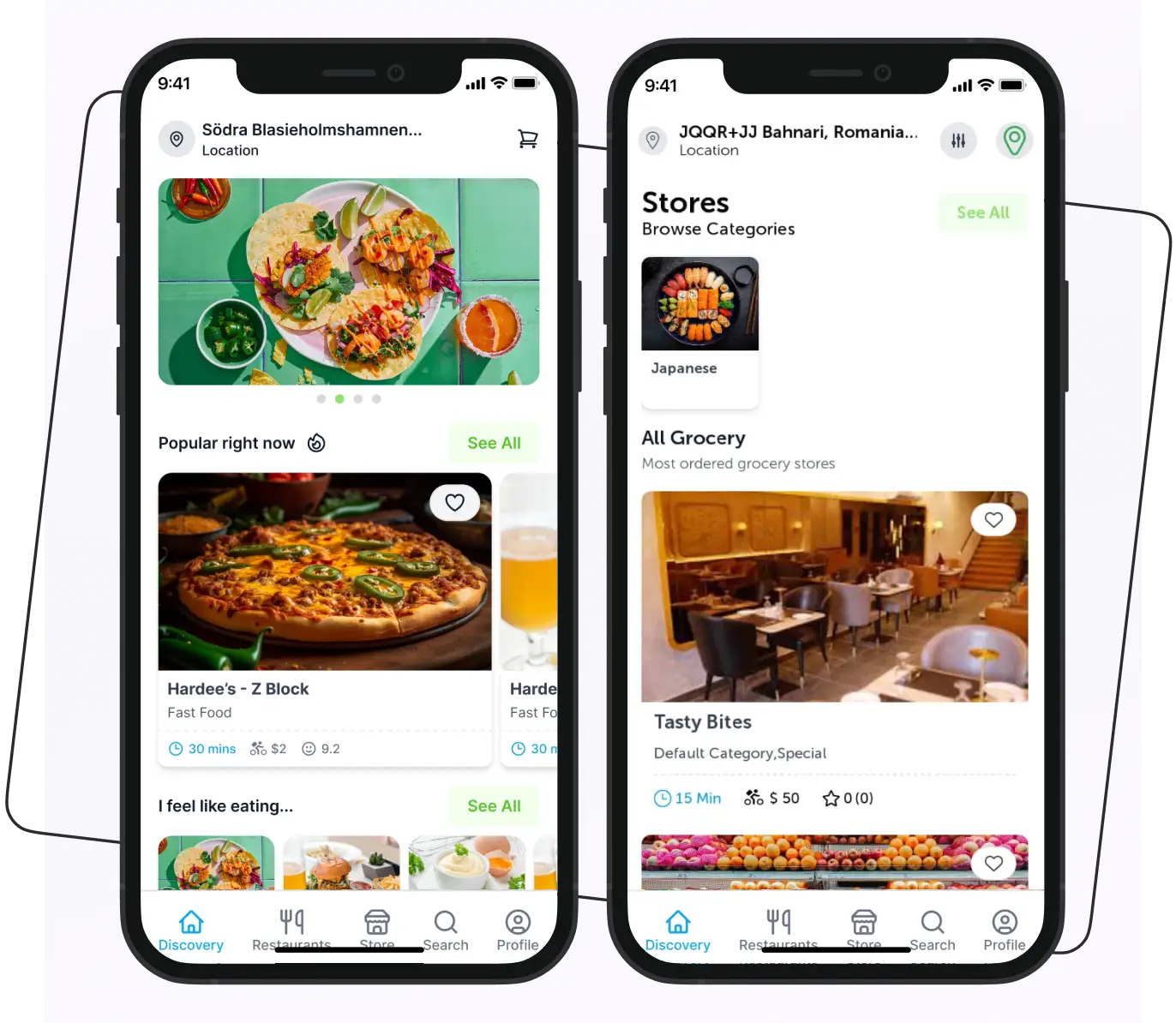
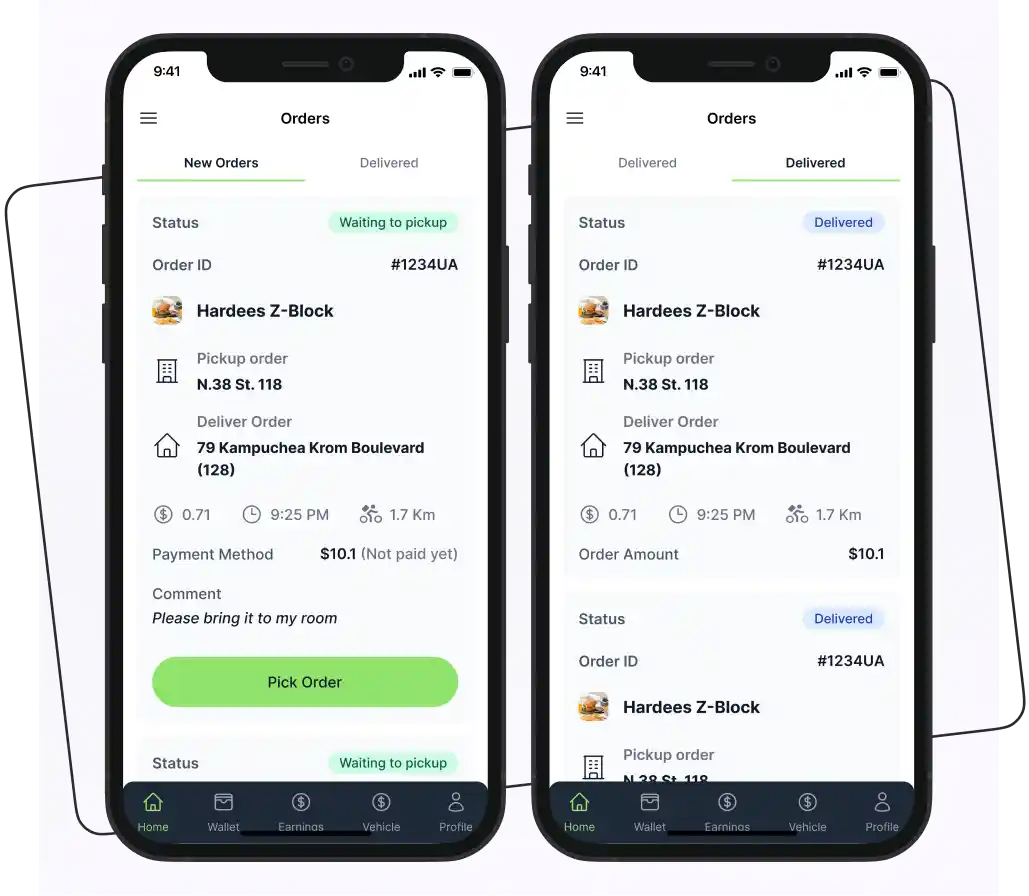
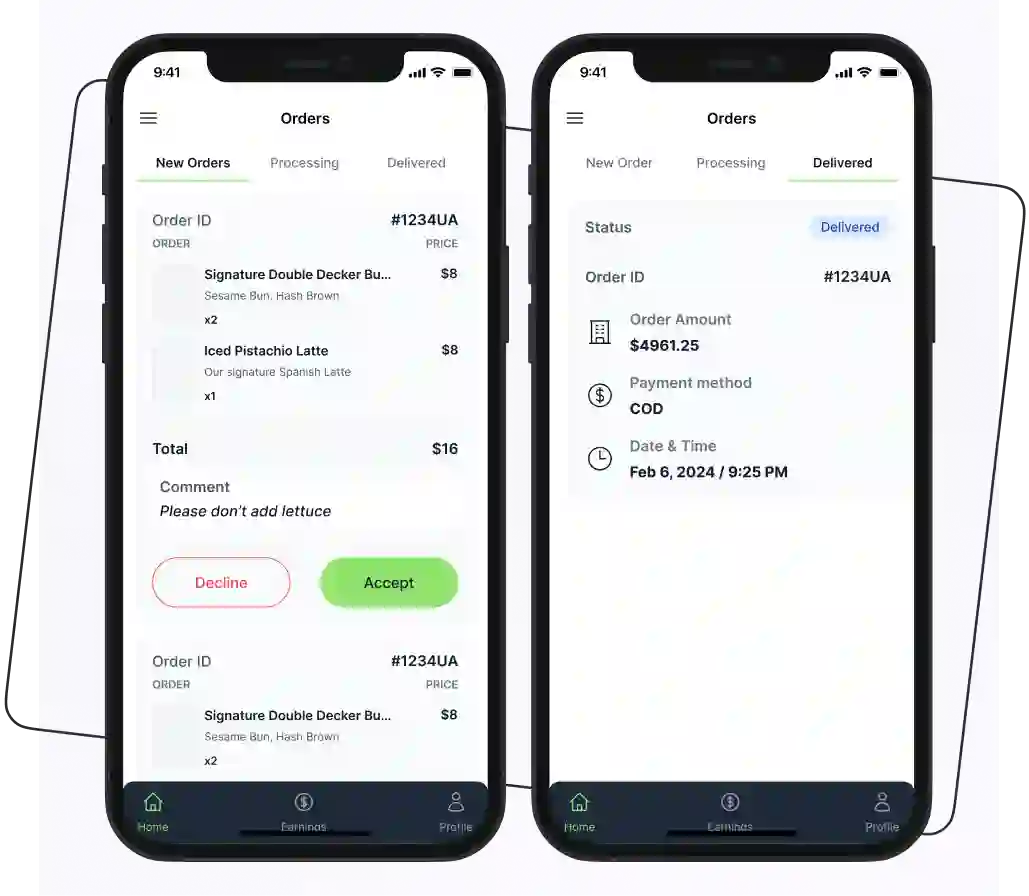
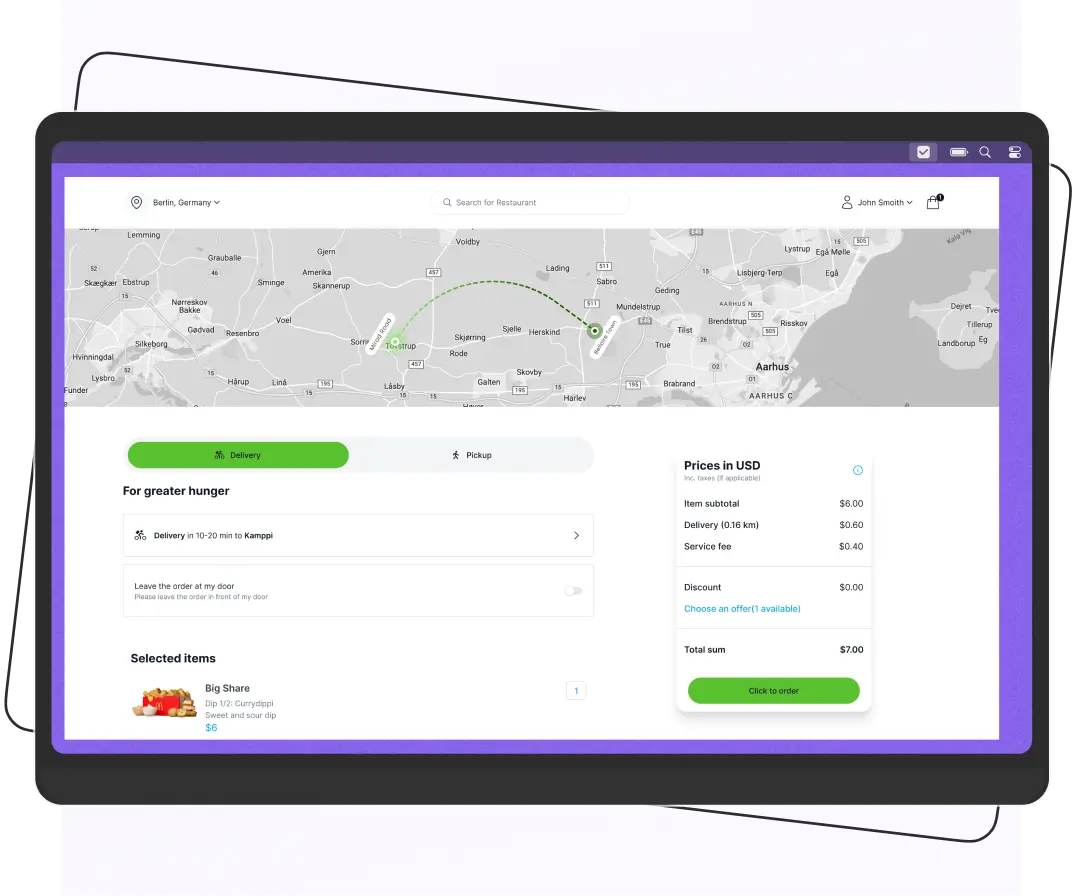
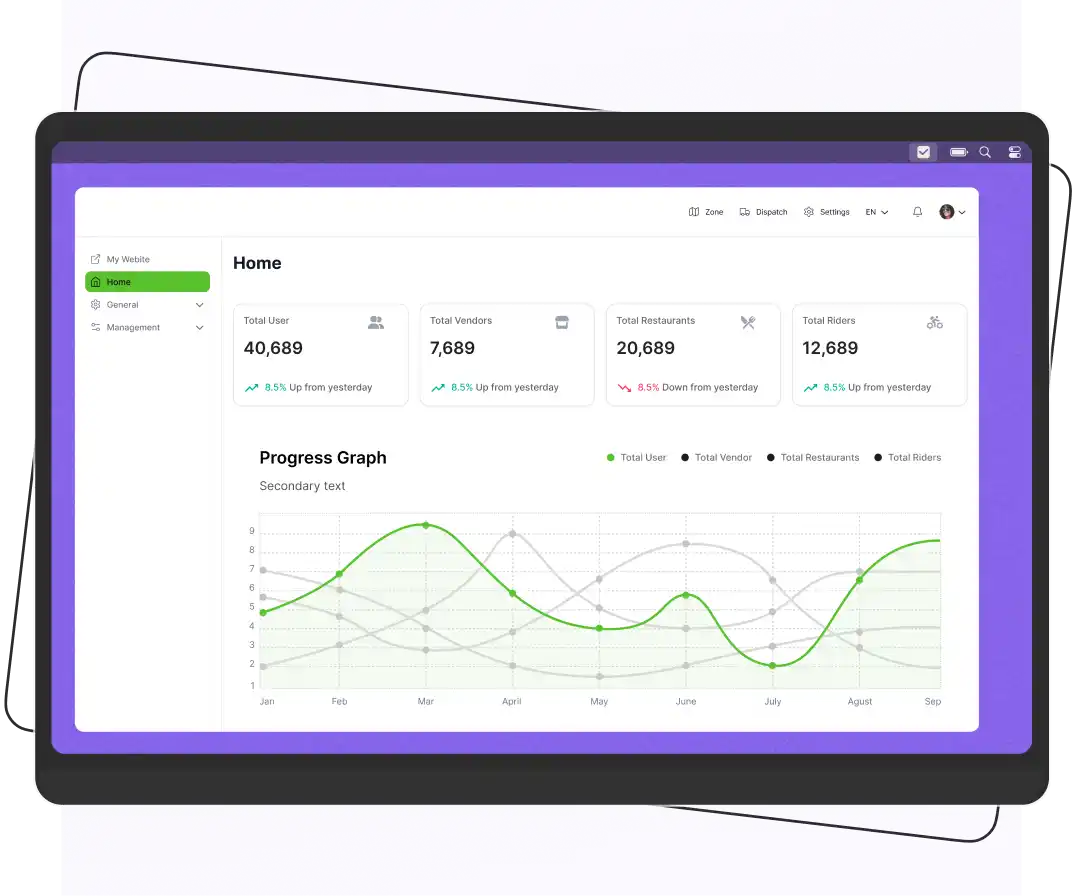
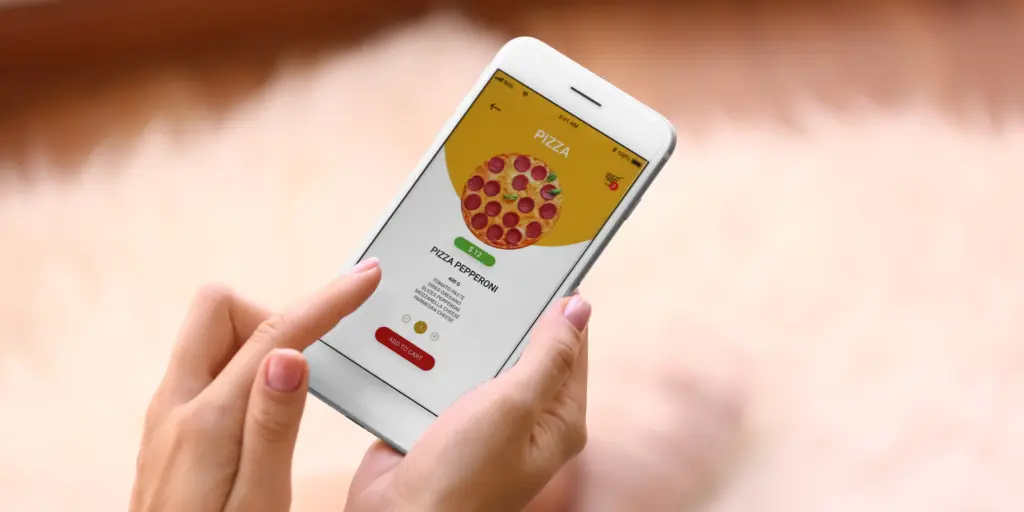
- All-in-One App Suite: Get three fully customizable apps (Customer, Restaurant, Rider) along with an Admin Dashboard, 100% white-label.
- App Features: Personalized offers, multi-language support, and real-time order tracking improve customer satisfaction and retention.
- Development Cost: Cost ranges from $20K to $180K based on app complexity.
A restaurant doing $10,000/month on Uber Eats loses up to $3,000 in commissions alone.
In 2026, restaurants are expected to lose revenue to third-party delivery platforms such as Uber Eats and DoorDash. That’s not just a cut, it’s a crisis. For restaurant owners trying to grow in a competitive market, these fees eat into already-thin margins.
But there’s a smarter way. With a ready-made, white-label food delivery app solution, you can take control, cut out third-party commissions, and build direct relationships with your customers all in just 1–2 weeks.
So, let’s explore how you can easily launch your food delivery app.
What Are the Advantages of Food Delivery Services?
The following are the advantages of food delivery services for customers and businesses.
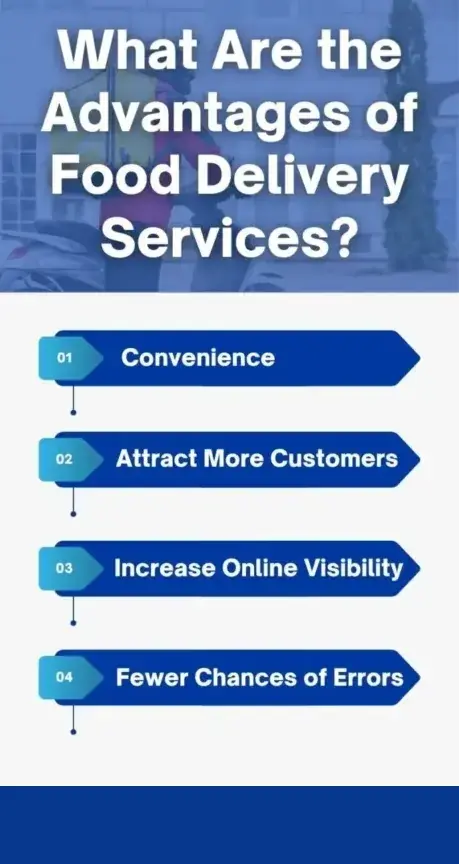
Convenience
With a readymade food delivery solution, restaurants can offer their customers a seamless online food ordering experience. Also, a custom food delivery app development solution is best for food delivery startups and restaurant businesses.
Attract More Customers
It is another main benefit of an online on-demand food delivery app solution. With an on-demand food delivery platform, restaurants can increase and retain more customers. In addition, the food app can help restaurants reach a larger audience outside their physical location.
Online ordering makes it easy for customers to order the restaurant’s menu from home or work. If the restaurants want to get people to place orders, the app should have features like:
- Personalized suggestions
- Discounts and reward programs
- Customize menu
Increase Online Visibility
The online ordering system can help to increase your brand’s visibility on various online platforms. The positive ratings can also help build your brand image, and more customers will use your site/app to place orders.
Also, many online meal-ordering services link to popular search and mapping websites. This makes the restaurant more visible to people who are looking for places to eat in the area.
Fewer Chances of Errors
The food delivery app development solution can help lower mistakes and deliver orders with zero errors. By integrating an online ordering platform into your food delivery business, your team can focus on other important tasks rather than repeating tasks like receiving and transferring orders.
Supercharge your deliveries with Enatega.
Register NowYour Food App vs. Third-Party Apps
The table below shows the differences between your own food app and third-party platforms.
| Feature | Your Food Delivery App | Third-Party Apps (Uber Eats, DoorDash) |
| Commission Fees | 0% commission | 20%–30% per order Uber Eats (15–30%), DoorDash (15–25%), Grubhub (5–15%) |
| Profit Margins | Keep 100% of profits | Reduced due to high fees |
| Branding | Fully branded with your logo and identity | Platform branding dominates |
| Customer Data | Full access to customer data | Limited or no access |
| Customer Loyalty | Build direct relationships and repeat customers | Customers stay loyal to the platform |
| Marketing Control | Run your own offers, discounts and campaigns | Limited promotional control |
| Pricing Control | Set your own prices freely | Often influenced by platform rules |
| Delivery Control | Manage your own fleet or system | Controlled by platform logistics |
| Customization | Fully customizable features and UI | Very limited customization |
| Competition | No direct competitors for your app | Competing with multiple restaurants |
| Revenue Growth | Higher long-term profitability | Slower growth due to commissions |
| Data Ownership | You own all business and user data | The platform owns the data |
What Features Should a Food Delivery App Have?
The key features of the on-demand delivery solution are:
| Features | Description |
| Smart Search | This feature allows customers to find a suitable dish, cuisine, or restaurant with intelligent filters and sorting options. The search feature should be easy to use so customers can easily use it. |
| Order Tracking | With an order tracking multi vendor feature, customers and restaurants get real-time updates to know more about their order status. |
| Promos and Offers | Customers get new deals and discounts using promo codes at checkout. |
| Ratings and Reviews | Customers give feedback about their food ordering and delivery experience on the on-demand food delivery platform. |
| Takeaway Option | Provide customers with the option of taking a takeaway order from a nearby restaurant when convenient. |
| Manage Profile | Customers and restaurants can manage their profiles, addresses, etc. |
| Payment Options | Provide safe and secure payment options for seamless ordering. |
| Live Chat | With the live chat feature on the food app, customers can communicate with riders and restaurants if they face any issues. |
| Add Favorite Restaurants | Customers can easily add their favorite restaurant to help them order from the same restaurant in the future. |
| Multi-language | The food delivery app solution comes in different languages. The customers can change the app language according to their needs. |
| Push Notifications | The customers and riders get notifications from the restaurant related to order status, deals, and more. |
Are you interested in launching your on-demand food delivery app? Book a free demo with the best on demand food delivery app development company.
How to Launch a Food Delivery App?
Below are some steps that help you launch a successful food delivery app.
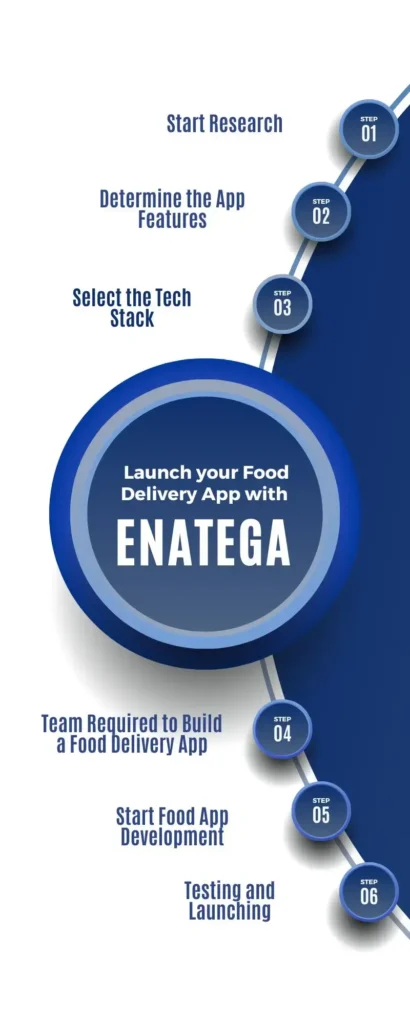
- Start research
- Decide on the app features
- Select the tech stack
- Team required to build the food app
- Start food app development
- Testing and launching
Let’s explore.
1. Start Research
Before developing the app, you must do in-depth research and gather all the information that you need to develop a food app. In this phase, you need to know these things:
- Your competitor’s strengths and weaknesses
- Target audience interest
- Latest market strategies and food delivery trends
- What features do you add that will attract your customers?
2. Determine the App Features
After gathering all the information, you can move to your next step. In this step, identify the app features and make sure to add those that are relevant and not available in your competitor’s app.
3. Select the Tech Stack
Decide on the tech stack for your delivery app. It impacts the scalability, performance, and overall success of the app. Common frontend languages and frameworks include HTML, CSS, JavaScript, and popular frontend frameworks like React.js or Angular.js.
For backend development, languages that are used include Node.js, Python, Ruby on Rails, and frameworks like Django or Express.js.
The ideal tech stack depends on several factors:
- Project scope
- Team expertise
- Scalability requirements
- Budget
By carefully considering these factors and selecting the right technology stack, you can build a scalable, performant, and successful app.
4. Team Required to Build a Food Delivery App
A team with excellent expertise is required to create the food-ordering app. Below is a list of team members whom you need to develop the food app.
- Front-end developer
- Back-end developer
- Research Analyst
- UI/UX designer
- Project manager
- Quality assurance
5. Start Food App Development
Now, start the development phase and implement all the features of your food app. Design the app to be user-friendly so that users can easily use the app without any issues. Follow the best practices for software development and create a successful delivery food app.
6. Testing and Launching
Testing is a crucial component in the process of developing an app. Remove all the bugs and errors to make the app stable for the users.
After removing all the errors, launch your app on the Play Store. Also, you must create a proper marketing plan to promote your app so that people know you have a food delivery app. Use social media platforms and promote your brand.
How Much Does it Cost to Build a Food Delivery App?
The cost of building a food app can depend on several factors, such as:
- The app complexity
- Time to develop
- The app features and functionalities
- Number of development platforms
- Development team location
- Size of the app
- Tech stack
Take a look below and get to know the rough estimated cost of developing a mobile app.
| App Type | Pricing | Features |
| Small | $20,000 to $50,000 | User profile, search, profile management, reviews and ratings, etc. |
| Medium | $50,000 to $120,000 | In-app chat, push notifications, order tracking, deals and discounts, etc. |
| Complex | $120,000 to $180,000 | Order history, group orders, real-time analytics, and more |
Moreover, the location of the team might also affect how much it costs to build a food app. For example, hiring an iOS or Android developer from the USA will likely cost more than hiring one from another country.
Below is a rough estimate of the hourly rate of other countries to help you make a better decision.
| Country | Development Cost (Hourly) |
| Australia | $90-$150 |
| USA | $70-$120 |
| Asia | $20-$50 |
| Middle-East | $50-$80 |
| Europe | $60-$100 |
How Long Does It Take to Develop a Food Delivery App?
Creating an advanced food delivery app can depend on several factors, which include:
| Factors | Description |
| Features and Complexity | Basic features (user registration, menu browsing, order placement) vs. advanced features (real-time tracking, payment integration, ratings). |
| Platform | Developing for iOS, Android, or both can affect the timeline. |
| Design | A simple UI/UX design will take less time compared to a highly customized and interactive design. |
| Team Size and Expertise | A larger, more experienced team can speed up the process. |
| Technology Stack | The choice of technology (native vs. hybrid development) can impact development speed. |
| Testing and Revisions | Time for rigorous testing and implementation of feedback. |
| Regulatory Compliance | Ensuring compliance with local laws and regulations can add time. |
Using Enatega Solution over Other Food Delivery App Development Solutions
By using Enatega, the white-label food delivery app, businesses can get more profit and revenue. With our solution, food business owners can streamline their operations online from one platform and increase their sales.
On Enatega, multi vendor food ordering platform, you will get three apps with a dashboard, which include:
- Customer app
- Restaurant app
- Rider app
- Admin dashboard
Using these apps that contain great features, you will easily manage all your food delivery operations seamlessly. You can also check our clients’ reviews and see how our solution helps them in their business.
Case Study
Snap Delivered, a fast-growing food delivery platform, is facing the issues of offering lower delivery fees and a more equitable business model for restaurants. However, they needed a robust, customizable solution to launch their platform quickly and efficiently.
Challenge
Snap Delivered faced the challenge of competing in a saturated market dominated by established players like UberEats and DoorDash. They needed a food app that could handle high traffic, offer a seamless user experience, and integrate advanced features like real-time order tracking and multi-language support. Additionally, they wanted a solution that could be rapidly deployed without compromising on quality.
Solution
Snap Delivered partnered with Enatega to use its white-label food delivery app solution. Enatega’s platform provided a 100% customizable solution that allowed Snap Delivered to tailor the app to their specific needs. The app included essential features such as:
- Smart Search: Enabling users to quickly find restaurants and dishes.
- Order Tracking: Offering real-time updates on orders.
- Multi-Language Support: Catering to a diverse user base across different regions.
- Promotions and Rewards: Implementing discount codes and loyalty programs to attract and retain customers.
Results
Snap Delivered successfully launched its app, gaining significant traction in the market. The platform’s user-friendly interface and advanced features led to an increase in customer retention. Moreover, restaurants partnering with Snap Delivered reported an increase in order volumes.
So, get a customizable food ordering and delivery system from us and grow your business online.
Supercharge your deliveries with Enatega.
Register NowFAQs
The ordering system is crucial because it benefits both restaurants and customers. It makes the entire process of online ordering, managing, tracking, etc, seamless.
Below are some points that help attract customers to online food delivery.
Keep the menu updated
Provide 24/7 customer support
Keep the prices budget-friendly
Offer promotions and deals
Add exciting dishes to the menu
Use social media regularly
Below are some of the best food delivery apps that are mostly used by customers to order food online.
Uber Eats
Grubhub
Zomato
Foodpanda
Yes, food delivery apps are profitable. Restaurant owners earn revenue by charging a delivery fee from the customers and a commission fee from restaurants.
The cost of maintaining a food delivery app can range between $10,000 – $50,000 or more. However, it depends on the app’s complexity and usage.
Below is the working of the food delivery app algorithm.
Optimizes order processing by matching user requests with nearby restaurants
Estimating delivery times
Routing drivers efficiently based on real-time traffic and order volume
Below are some steps to help you build an app like DoorDash.
Market research
Define features
Choose a technology stack
Design UI/UX
Start the app development
Testing
Launch and market
Food delivery apps are most commonly used by:
Young adults
Busy professionals
Students
Families
Health-conscious customers
To start your food delivery service, follow these steps:
Market research
Decide on the business model
Legal requirements
Develop a user-friendly app and website
Plan your delivery system
Build partnerships
Develop a marketing strategy
Start with a soft launch to gather feedback and make improvements
Conclusion
The on-demand food delivery industry is growing rapidly, and there's no better time to join the movement. Whether you're aiming to reduce third-party fees, boost order volume, or expand your brand reach, launching your delivery app is the smartest move.
Build your food delivery platform like Uber Eats in 7 days with Enatega.
About the author

Hudaibia Khalid is a senior content writer with several years of experience in creating clear and easy-to-understand content. Over the years, she has worked closely with startups, restaurants, and entrepreneurs, helping them simplify complex digital and technical topics into actionable insights.
Her expertise lies in writing about on-demand platforms, food delivery solutions, and business growth strategies in a way that is accessible even to non-technical readers. With her experience in the industry, she focuses on guiding businesses step by step, from understanding ideas to turning them into fully working solutions.
SHARE






 IOS
IOS Android
 Web
Web