

Key Takeaways
- Open source food delivery apps offer full control, flexibility, and cost savings.
- They can reduce long-term costs but still require spending on development, hosting, and maintenance.
- Popular platforms include Enatega, GloriaFood, TastyIgniter, Comeneat, Ontabee, and Flipdish.
- With basic features, development costs can range from $12,000 to $25,000, and more for advanced versions.
- Ideal for startups, restaurants, and developers wanting scalable, branded solutions.
Thinking of building your own Uber Eats or DoorDash-style platform? You’re not alone. With the food delivery market rapidly growing, more and more restaurant owners and entrepreneurs are turning to open-source food delivery apps to cut costs, take control, and get their business online fast.
According to the Grubhub and Technomic report, 90% of customers plan to use food delivery services. In addition, according to Grand View Research, the global online food industry will expand by almost 10.3% between 2023 and 2030.
Instead of paying hefty subscription fees to third-party platforms, open-source solutions give you the freedom to customize your app, own your data, and scale on your terms. But with so many options out there, how do you know which platform is the right fit for your business?
In this blog, we’ll cover everything you need to know, from what an open-source food delivery app is to the best platforms available today, and how much it might cost to build your own.
What is an Open Source Food Delivery App?
The open source food delivery app is a type of app that is built for ordering and delivering food to customers at their doorstep. In software development, open source refers to software whose source code is available publicly. The open source code for food delivery apps can be used, viewed, and modified by everyone.
The primary purpose of the food delivery app open source is to:
- Have control over the solution
- No need to sign the contract
- Reduce the cost
- Have the permission to customize it according to your needs
Further, an open source delivery app helps food delivery businesses cut down their staff time spent taking orders over the phone or in person.
Open Source vs. SaaS Food Delivery Platforms – Which Food Delivery Solution Will Save You More?
Look at the table below and understand the differences between open source and SaaS-based food delivery platforms.
| Feature | Open Source | SaaS |
| Cost | Free; costs for hosting and support | Subscription-based; monthly or annual fees |
| Customization | Highly customizable; modify source code | Limited customization; features are defined by the provider |
| Maintenance | Requires in-house or outsourced maintenance | The provider handles maintenance and updates |
| Scalability | Can be scaled, but requires technical expertise | Easily scalable; handled by the provider |
| Deployment | Self-hosted; requires server setup | Cloud-based, quick to deploy |
| Ownership | Full ownership of code and data | Limited ownership; data stored on provider servers |
| Support | Community support may require paid support | Professional support is included in the subscription |
| Security | Depends on the user’s implementation | Provider-managed security measures |
| Features | Varies widely; may require additional development | Regular updates, access to new features |
Supercharge your deliveries with Enatega.
Launch NowBenefits of an Open Source Food Delivery App
Achieving profitability and building a brand name in the food delivery industry is complex because the competition is very high. It can be hard to stand out from the crowd. However, with the help of a food delivery platform, many businesses can easily succeed.
Below are the main benefits of an open-source food delivery platform for restaurants.

Cost-Effective Solution
It is one of the main benefits of the food delivery system open source platform. This platform is a cost-effective solution for small to large-sized businesses. The cost is less than that of other options and helps companies allocate money elsewhere. Due to its cost efficiency, it is an ideal choice for businesses looking to optimize their resources.
Flexibility
Flexibility is another main advantage of the food delivery app open source platform. With software for food delivery businesses, food delivery companies can tailor their menu to customer preferences, which increases customer loyalty and satisfaction.
Food ordering and delivery software also helps generate revenue through advertising, deals, and other revenue streams.
Complete Control Over the System
The food delivery software open source helps businesses create a website, deploy apps, and get them approved quickly. It is a one-stop shop for quick development.
Customization
The food delivery platform allows you to customize the app according to your requirements. You can easily customize the user interface, add features, integrate with other systems, and more. Easily give your personal touch to your food delivery app that sets you apart from your competitors.
Improvement and Updates
Businesses using software for food delivery services can benefit from the huge community of developers if they face any issues. They can help fix bugs, add new features, change the app’s theme, and more.
Disadvantages of Open Source Food Delivery Apps
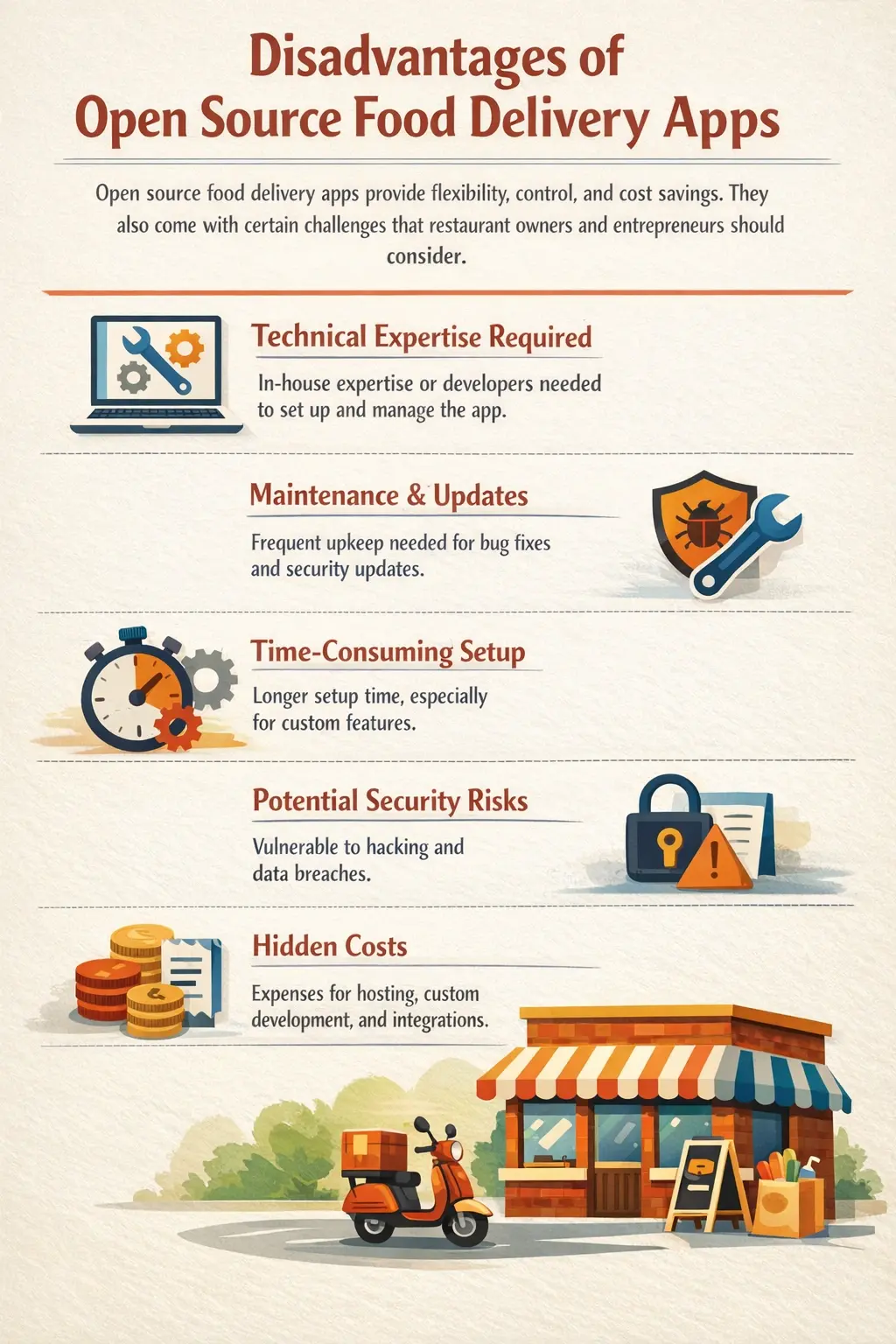
Open source food delivery apps provide flexibility, control, and cost savings. They also come with certain challenges that restaurant owners and entrepreneurs should consider.
Technical Expertise Required
Open source platforms often require in-house technical knowledge or hiring developers to set up, maintain, and customize the app. Without this expertise, businesses may struggle to get the app running smoothly.
Maintenance and Updates
Unlike SaaS platforms that handle updates automatically, open source apps require regular maintenance. Businesses are responsible for fixing bugs, implementing security patches, and ensuring compatibility with new devices or OS versions.
Time-Consuming Setup
Setting up an open source food delivery system can take longer than using a ready-made SaaS solution, especially if you want custom features or integrations.
Potential Security Risks
The source code is publicly available, and open source apps can be more vulnerable to security threats if proper security measures aren’t implemented. Businesses must invest in secure hosting and follow best practices for data protection.
Hidden Costs
The software itself may be free. However, additional costs like hosting, third-party integrations, custom development, and server management can add up quickly.
Best Open Source Food Delivery Platforms
Several ordering and delivery software are available in the market. For your help, we compiled a list of the best open source food delivery software.
| Platform | Best For | Customization | Platform Type |
| Enatega | Fully branded apps, startups | High | Web and Mobile App |
| GloriaFood | Small to medium restaurants | Medium | Web and Mobile App |
| TastyIgniter | Cafes, cloud kitchens | High | Web-based (can integrate mobile) |
| Comeneat | Takeaway and ready-made food | Medium | Web, iOS, Android |
| Ontabee | Small restaurants / single outlet | Medium | Web and Mobile App |
| Flipdish | Cafes and restaurants want full marketing support | Low-Medium | Web and Mobile App |
Enatega
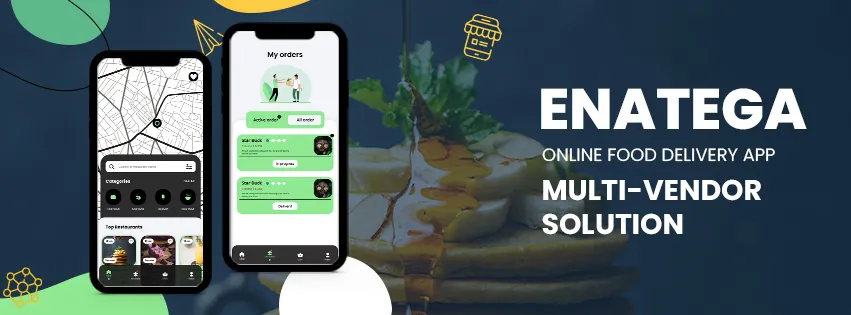
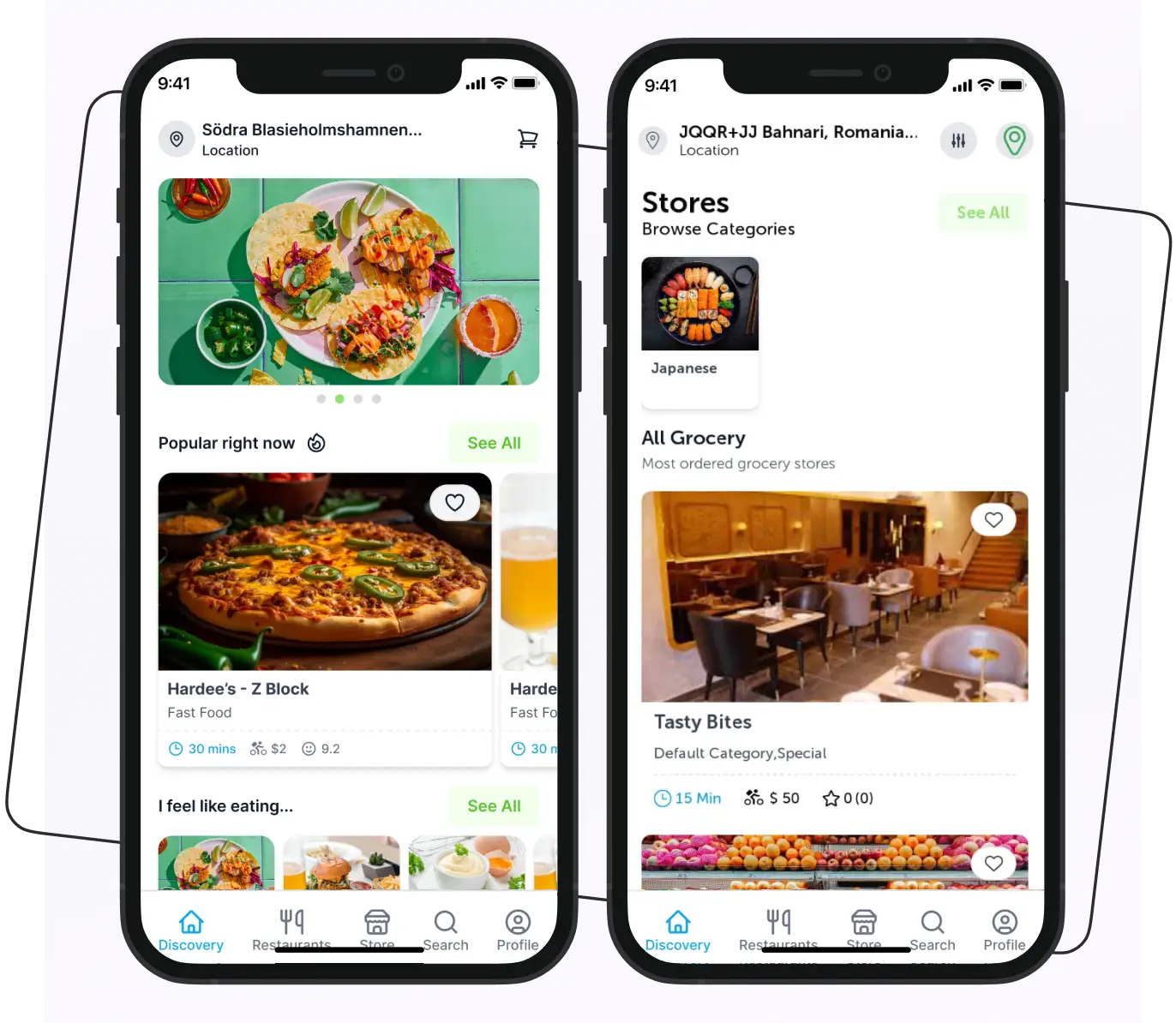
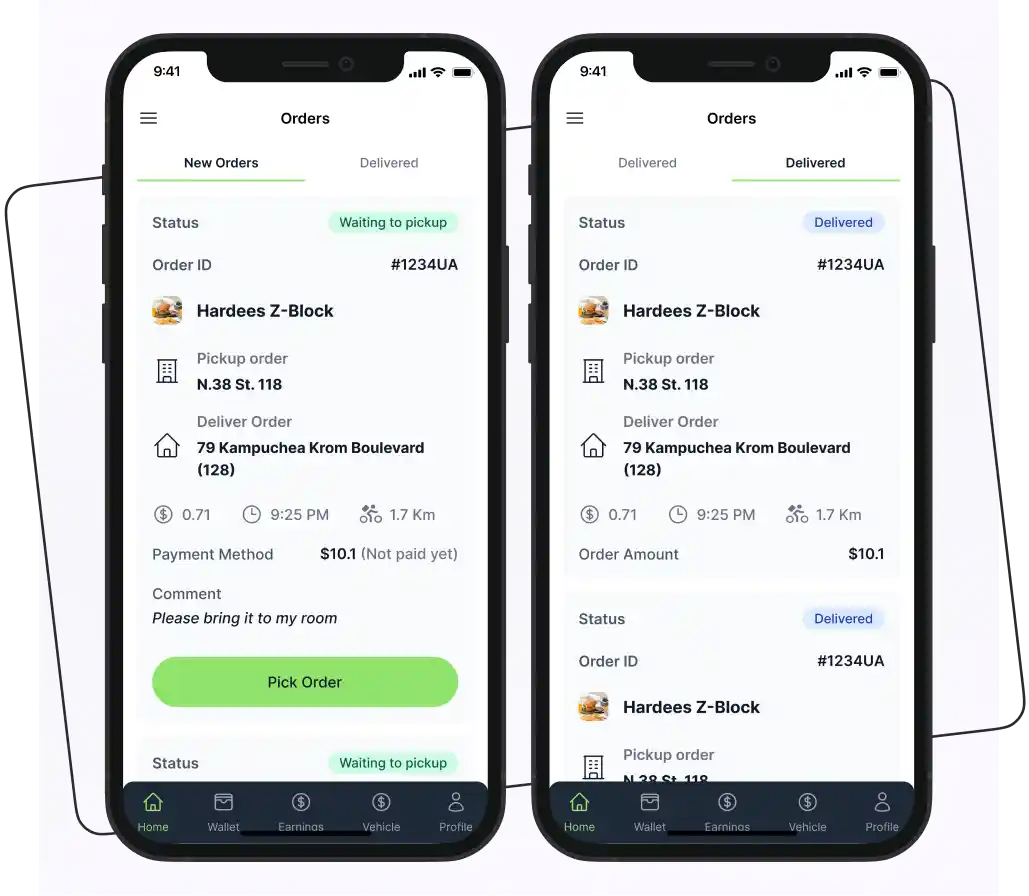
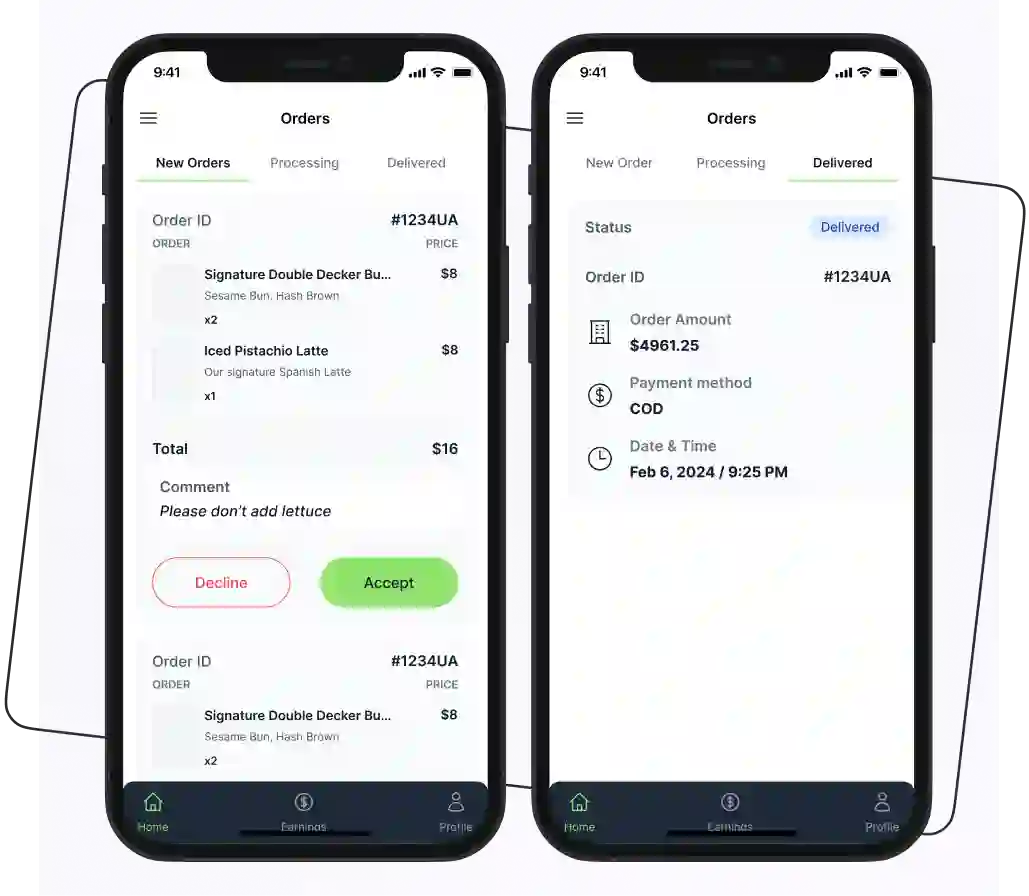
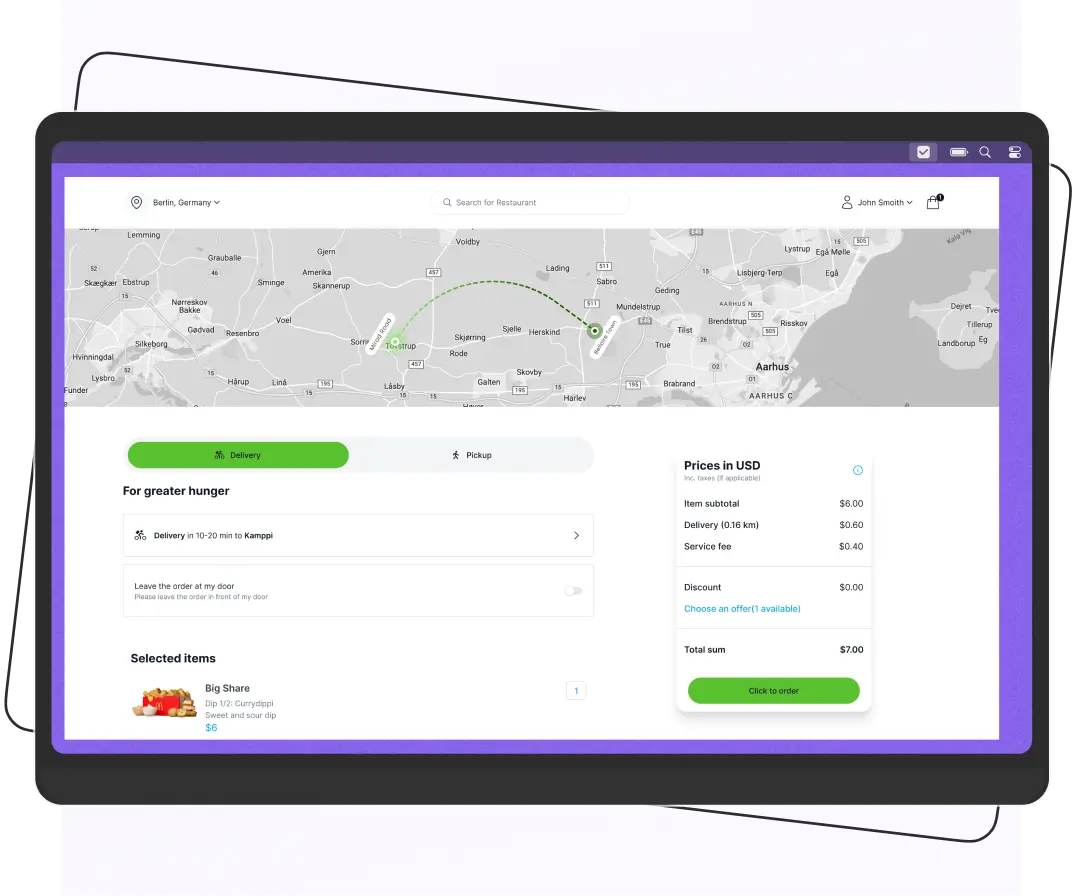
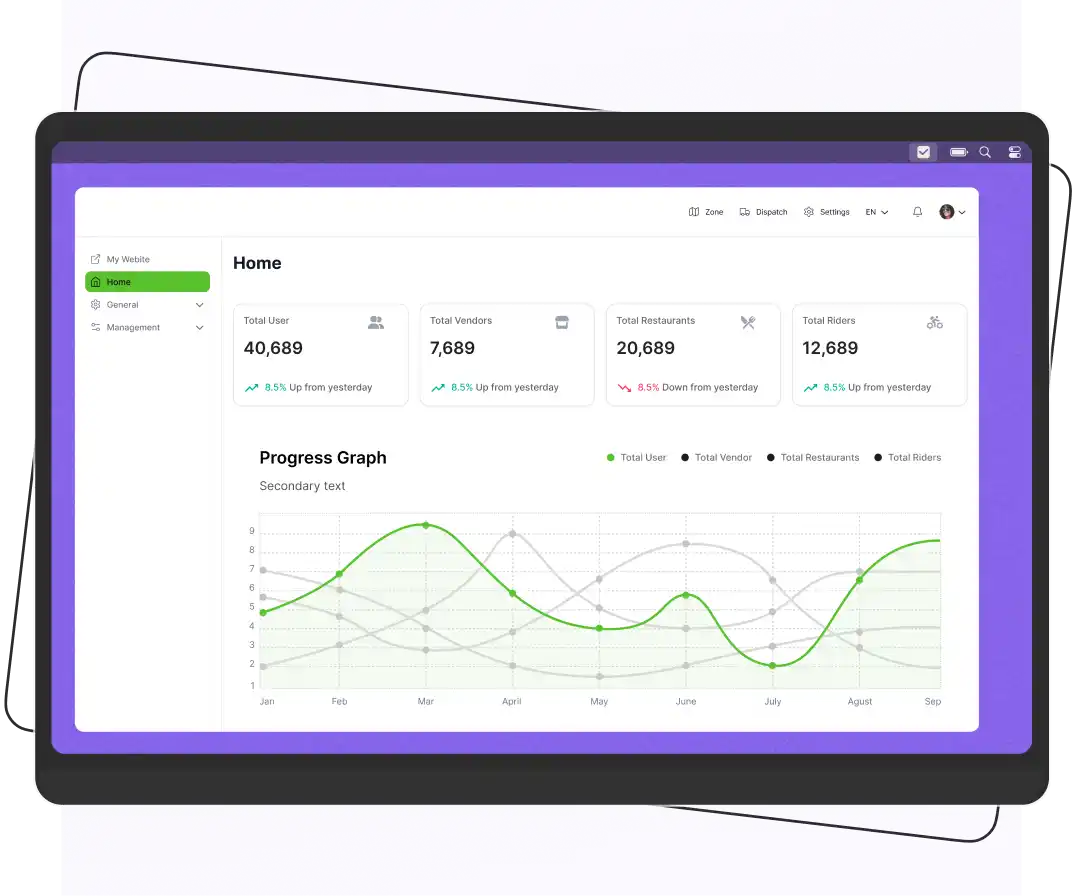
Enatega is one of the best online ordering platforms for food delivery businesses. This food delivery app helps you to start your business from scratch. From real-time order tracking to order management, all are covered under the Enatega app.
The main features Enatega provides are:
- Multi-language dashboard
- Restaurant management
- Riders management
- Role-based access
- Order tracking and more
Enatega Pricing
Enatega offers a flexible pricing structure with a one-time payment, and no monthly subscriptions are required.
GloriaFood
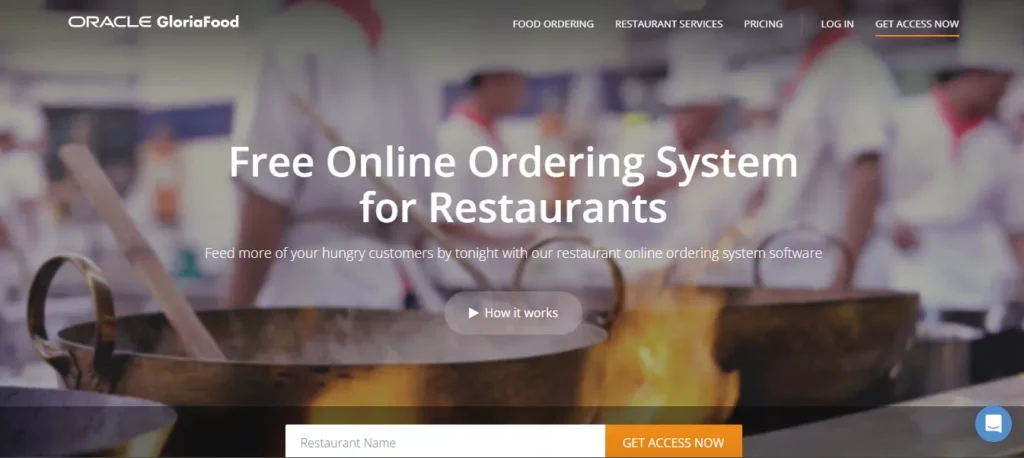
GloriaFood is an online ordering platform for restaurants that helps them receive orders from their Facebook page and website. Also, this online food delivery solution allows restaurants to streamline their orders. GloriaFood integrates delivery tracking with restaurant delivery software like Tookan.
Below are the main features of GloriaFood.
- Sales optimized website
- Restaurant POS system
- Website tracking tools
- Facebook ordering
- Delivery management software
GloriaFood Pricing
GloriaFood offers flexible pricing with both free and paid options tailored to restaurant needs. The basic online ordering system is free, allowing restaurants to manage orders without upfront costs.
Paid services include:
- Sales Optimized Website: $9/month
- Promotional Marketing Tools: $19/month
- Online Payment Processing: $29/month
- Branded Mobile Apps: $59/month
Moreover, GloriaFood also provides free trials for its features, making it easier for businesses to test the platform before committing to paid services.
TastyIgniter

TastyIgniter is a well-known open-source tool that helps cafes, restaurants, cloud kitchens, and other food businesses manage online orders. This tool can be easily integrated into an existing website or used to create a new one with vendor extensions.
The main features of TastyIgniter are:
- Offer promo codes
- Customized delivery zones
- Marketing campaigns via newsletter
TastyIgniter Pricing
TastyIgniter is open-source, there are no hidden costs, subscription fees, or commissions. Users can download and use the software for free, although additional costs might be incurred for hosting, custom development, or integrations.
Comeneat
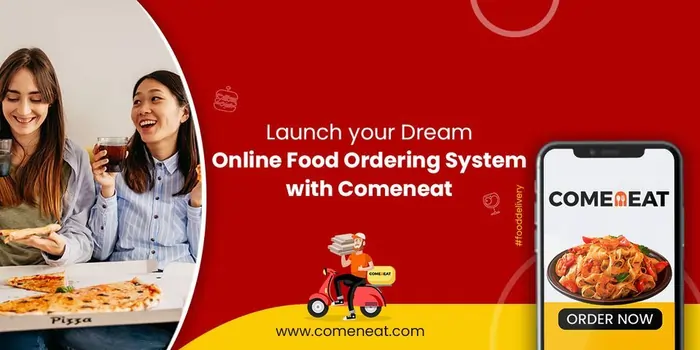
Comeneat is an online readymade food order and takeaway system. Its main aim is to connect customers to restaurants. It simplifies the taking of food orders online and the delivery process. The Comeneat food ordering software is accessible on Android, iOS, and web platforms.
The features provided by Comeneat are:
- Search restaurant Postcode/Google address
- Easy sign-in process
- Driver management
- Track location
- Order tracking
Comeneat Pricing
Comeneat operates on a subscription model, and its pricing structure is flexible.
Ontabee

Ontabee is a free online ordering and delivery system for restaurants. It manages in-house delivery items and online ordering. The Ontabee also offers customers the digital wallet option to recharge and pay for orders.
In addition, the customers give cooking instructions, and the tool reports hourly sales, total orders, and total sales. Payment processing, location tracking, pickup/delivery options, etc, are the main features of Ontabee.
Ontabee Pricing
Here is an Ontabee pricing structure.
| Monthly | |
| Free (Web only with single outlet) | Premium (Web + Customer App + Delivery App) |
| US $0 Features Single outlet Unlimited orders Integrate live chat Basic reports Loyalty point conversion Website ordering Ratings Custom domain | US $399 Features Multiple outlet All features of the free plan Credit Card service Delivery app for Android Order receiving app for Android Google Map API Customer support Customer app in your brand name (Android and iPhone) |
| Annually | |
| Free | Premium |
| US $0 | US $590 / year |
Flipdish

With the help of Flipdish, cafes and restaurants can set up mobile apps and websites for online ordering. It also provides built-in marketing features to support loyalty programs and notifications. Also, Flipdish offers SEO optimization that helps your website rank higher in Google SERP.
The main highlights of Flipdish are:
- Quick overview of online sales performance
- Integration with field service management tools and service dispatch
- Order location
Flipdish Pricing
Flipdish offers different pricing plans, such as:
| Point of Sale | ||
| Essentials | Pro | Advanced |
| From 59 £/month | From 89 £/month | From 179 £/month |
| Online Ordering | ||
| Website | Website and Mobile App | Seld-Service Kiosk |
| From 49 £/month | From 79 £/month | From 59 £/month |
Cost of Building the Open Source Food Delivery App
The cost of developing the open source food ordering system is determined by various factors, which include:
- Complexity
- Number of platforms
- Technology
- App features and more
An app with basic features could cost between $12,000 and $25,000. However, with advanced and multiple features, it can be $52000 or beyond.
FAQs
1. How do you create a food delivery system?
Below are some steps to help you create a food delivery system.
- Define your objective
- Define the features
- Know the latest market trends
- Look for a software app development company
- Start developing
2. How to build an app like Uber Eats?
Creating an app like Uber Eats is easy if you follow the proper steps, which include:
- Research the market
- Choose the business model
- Select the key features
- Choose the right technology stack
- Hire the development team if you don’t have coding expertise
- Build the app
3. What food delivery service is best for small businesses?
Numerous food delivery services are best for small businesses, but the most commonly used and provide better services are:
- Enatega
- Instacart
- DoorDash
- UberEats
- Grubhub
4. Which platform is best for food delivery?
Below is a list of platforms that are best for food delivery.
- Grubhub
- UberEats
- Zomato
- Postmates
- Foodpanda
5. Are any food delivery apps profitable?
Yes, several food delivery apps are profitable, such as:
- UberEats
- Zomato
- DoorDash
- Grubhub
6. How long does it take to create a delivery app?
The table below shows the estimated time to create a delivery app.
| Simple app | 2-4 months |
| Medium app | 4-6 months |
| Complex app | 10+ months |
7. How much does it cost to start an online food business?
Starting an online food business can cost anywhere from $1,000 to $10,000, depending on factors like licensing, website development, and initial inventory.
8. What is the best food business to start?
The best food business to start often includes catering, meal prep services, food trucks, or online specialty food shops. They have lower overhead and a growing demand.
9. Do I need a license to use open source software?
Yes, you need to comply with the license terms of the open source software. Most open source licenses allow free use, modification, and distribution, but they may have specific requirements, such as attribution or sharing modifications.
Supercharge your deliveries with Enatega.
Launch NowConclusion
An open source delivery management software is a cost-effective solution for small to large eateries. The online food delivery platform provides great benefits and positively changes your food delivery business.
So, if you want to make an open source food delivery app, contact the best food delivery app development company. With the help of experts, your business will reach new heights and dominate the online food delivery market.
About the author

Hudaibia Khalid is a senior content writer with several years of experience in creating clear and easy-to-understand content. Over the years, she has worked closely with startups, restaurants, and entrepreneurs, helping them simplify complex digital and technical topics into actionable insights.
Her expertise lies in writing about on-demand platforms, food delivery solutions, and business growth strategies in a way that is accessible even to non-technical readers. With her experience in the industry, she focuses on guiding businesses step by step, from understanding ideas to turning them into fully working solutions.
SHARE






 IOS
IOS Android
 Web
Web